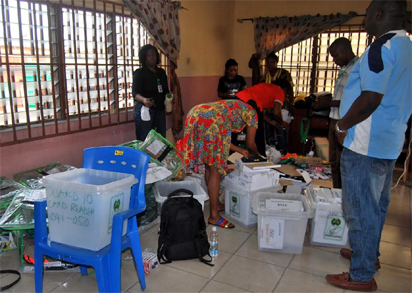
Electoral officers returning materials issued to them by INEC at South-South Zonal Store after the Rivers Legislative Rerun Election in Port Harcourt on Saturday
By Tonnie Iredia
As part of the determination of government to ensure hitch-free elections in the country, President Muhammadu Buhari last Wednesday swore in six new Commissioners of the Independent National Electoral Commission (INEC) to strengthen the work of the commission. On the occasion, the President charged the commissioners to be firm and fair in the discharge of their duties adding that his government would rely on them to help consolidate the integrity of the electoral body.
The appointment of the new commissioners is commendable bearing in mind that in line with Section 154 of our constitution, they are all renowned as people of great integrity. But then can the development guarantee free and fair elections for the nation? It is difficult to answer in the affirmative because all our failed elections were supervised by people of proven integrity who had been successful with every other previous assignment. They are made to fail only when charged with the conduct of elections. For example, Humphrey Nwosu an academic with a first class degree in political science organised what is universally acclaimed as the best election in Nigeria’s history- the June 12, 1993 Presidential election; yet, he was not allowed to declare the winner.
Any government that is desirous of free and fair elections can therefore not rely solely on competent election managers because the problem of our elections is systemic. As a matter of fact, our unending emphasis on election personnel may inadvertently be our undoing. In developed democracies, it is hard to find an all-powerful electoral body like our INEC. Indeed, in Britain and the United States which we often imitate, the name of the chairman of an electoral body, is hardly known by people contrary to the super power status accorded our INEC chairman.
Again, the crucial election duty of voter’s registration is done by the local council as a continuous exercise in which persons who become eligible to vote or have died are added or deleted as the case may be. It is not an annual event in which the entire nation is shut down for voter’s registration. Despite provisions made for it in the nation’s successive Electoral Acts, we are yet to have continuous registration. More importantly, candidates, political parties and the electorate in other climes know and are always ready to adhere to the rules of the game of politics and elections
Nigerian politicians on the other believe that an election is a battle that should be won at all cost. So in an election, our politicians materially induce election personnel to subvert the plan of action by a commissioner concerning an electoral event. In Anambra State in 2011, the Direct Data Capture (DDC) machines for voter’s registration were diverted to four illegal registration centres at a shrine in the deep Nziko forest at Nteje in Oyi Local Government Area of Anambra State. Painfully, DDC machines were in short supply in Awka, the state capital and many other urban centres of the state. Can our new commissioners in all honesty stop such? If not, our elections will not improve simply because new commissioners have been appointed. The latter will no doubt ensure good policies but since our electoral problems are not in the area of policy making, commissioners cannot solve the problem on ground.

Electoral officers returning materials issued to them by INEC at South-South Zonal Store after the Rivers Legislative Rerun Election in Port Harcourt on Saturday
One other arrangement which is exceedingly cosmetic is the trend whereby University Vice Chancellors are appointed to serve as returning officers. Being highly rated Chief Executives, their presence deceitfully suggests that the process is credible. Meanwhile, returning officers not being at the voting centres, cannot alter or reject figures from the field; they only parrot such figures. What then is the essence of appointing Vice Chancellors? What is more, as opined here a few years ago, many Vice Chancellors have not been able to stop examination practice in their campuses, what magic are they coming with to stop election malpractices?
An election is a multi-dimensional process which involves several segments. While some of the segments are handled directly by an Electoral Agency, other segments are under the control of some other bodies. In other words, the fate of an election is dependent upon the relationship between those charged with its conduct as well as what each actor perceives of his role. Thus, while an Electoral Agency works out the processes and procedures of an election as well as its logistics, but it cannot effectively enforce electoral law. The police and other law enforcement agencies are set-up to do that. The trend for sometime has been for the Police to deploy an average of 25,000 operatives per state to election venues. In the presence of such law enforcers, hoodlums still hijack ballot boxes. What can our newly appointed men of great integrity do about the trend?
In Nigeria, the law provides that disputes arising from an election are to be resolved through petitions not to the Electoral Commission but to the relevant Election Tribunal. Put differently, the settlement of election disputes is outside the scope of the functions of an Electoral Agency. This has created room for politicians to use the judiciary to win election through justice for sale.
This is obviously beyond the capacity of our newly elected electoral commissioners. Luckily it is an area where government has taken proactive steps to sanitize the situation. Our new commissioners should be assisted not to act in vain by putting the Judiciary back to its correct position. Otherwise, we shall continue to have inexplicable decisions such as the one in the recent Ondo election where INEC at the instance of the Judiciary replaced the name of a candidate with that of one whose party primary election was not monitored by the electoral body.
Government must similarly put a halt to the trend whereby electoral offenders are not punished. If that does not happen, thugs would continue to hijack ballot papers and massively thumb-print them to be announced as results for constituencies which did not vote at all. In all of these, the real solution is more likely to be found in the adoption of global realities on election management particularly the use of new electoral technologies that can produce credible data. Without that, electoral commissioners would be ineffectual.
Disclaimer
Comments expressed here do not reflect the opinions of Vanguard newspapers or any employee thereof.