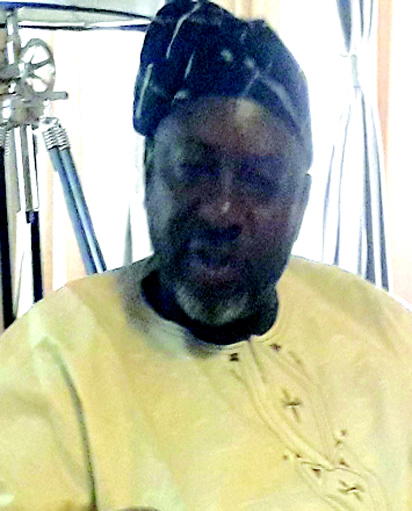
Dr. Paul Angya is the Acting Director General, Standards Organisation of Nigeria, SON
By Emeka Anaeto, Economy Editor & Franklin Alli
Dr. Paul Angya is the Acting Director General, Standards Organisation of Nigeria, SON. He was heavily involved in the development of the National Quality Infrastructure (NQI) policy as Chairman of the Technical Committee. The NQI policy which encompasses standardisation, metrology, accreditation, testing and certification was introduced by the Federal Government to ensure that products coming out of Nigerian industries conform to international requirements.
In this interview with VANGUARD, Dr. Angya talks about recent developments at SON since he took over few months ago, how they are building the capacities of local industries to produce good quality products for exports and how its metrology institute will transform the country. Excerpts:
What are the new things that you have been doing at SON since you came on board as Acting Director General?

Dr. Paul Angya is the Acting Director General, Standards Organisation of Nigeria, SON
We have a lot of new things happening at SON. What we have been doing is to try to communicate the benefits of standardisation which translates to quality for Nigerians. We have devised innovative ways of communicating to people to buy the culture of standardisation.
The major mandates of SON has not changed- elaboration of standards and quality assurance, the regular inspections of factories and production lines of products; audit of companies and advising industries to improve on their products.
Basically, we have been doing this for a long time but standardisation is a voluntary concept; it is not a compulsory thing and it is not conscription so to say. All over the world, people voluntarily embrace standardisation. So when a standard body like SON issues standards and publishes them; the society ordinarily should embrace them and that translate to quality.
However, the problem which we have in Nigeria to a large extent is that people don’t immediately embrace issues of regulation and that is why there are unlawful behaviours in the society. And so, it now becomes the duty of the standards body to enforce standards rather than compliment society by way of standardisations. And so, what we have done in my time is to try and communicate to the people to imbibe the benefits of voluntary standardisations and where the information and education does not seem to work, we apply the big stick but mainly, majorly, our focus is on enlightenment and education .
Since I came into office over three months ago, I have engaged critical sectors in production and commercial industries in Nigeria. I identified critical sectors from which there are most complaints of circulation of substandard products and the impacts of substandard products on lives, investments and the economy. Unfortunately, contrary to your view, this sector is not confined to local productions; most of the substandard products are from the imported products.
We have since March instituted Standards Clubs in secondary schools. My predecessors preached it and I have been preaching it. We recorded a large number of successes but sometimes, when you talk about standardisation, people think it is alien concept and they don’t apply it in their ways of life and way of doing things. It sounds abstract. Perhaps; it is because standardisation didn’t come to us early.
So, perhaps, if we introduce it to people at the youngest stage, it will become part of their lives and so when they grow up, they will see it as a given and demand from their parents that they are entitled to quality and if you don’t give it they won’t accept. Nigerians are not committed enough to their own personal welfare by insisting or using only products that have quality assurance.
It may be a lack of commitment and sometimes, it may be due to issue of economics. No Nigerian will spend 10-30 minutes at the SON Office to make a complaint and to police. He goes to buy a product for N500 in the market, probably at Ikeja, and he drives back to Egbeda in Lagos and finds that the product doesn’t work to his expectation, he would check the cost of going back to Ikeja which might be N750 and he has N1000. So he throws it away and picks another equally substandard product and it continues like that; he loses his money and dignity and sometimes it affect his health.
He also encourages those dealing in the sales of substandard products because he continues to buy them. But if he had gone back to the shop even at the cost of N1000 and said ‘I’m not going to accept this, give me a good product or give me back my money or else I am going to report you to SON. If two , three, four Nigerians make similar complaint, he won’t continue in that business.
In the advance societies which we are copying, government is not an enforcer of consumer interests. What government does is to make a policy, consumer policy, standards and quality control policy and then there are consumer advocates whose duty is to take up consumer advocacies. In that society, they respect people and people there insist you give them value for their money.
So education is the key and that is why we have set up Standards Club in schools and we are hoping that we are working with other institutions like education authorities in primary and secondary schools, National Universities Commission, NUC, and National Board for Technical Education to introduce standardisation curriculum in schools.
Also, we are encouraging people to write books on Standardisations. I personally have written a book on Standardisations. So, we expect that by the time we encourage intellectuals to write books and to teach the subjects, it will be a part of our culture for people to demand and insist for quality products.
How are you carrying those who are educated and knowledgeable along in the enforcement of standards?
Unfortunately for us, like I told you, we have not arrived at a point where people adopted those issues as their own, as personal to them, even for those who are knowledgeable and involved because they reason that somebody else is responsible for it. Like they say in my community, the community goat usually starves because nobody owns it, and nobody is feeding it.
People need to buy into the concept, own it and adopt it. Another new thing that we have introduced is to open up the process of standardisation to people so that they could get involved.
Hence, all the people who are using the products or services will make input into that standard. The standard will have the benefits of wider participation and when we have finally collated it into a draft, we also publish it and invite comments from informed sectors. And when that is done, we know the standard has input from all stakeholders and it is what they want.
So, they will willingly apply that standard; it becomes a public ownership; the standard will have wider acceptability and application; and the impact will be felt on the community.
What is SON doing to make Nigerian products exportable and earning foreign exchange?
In Nigeria, long before President Muhammadu Buhari came on board and instituted his programme of finding alternatives to oil, SON, had started the programme of encouraging local production and we introduced MANCAP certification. MANCAP means Mandatory Conformity Assessment Programme.
The certification is aimed at ensuring that all locally manufactured products conform to relevant Nigeria Industrial Standards, NIS, before they are presented to the consumers. Every manufacturer in Nigeria is expected to get the certification before you push your products into the market and there are sanctions for defaulters.
There are basic standards for products all over the world. But then some products have additional requirements. That is why you hear about American spec, European spec; Japanese spec and so on, they are additional safety requirements in those countries.
Meeting global standards
We insist that products manufactured in Nigeria must meet acceptable global standards. It is part of what we have been doing and we are still doing it-building the capacity of operators in our local industries. We have identified small and medium enterprises (SMEs) as the engine room of economic development. So, we have structured projects of offering technical assistance and certification to SMEs.
Most times, we offer these services free for them to know how to meet the standard, know how to process, package and label their products. Since President Buhari came on stream, the Nigerian Industrial Revolution Plan, NIRP, was adopted for implementation. Under the NIRP, which is to grow alternative sectors to oil, SON is given specific assignments.
Number one is to build a national quality infrastructure for Nigeria and all these I have been telling you about standardisation and quality issue is built into it. It prescribes the basic minimum precepts that if imbibed by people, by the government, industries and everyone in Nigeria, it will culminate into delivering quality to Nigerians and quality to Nigerian products and they can compete anywhere in the world.
In fact, the main focus of the national quality policy is to examine the environment and see what are those necessary facilities that a nation should have.
First of all, we surveyed why is China producing and able to produce so massively. We made a survey on how modern nations are delivering on quality and we found that in the current practices, the critical ingredients that enable a country develop economically is what we call quality infrastructure. And every nation requires quality infrastructure to develop its economy, develop its industry and to protect its people.
Developing quality infrastructure
When a country develops the quality infrastructure, it becomes a national treasure. So those are the components that are aggregated together to deliver quality to a nation. Fortunately, in Nigeria, that project was anchored on SON, and, I personally was the chairman of the Technical Committee that developed the National Quality Infrastructure. Standards itself is a quality infrastructure because it is the basis on which production, industry and quality are grounded.
And then we look at the issue of Metrology, which is the science of accurate measurement. We have legal metrology that goes into the public and interfaces with services delivered to make sure that the delivery to the public is the exact nature of the prescription. For instance, if you go to filling station to buy fuel, it is priced at N145/litre now, and the guy at the station fix the pump into your car and he keeps pumping and said he has delivered 50 litres but when you switch on you ignition key, you discovered it was 25 litres and you have been cheated.
So, it is metrology that will ensure the pump deliver the exact 50 litres, it is not pumping air into your car. To be able to deliver the exact quantity with the price, those machines need to be calibrated and the authorised institution that does the calibration is the Institute of Metrology.
This is a very relevant quality infrastructure. Any nation that doesn’t have it can’t progress. In fact, the success story of Germany as the most technologically developed economy is driven by its national metrology institute. It is called German National Metrology Institute (PTB). They are so rich and they are the one funding developments around the world, even in Nigeria. We just finished a programme which they sponsored for us, building our capacity of improving our agro-allied exports.
And then we have another one called laboratory institute. Without laboratories, your products can’t sell outside your country because what your trading partners are looking for is evidence that your products can sell outside your country and where do you get the evidence, if not from laboratories. So, we produce agricultural products in Nigeria and we take them to sell abroad and they are rejected not because they don’t meet the required standards but because they lack certificate of evidence and why don’t they have certificate of evidence is because there is no accredited laboratories in Nigeria that can test those products and certify that they meet that standards.
There are laboratories in Nigeria but they are not accredited laboratories because there are no accreditation institutions in Nigeria. This is a relevant quality infrastructure that will evaluate laboratories from the premises where they are to the equipment in the laboratories to the personnel who are running the laboratories and issue certificates that the environment is conducive for this kind of test, that the equipment is sophisticated and sufficiently provided to run this kind of tests; that the personnel are sufficiently skilled to run this kind of test.
When all these are put together and they get pass mark, then the accredited service will give you an accreditation that you have competence to run this test. When they give you the certificate, then, the lab can now run the test; for instance, Nigerian beans that were rejected in Europe didn’t get certificate from an accredited lab showing the beans met the requirement of the EU market.
The market may require that the moisture content of the beans shouldn’t be more than 12 percent and the residue of the pesticide that was used in storing the bean should be of such a level that it should not harm humans when it is bought and consumed. And so, EU market will insist that the certificate accompanying this product must specify the moisture content, the chemical residue and even the soil content of the farm where the bean was planted and harvested.
So all these are what is called quality infrastructure and all these have been prescribed in the National Quality Infrastructure policy – standardisation, metrology, accreditation, testing and certification and that is what we called conformity assessment, the capacity to be able to determine that products coming out of this industry meets standards specification. So, a nation must have capacity to do conformity assessments to assure international community that the products coming from this country conform to international requirements.
We did that for Nigeria, but unfortunately it has not been promulgated into law by the Federal Government. We are still trying to get the present government to accept the document and to pass it into law so that it will begin to operate in Nigeria.
Already, the components of the quality infrastructure are being addressed at SON as part of our responsibility under the NIRP, we are building a gargantuan headquarters of National Metrology Institute in Enugu State. It’s 100 percent funded by SON and it’s over N1 billion. When the institute is completed and functioning, the issue of testing and calibrations will be solved and it will save costs in hard currency.
Disclaimer
Comments expressed here do not reflect the opinions of Vanguard newspapers or any employee thereof.