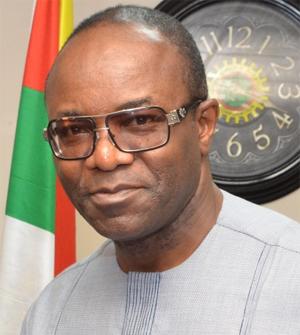
Dr. Emmanuel Ibe Kachikwu
Recently, the Group Managing Director, Nigerian National Petroleum Corporation, NNPC, Dr. Emmanuel Ibe Kachikwu, intimated journalists with his plans to make the Corporation more profit-oriented.

Kachikwu
In view of scepticisms over the NNPC’s financial health, these plans may well become the litmus test of whether it is truly commercially viable. But the question is, what becomes of these plans when Kachikwu becomes a minister.
There are all kinds of very hard decisions, and sometimes you find those decisions are hard, but my job is not an emotional job. It is a practical reality job to get things working.
Pipelines & products movement
The pipelines have got to work. There is absolutely no model under which you are going to be able to do petroleum business in this country without the pipelines working. It is inconceivable! Militancy, insurgency, difficulties, whatever the reasons, are no explanations why our pipelines will not work. So, I am working with the security forces and the communities to ensure that they provide enabling environment to have access to those pipelines and to repair them as need be.
In the medium or longer term framework, we need to build other pipelines, obviously better buried, with more toxicity in terms of the metals, to be able to carry and resist attempts to interfere with them. We have got to do scanning. We have got to do patrols. We have to be able to find real time online what is happening in the pipelines through the entire breath of the country. If we are able to that, then we can at least have products distributed to the pipelines. That is a model we must work on fairly quickly.
Coastal movement of products, whether it is crude or refined products is not the solution. It is not profitable. It is not sustainable. It is as simple as that. Every area you look at in our operations, you find difficulties. Bear in mind however, that if this was a private company run without any social responsibility and emotion, some of these things are very easy. You don’t get pipelines or you get out of the business.
We don’t have that option because we have a service to render to the people of Nigeria. We must try and give those services because we are compelled by law to give them. With good efficiency, with good planning we will achieve those results.
Some of those things we are doing in PPMC (Pipelines and Products Marketing Company) for example are to unbundle the PPMC to have a pipeline company, with a Managing Director that focuses strictly on pipelines.
Whether it is pipeline security, whether it is pipeline expansion, whether it is pipeline earnings, it is a 24 – hour job, to ensure that the pipelines are working. Once we do that we’re good to go. We pumped for the first time after I have joined, to Enugu and the effects on the East and those areas were massive, because for the first time we could actually get products.
Kerosene availability and fuel subsidy
We are getting disciplined in terms of what we could with kerosene for example, because are we going to do it in such a way that if you have it you will be compelled to sell it at the right price.
The share issue of subsidy will continue to be a major challenge for us. There have been all kinds of issues of whether we should remove subsidy or not. I don’t want to get into those debates. They are very political. That is not my focus. My focus is to deliver products at the price that makes sense for this Corporation so that we can survive as an entity.
That may not necessarily mean a full pull out from subsidy. I need to find a contractual and performance model that enables me to deliver products at some set prices for NNPC stations, probably at subsidised prices. But the fact that NNPC will now become the importer of products for the entire mass of oil companies who are doing their own private businesses and take the heat for that. That is not what the Corporation was set out to do.
Again, one needs to sit back and say, what exactly is my goal? What exactly are my responsibilities? If we look at that and focus on our own outlet delivery, you find out that we could actually reduce the subsidy elements dramatically and let those in private business do their own model. It is too early in the day. All these things require a buy in by the President. It requires that I go to have a conversation with him.
The President is very emotional about the poor people. He is very emotional about the system. He is very emotional about the support. It is something he is very focused on. My job is to get him to a point where he sees that he is able to deliver on his promises, and hopefully, I am able to deliver on my undertakings as the Managing Director of NNPC.
Price, costs & capital
For the upstream, the key challenges are first, value chain. Am I doing these mega projects at the price they should be done? Am I reviewing them enough? Some of the things that I am doing are putting institution support for places like NAPIMS, NPDC and the rest, to ensure that every contract is looked at thoroughly at international level. If my JV partners throw projects at me, I will be satisfied that a thorough analysis has been done and what they are saying is or isn’t. In this environment, the emphasis is both on growing volumes but not growing excessive volumes. The whole world is wet with oil. It means that the little I produce must be produced efficiently. It means that I need to drive down cost. Average cost of producing a barrel today, for the big projects is about $27.
We need to get things back to what Nigeria used to be, which was one of the lowest price producers. This means that we need to be moving towards the $20 margin. It requires a lot of analysis. It requires careful choice of projects that fall in within those sets of band and have an immediate impact. For the next two years, I am going to focus on what I call the low hanging fruits. Where are those integrity projects that cost very little to bring on, abandoned fields that have been worked before, which cost very little to bring on board, and yield very immediate returns. There are quite a lot of them. Of course, we have long term projects that we will review later. Therefore cost is key. Relationship is key. We cannot afford to carry on as if we are people who do oil business as a favour.
I was in the forefront of those seeking alternative capital for Africa for 15 years. To attract every arm of dollar to Africa requires a lot of marketing. We must like every other country in the world, put on our real marketing arm, our charm. We have a lot of it in Africa. What has happened is that you have seen entities like NAPIMS and the rest behave as though they do you a favour once you step into the oil block. No! That capital has an option to be here. It can go to Angola, where it is increasingly going or to Asia or Latin America. Capital is the same everywhere. It does not have a name or preference or brotherhood. It goes to where it is received well at the best opportunity cost. That’s what it does. The same capital that we are all chasing, Americans are chasing it, Latin Americans are chasing it. The Chinese are chasing it. Asians are chasing it, and Africans are chasing it. We cannot be docile about it.
Venture operations
I am going to visit oil majors myself. The history has been that they come to NNPC. I will go to their offices and hold meetings, because I am a 60% holder on their operations. Their offices are my office. We are going to sit down and look at their models, look at their problems and try and find solutions. They will also understand my own problems. If we work collectively without this mother superior attitude, we will get to where we should be going. That’s the focus for me in the upstream.
Disclaimer
Comments expressed here do not reflect the opinions of Vanguard newspapers or any employee thereof.