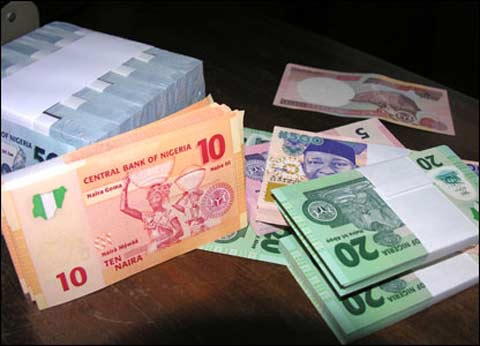
Naira
By Babajide komolafe
Analysts at Financial Derivatives Company have predicted a one percent increase in inflation rate to 9.1 percent for the month of June. The prediction is contained in the FDC Economic Bulletin issued on Wednesday. The company also stated that another devaluation of the naira is inevitable despite addition restrictions to the foreign exchange market recently announced by the Central Bank of Nigeria (NBS).
 The inflation rate predicted for June is coming about two weeks to the July 16th date scheduled by the Nigeria Bureau of Statistics for the official inflation rate for June. The company stated, “Based on our forecast, headline inflation in Nigeria for June is expected to increase marginally to 9.1% (±0.2%) from the level of 9.0% in May 2015. “If accurate, this will be the seventh consecutive monthly increase in inflation since November 2014, and the highest level in 2 years.
Nigeria’s inflation continues to yield to the impact of protracted fuel scarcity that extended into mid-June. “Other factors that have contributed to increased inflation include reduced supply of food, owing to logistics issues and heavy rainfall, which has affected planting in some regions of the country, and higher price of imported goods due to the exchange rate factor.
“At its next Monetary Policy Committee (MPC) meeting on July 20 to 21, the Central Bank of Nigeria would have to proffer solutions to address inflation, depleting external reserves and determine an efficient exchange rate price mechanism. This is a significant development given the apex institution’s decision to restrict access to the interbank currency market on 41 select items, including staples, rice, cement, tomato products and poultry. This pushes the pressure towards the parallel market.
The additional N33 that importers would have to pay to purchase dollars will translate into increased prices of imported goods. This increase in inflation rate puts the CBN under pressure to review interest rate (MPR) upward at a time when a downward review was being mooted. Commenting on the need and impact of further devaluation of the naira, the Company stated, “Despite the CBN’s attempts to prevent a further devaluation of the naira, it is inevitable that the CBN would succumb to pressure.
The effect of an exchange rate adjustment will include: Higher inflation stemming from more expensive imported items. Producers may have to pass on the cost of imported raw materials to consumers, thereby causing cost-push inflation; “Domestic investors that want invest in foreign stocks would have to source for the dollar at a higher rate.
On the other hand, a weaker naira could spur increased stock market participation by foreign investors; “Majority of the stocks quoted on the floor of the stock exchange are owned by foreigners. Devaluation provides an avenue to own more shares of Nigerian companies; “The CBN restriction of importers’ access to foreign exchange at the interbank market would lead to inflation. However, in the long term, this decision could revive and bolster the agricultural and manufacturing sectors.”
Disclaimer
Comments expressed here do not reflect the opinions of Vanguard newspapers or any employee thereof.