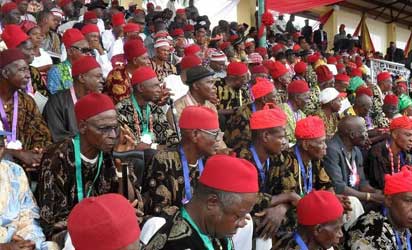
Igbo Chiefs
The concluding part of Patrick Dele Cole’s write up on the doggedness of the Igbo race in achieving their goals against all odds.
 Thereafter, another family has its plot of land and farm and so on. There are few Igbo urban centers. This small cluster will live near a stream for water and there are market days where goods and services are exchanged. There are four important market days and these market days are used as calendars for when one thing or the other is to be done. But, again, Onitsha is a large native Igbo town.
There is a village square for meetings, announcements, etc. But the nearer the Igbo are to people of other or even similar culture, the villagers become bigger (i.e. they are more urbanized than the Igbo). The Yoruba live more together in villages and go sometimes far distances to their farms.
The social structures of the Igbo are based on Age Grades, especially in the bigger conurbation or cities, such as Onitsha,Awka, etc. The Igbo have always been clever people, and took very quickly to missionary education and other aspects of Westernization.
The Onitsha Igbo
The Onitsha Igbo are made up of three ethnic groups- the Igala who followed the River Niger downstream from Lokoja to Onitsha, the Edo who came from Benin and the Igbo who lived in villages surrounding Onitsha. The amalgam of these three ethnic groups made up Onitsha which itself had off shoots in Obosi and environs. Because of early European contact the Onitsha Igbo went to school early and embraced Christianity- protestant and Catholics. Onitsha is still a major education hub in the east of Nigeria with many prominent schools- the most famous Dennis Memorial Grammar School, Christ the King College, Holy Rosary Girls School, Christian seminaries and teachers training colleges.
This early introduction to education and commerce stood the Onitsha Igbo head above other Igbo, producing the first Igbo doctors, lawyers, professors, etc. The colonial service employed Onitsha Igbo – leading to their dominance in the professions, the judiciary, politics, etc. It is, therefore, no accident that Dr. Nnamdi Azikiwe, Justice Anyeagbunam, Chuba Ikpeazu, Ofodile, Prof. Chike Obi, Aje Asika, Sir Louis Mbanefo and a host of others were from Onitsha. So dominant were they that at one time, the upper echelons of the civil service, permanent secretaries, and leaders in the profession in eastern Nigeria, etc were all Onitsha people. There was a back lash when other Igbo people thought the dominance too pervasive and started asking for Onitsha Igbo to move out of positions. It took a long time to get some in Eastern Nigeria balances. The Onitsha Igbo discriminated against other Igbo as uncouth and unpolished people and would not associate with them preferring their daughters to marry any one else except their non- Onitsha Igbo. As a child I often heard Onitsha Igbo drive away other Igbo children who came to play with their own children (sa, nwa onye igbo pu a eba – get away you child of an Igbo man), the Yoruba of Lagos have the same feeling for the so-called Ara oke -Yoruba from the hill, the Saros of Freetown for people from the hinterland- (up – country people) the Parisians for all those outsiders not from Paris etc.
Apprentice system.
Today, they have perfected the apprenticeship system. A successful car dealer, motor spare parts dealer, or mechanic, or trader in electronics, drugs – medicines and other pharmaceutical goods, or transport owner, etc., would have young boys,sometimes as young as 10 years,who have been to school for a few years. The young boys are apprenticed to such car spare parts dealer, or a patent medicine shop owner, or a transporter. The apprentice is supposed in the 10 -12 years he works for his boss to know every spare part in an automobile (3000), the name and use of every drug sold in the patent medicine store, etc. After a long time, the owner of the store or transporter would give a substantial amount of money to the apprentice to start his own business in electronic, spare parts, medicines, etc else where. This is the classic way the Igbo do business; and it has benefited them well. They are able to easily beat competitors because of superior knowledge of the product, accessibility and a burning desire to succeed quickly.
Today, there is a virtual Igbo monopoly of spare parts trade (usually Nnewi people), local “pharmacies”, and transportation.
The young man who used to be an apprentice bus attendant would soon grow to own a fleet of buses which will need spare parts, etc. The intercity luxury bus business is 70% in Igbo hands. They are also transporters for goods and small vehicle transporters. The car hire business is perhaps 60% in the hands of Igbos.
The Igbos ventured into the sale of electronic appliances many years ago, paying exorbitant rents for cramped up spaces in Broad Street, Lagos, which then was busy and noisy as one loudspeaker sought to out do the other. The then Lagos State Governor moved them to Alaba Market which today is the largest electronic market in Africa. Other ancillary and supporting businesses soon followed – apart from radios, TVs, etc, the market now sells washing machines, refrigerators, freezers, microwaves, etc. It is the centre of pirated music and video films. Given the opportunity, the Igbo has incredible drive to make a success of any venture.
The biggest property developers in Lagos and Abuja are Igbo. They seem to have a sixth sense for these things. They were first to really believe that Abuja will succeed as the capital city of Nigeria. They moved into Abuja with a vengeance. Most of the malls in Abuja are Igbo owned. They were willing to pay the price needed for land and permits; and went at it as only the Igbo can do. Other ethnic groups have estates but nothing compared to what the Igbo have. Yet other Igbo branched out into estate development for sale and establishing myriads of hotels.
Marriage among Igbo
All these frantic activities must take a toll on social life. Many Igbo billionaires are self educated, having come up through the apprenticeship system. It means that the girls in Igbo land stayed back to go to school, even though, at the beginning, like most Nigerians, they regarded education of women as a waste of time and money since the young girl will soon marry and leave the family. Thus, today, there is a preponderance of Igbo girls at school, who currently far out number the boys in both secondary and tertiary institutions.
Bride price in parts of Igbo land used to be expensive. Non-Igbo suspected that the girl’s family was calculating how much they spent on her education and expected the husband for recompense. In the early 40s and 50s, bride price was so high that the Eastern House of Assembly legislated on it!! The girls today fear high bride price for it scares away suitors and now have started to revolt against it. How do these girls pay for tuition? Sometimes parents help, relatives help and there is a good dose of self help.
Marriage custom of Igbos is similar to that of many other ethnic groups. For example, that marriage is not just a union between individuals, but one between families, who, in fact are, sometimes,the initiators, and actually arrange the match-making between the spouses. Today this is not so common. But the other processes remain largely unchanged. When a suitable spouse has been found, people are sent to ask questions about the spouse’s pedigree – is there disease in the family, any witches or wizards or unkind and wicked people, how fecundious have the women been, etc (Aju-ese?)
On receiving satisfactory responses to these questions, a delegation from the family of the husband-to-be is then sent to the girl’s family to ask for her hand in marriage; and her family,at some stage, would have to ask her for her consent. The bride price is then haggled over. On reaching a consensus, the proposed groom is supposed to supply drinks, etc., for four market days (Eke market days).
You may shorten the period by bringing everything in one day. After consultation, including reports on the groom’s family, his standing in society and wealth, a date is fixed for the marriage. To show the bride’s consent publicly –she would take a glass of wine (often palm wine) to the groom to drink in public during the traditional marriage ceremony.
Thereafter, the parents bless the couple and festivities begin. If the marriage is unsuccessful, the dowry is returned; but not if the couples have a male child.
The Igbo take marriage seriously, probably more so than any other ethnic group in Nigeria. Many non-Igbo girls want to marry Igbo men because of this myth that an Igbo man knows how to look after his wife and family. Many of the semi illiterate billionaires marry graduates and they insist that their children get the best education which they had missed.
Trial marriage
Every December, thousands of Igbo travel home, especially in areas where Christmas is robustly celebrated. During these holidays, marriages are arranged, couples introduced, etc. One variant of Igbo courtship that is rapidly gaining ground is that of trial marriage. It is really an extension of the custom of knowing the family one is marrying into. Many Igbo bachelors from the U.S flock home every Christmas to see who they can marry while resuming the family bonds which living overseas may have somewhat loosened. Where a successful introduction has been made, the young lady and prospective husband agree to go back to the U.S and live together for some months to see whether they like each other enough to stay married (usually for three to six months), at the end of the period,a decision is made to continue with the ‘’marriage” or to terminate it.
Sometimes, the girl would go to the city where the ‘’husband” is working in Nigeria – usually Abuja or Lagos again on trial basis to make sure the marriage is successful.
In the old days, the girl would have gone to stay with the parents of the prospective husband for a while for the groom’s parents to assess her. These are simply variations of the theme of arranged marriages. Where the experiment does not work, there is no shame or bitterness, whatever was paid in dowry is returned and the ‘’marriage” is dissolved.
The Igbo economy
Nnewi, in Anambra State, is now the manufacturing capital of Nigeria. It has several manufacturing factories, several breweries, soft drinks, bottled water, etc, food processing plants, vehicles assembly plants, etc., including the making of generators, and a host of other items. Nnewi has overtaken Ikeja as the industrial hub of Nigeria.
The Onitsha market remains the largest market in Africa, selling practically everything: There are Indian, Chinese, Vietnamese traders in the market. The banks in Onitsha carry the largest amount of cash than any other city. There is an airport in Asaba, capital of Delta State. The Niger Bridge is the main transport artery between East and West, and perhaps even large parts of Middle Belt and some parts of northern Nigeria. Just south of Onitsha is Awka, the Anambra State capital. There are plans to dredge the River Niger, build a second Niger Bridge, and a cargo airport in Anambra State. Thus, within an area of a few kilometers to Onitsha, the major market, there is the industrial hub, Nnewi. Also, the administrative capital of Anambra State is 20 kilometres from Onitsha. Nnewi is 10 kilometers from Onitsha. Our planners have to be (compare the axis between
New York and New Jersey) blind not to see the potential of a conurbation axis between Asaba/Onitsha; Onitsha-Nnewi, and Nnewi–Awka. A small investment of building 10-lane highways between these three towns will give the biggest industrial and financial fillip for Nigeria; not just for Igbo land.
The Igbos, who live in these areas, have, amongst themselves, the richest individuals in Nigeria. Oraifite has over 10 billionaires; the best known of which is Sir Emeka Ofor.
Anambra State governor, the other day ,called a meeting of 50 people and 25 of them were billionaires. The rest were no slouches.
The Igbo, sometimes, are too polite for their own good. Each time a politician goes to Anambra State, he makes the promise to build a second Niger Bridge or to dredge the Niger. The Igbo feel that people say these things because they think they are fools. They ask whether the Federal Government built the ports of Lagos for Lagosians? Was the 23 kilometers Third Mainland Bridge built for Lagosians?
A bridge across the Niger is a development of infrastructure that would yield benefit for all Nigeria. Why does the Federal Government need a special loan or bond to build the bridge? That they do not openly say this in public is perhaps an element of the sublimation of their persecution complex.
Culture
The Igbos are proud of their culture. But are also willing to participate in other peoples cultures, and, more importantly, to adapt foreign culture to their own. For many years, the black people in the United States had been insulted by being regarded as having no culture. Many changed their names in the belief that this would identify them with Africa; they preferred to be called African-Americans, and took names like Kobe, Jamal, Hussein, etc, little realizing that these were Islamic names, not African names. No matter, the point had been made that Mr. X was African-American and his name was Jamal Juba. About 15 years ago, two cultural tends burst out on the African scene – a distinct music genre, distinct dancing genre and distinct theatre genre. The U.S. has always been open about its debt to Africa in term of music – jazz, pop culture, ghetto dancing and music, etc. The Yoruba and other Africans contributed to this, not only Igbo. But in the past few years, the young African musicians had taken on world pop culture and Africanized it, dominated it and now own it. There is no Igbo mega star like Fela- so massive was this genius.
However, young men and women are hitting the world stage with beats that cannot have grown from any where else than in Nigeria, and a lot of it, due to Igbo. Hand in hand with this musical explosion. African drama was re-born but, this time,using new techniques to attune old theme – the advent of Nollywood – which in 10 – 15 short years -is now the third largest movie industry in the world. Igbo influence, both in new music and in Nollywood, is substantial.
It was generic, and should remain so. But it may die if it imbibes government contagion.
Nearly everything shown in Nollywood about Igbo kingship, princesses and princes, etc., is an exercise in the producers’ imagination. The cultural basis is there; but the manifestation is poetic license of the producers, and rightly so. Nollywood is not a cultural course: it is entertainment within the imagined context of Igbo culture.
The Biafra war
It is impossible to write about the Igbos without writing about the Biafra war. It is futile to go into the pros and cons of the war. The war affected Igbos, as it did other Nigerians. The Igbos felt that they had something precious to contribute to Nigeria; but the civil war deprived them from contributing, and Nigeria from accepting Igbo contribution. They lost a war they felt was unjust. They lost property every where, especially in Port Harcourt.
But they learnt how better to handle other Nigerians. They channeled their sense of loss into more productive avenues. They now believe in Nigeria; but also believe anything can happen and hedge their bets and build large houses in their villages should any other war break out. They have a mixed feeling for – yet believe that it is now their turn to rule Nigeria.
Some Nigerians, including some Igbos, believe that the eventual break up of Nigeria is a matter of time, unless some fundamental changes are made soon in the political arrangement. The Igbo believe in meritocracy because they are supremely confident that they would prevail.
An apocryphal story goes something like this: If you do an examination with an Igbo man and he has better result and beats you, he will nod as if to say that is natural, that is as it should be. But if you beat him, he would ask you whether the examiner is your brother or who leaked questions to you.
The Igbo lost a lot of houses in Port Harcourt. Lately an old wise Rivers man seeing the Igbo contribution to Abuja and Lagos wondered whether the Rivers State Government should not invite Igbo back to Port Harcourt to do their magic on housing and the economy in Rivers State.
The practice of young men and women living together before marriage is unknown in all African cultures including Igbo. Hollywood’s portrayal of this practice is non-Igbo and due more to Western acculturation than any thing traditional as a girl may go to her husband’s house after the payment of dowry and the consent of her parents, herself.
Inheritance, even “kingship” and property legally does not go to the children but to the eldest brother of the deceased who, by custom, is now supposed to look after his brother’s wife and her siblings.
Disclaimer
Comments expressed here do not reflect the opinions of Vanguard newspapers or any employee thereof.