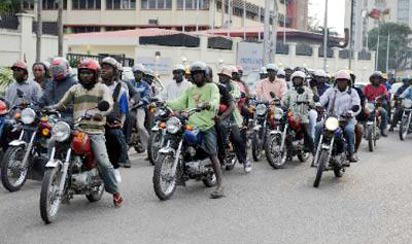
*File Photo okada riders
By Dotun Ibiwoye
NOISE from traffic, public address systems and loud music are gradually becoming the primary sources of noise contamination and pollution in Lagos with the attendant hearing problems and health issues. The Lagos State Environmental Protection Agency (LASEPA) General Manager, Mr Adebola Shabi, recently disclosed that the agency receives an average of 10 to 15 petitions on noise pollution daily.

According to Shabi, LASEPA considers sensitisation of the people and the authorities at the grassroots as a quick means of solving the problem of noise pollution in the state. “We have even taken the crusade on the issue of noise pollution down to the traditional rulers and local chiefs. We are involving the traditional rulers and local chiefs now because they are the custodians of their localities and they have to educate their people on noise pollution, he said.
“We started at Oworonsoki to Ikosi, Ketu, Ojokoro and some other areas too. In these areas, we met with the traditional rulers, local chiefs, CDAs, all the religious houses and everybody in the locality on the need to check noise pollution. He said that there is the need for the local people to understand the negative effects of noise and check it.
Reduction in noise
The LASEPA general manager, however, said that the noise level in the state had reduced drastically. Shabi affirmed that in 2014, the Agency sanctioned a lot of religious houses, including churches and mosques. Apart from religious houses, the Agency also sanctioned some club houses. He said that the rate of noise pollution was always related to population, adding that the Agency had been trying to reduce the noise pollution in a state of over N20 million people. Shabi said that once a complaint or petition is received, the Agency moves in immediately to ensure it was stopped.
He enjoined Lagos residents to always report such distractions within their areas to the Agency, for quick action. The reduction is as a result of the Agency’s sensitisation programmes around different communities in the metropolis Shabi stated. “When the Agency gets such petitions, it arranges a meeting with those involved to first educate them on noise pollution and the need to reduce the number of speakers in their premises,’’ he said
“averagely in a day, we have 10 to 15 petitions on issues of noise pollution and air pollution from generators and generating sets and religious houses. After the meeting, most of them do comply but the few that failed to comply we then shut down their premises. They will then sign an agreement with the Agency to comply fully before the premises are reopened.’’
Disclaimer
Comments expressed here do not reflect the opinions of Vanguard newspapers or any employee thereof.