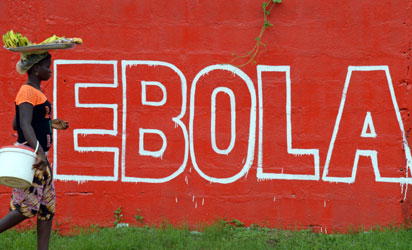
File: A seller of bananas walks past a slogan painted on a wall reading “Ebola” in Monrovia on August 31, 2014. Liberia on August 30, 2014 said it would deny permission for any crew to disembark from ships at the country’s four seaports until the Ebola epidemic ravaging west Africa was under control. AFP PHOTO
By Sam Eyoboka, with Agency Report
To respond to the Ebola Virus crisis in West Africa, which has taken more almost 4,500 lives, the World Council of Churches, WCC, brought to the table representatives of Christian aid organisations and United Nations’ agencies to learn from each other and up their efforts.

The WCC consultation, held recently in Geneva, Switzerland, affirmed a greater role for the churches and faith-based organizations in helping to stop the epidemic.
Dr. Pierre Formenty, an epidemiologist and the coordinator of the WHO’s campaign against Ebola, while addressing the WCC consultation, said it was a situation where everyone needs to work together: politicians, media, communities, faith organisations. We all have to do something. If one fails, everybody will fail,” said Formenty, stressing that faith organisations in Africa have a huge role to play.
Influence of the Church
Participants stressed that churches and other religious communities not only have a constant and influential reach to the grassroots populations to offer practical advice about hygiene and safe funeral practices but can also directly address the deeper cultural and religious roots of widespread stigma and discrimination that have accompanied the epidemic.
Dr. Gisela Schneider from the German Institute for Medical Mission, who was in Liberia a few weeks ago, shared observations from her visit. “Christian hospitals are highly vulnerable,” she said. “This is why ‘keep safe, keep working’ is an important slogan we promote for the health workers serving Christian hospitals. She said “people working on the ground need a great amount of encouragement, training, mentorship and support.”
Schneider added that while it is important to increase health facilities that reach the household level, it is “crucial to empower local communities to take care of themselves.”
Christoph Benn , former advisor to the WCC for its programme on health and healing said the WCC, churches and ecumenical organisations need to take full responsibility in not only helping to curb the disease but in communicating the right message, in raising awareness and challenging the stigma attached to Ebola.”
The consultation also highlighted the sanctity and dignity of the dead during burial rituals, an occasion which poses high risks of spreading the disease. The speakers said that while it is necessary to prevent the spread of the virus, support to families and communities is also essential. It was stressed that women should be empowered in their response to Ebola. The impact of virus especially on children and women was discussed at length at the event.
Statistics shared at the consultation showed that 4.5 million children under the age of five are living in areas affected by the Ebola virus. Children and women constitute 75 percent of survivors and victims.
Disclaimer
Comments expressed here do not reflect the opinions of Vanguard newspapers or any employee thereof.