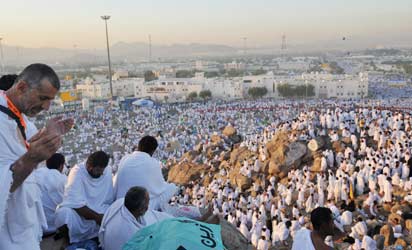
File photo: Muslim pilgrims gather to pray at Mount Arafat near the holy city of Mecca during the annual pilgrimage. AFP PHOTO/FAYEZ
BY HARUNA RAZAQ
Excellent manners are essential part of Islam. This etiquette is universal and must be exhibited by every Muslim everywhere at all times and more importantly by the intending pilgrims before embarking on Hajj and on returning home after Hajj.

This is in line with several verses of the Qur’an and Sunnah of Prophet Muhammad (SAW) which explain the category of Muslims that must perform Hajj; encouragement to perform it in the right manner and what is expected of the Hujjaj after exercise.
Some of these divine orders include: “…whosoever intends to perform Hajj therein (by assuming Ihram), then he should not have sexual relations (with his wife), nor commit sin, nor dispute unjustly during the Hajj. And whatever good you do, Allah knows it.
And take provisions for the journey, but the best provision is At-Taqwa (piety, righteousness). So fear Me, O men of understanding!) (2:197). “… and whoever inclines to evil actions therein or to do wrong, him We shall cause to taste from a painful torment. (Q22:25).
Others include: Q2:158, Q2:196-203, 3:97, 5:2, 22:26-33. And from Hadith, Abu Hurairah (RA) said: I heard the Messenger of Allah (SAW) say: “Whoever performs Hajj and does not utter obscenities or commit sin, will come back as on the day when his mother bore him”.
(al-Bukhaari, 1521; Muslim, 1350). Working with the above divine orders, the first set of Nigerian Muslims that performed Hajj though, are very few in number but distinguished themselves with exemplary character that are known with al-Muttaqun (the pious and righteous persons), for example, they made the pilgrimage to Hajj on foot at a time when most people dreaded the rigorous and journey to the Holy land of Makkah and Madinah, and increased in acts of Ibadah after returning to Nigeria.
As a result, they were respected and honoured by Muslims and non- Muslims. For example, Judges held the status of Alhaj in high esteem and relied on their evidences when they stand as witnesses in court.
They were allowed to wear Sabaka (a kind of special cap that are won by Hujjaj) in several places that other type of cap are forbidden such as: court of law, in the palace of traditional kings, etc; their request are usually granted in the area of marriages, making settlements etc.and they were being proud of not only by their family but by the entire town they came from.
In other words, day in day out, the number of Nigerian Hujjaj increases in number, however, the good characters that are known with the first Nigerian Hujjaj begin to disappear to the extent that some of the Hujjaj are now known with series of un-Islamic practices. May Allah protect us from such mai’sha.
Disclaimer
Comments expressed here do not reflect the opinions of Vanguard newspapers or any employee thereof.