By Tony Ubani
With the 2014 finals already heating up here in Brazil…here are some unforgettable moments of the world Cup and as the tournament progresses, the world is watching the unfolding drama, with the hope their favourite team will win.
The year of Pele
1958 was the year in which the world was introduced to football’s first superstar – Pele. At 17 years old, he was the youngest to feature in the tournament and burst onto the scene, setting the sixth World Cup tournament alight as he helped Brazil claim their first title. Netting his first ever World Cup goal in the quarter-finals against Wales, Pele then went on to claim a hat-trick in the semis against France before bagging a brace in the final as the Selecao hammered Sweden 5-2.
Two world wars, one World Cup… England
England hosted the World Cup for the first time in 1966 – in the era of ‘swinging London’. And even though the famous Jules Rimet trophy was stolen from Westminster Central Hall just three months before the first ball was kicked, the ’66 tournament will be remembered for one thing: the final. Yes, England beat arch rivals Germany to be crowned champions for the first (and only) time. Yes, Geoff Hurst became the first (and only) man to score a hat-trick in the final, but the memory that sticks out for many fans – particularly those of an English persuasion – is that of Kenneth Wolstenholme’s commentary as Hurst wrapped up the 4-2 win. “They think it’s all over. It is now!”
Yellow cards, colour TV and Brazilians goals
The 1970 World Cup in Mexico marked a new era in football. For the first time in World Cup history substitutes were used, yellow cards were issued and audiences around the world had the delight of watching the matches on colour television. Perhaps it was quite fitting, then, that the great Brazilian team’s attacking, attractive style of football was complimented by their dazzling yellow shirts broadcast through television sets across the world. And no better time, indeed, than to watch one of the great Brazilian goals; Pele laying the ball off out wide on the right – seemingly into unaccompanied space – only for captain Carlos Alberto to zoom into picture before crashing the Selecao’s fourth goal past Italy, helping them claim their third title.
Cruyff the total football icon
The Western half of a divided German any hosted the 1974 World Cup, and, with a new trophy available, it was a chance for the host nation to project a new image to the world. But the image that is etched upon the memory of those watching is that of Johan Cruyff. The talismanic Dutch forward – who wore two stripes, rather than three, on his Adidas jersey because of his affiliation with Puma, such was his influence – helped his side usher in a new brand of football. ‘Total Football’ was a revolutionary tactical system in which every player was required to be more flexible and adaptable than ever before. The Dutch advanced to the final, which they eventually lost to the hosts, but it for a moment in a group match against Sweden that the tournament will forever be remembered. It was here, on the world stage, where Cruyff produced his dazzling ‘Cruyff turn’, completely bamboozling defender Jan Olsson. There are reports that Olsson is still looking for the ball today…
Diego Maradona the Argentine god of soccer
Mexico hosted the World Cup finals for the second time in 16 years as Argentinean whizkid Diego Maradona guided his side to glory in front of 115,000 inside the Stadio Azteca. But it was in Argentina’s semi-final with England that the little magician made history. With the game tied at 0-0, Maradona capitalised on a defensive mistake to challenge England goalkeeper Peter Shilton for the ball – but rather than making contact with his head, El Diego stretched out his arm to punch the ball into the back of the net. England players and fans pleaded with the referee, but the goal stood. What came next, however, was nothing short of genius. Just four minutes after the infamous ‘hand of god’, Maradona ran the near length of the pitch, dancing past every England player’s challenge, rounding Shilton and rolling the ball into an empty net in what is regarded as the greatest World Cup goal of all time.
Zidane headbutt of ragging bull
Germany hosted their first World Cup as a united nation in 2006 and put on one hell of a show. What started in a frantic, mesmerising and heart-stopping manner, as hosts Germany shared six goals with Costa Rica in a 4-2 win, finished in the same way. An aging Italian side battled their way to the final, as Zinedine Zidane virtually dragged France to the showpiece fixture in what was to be his final ever match. The mercurial Frenchman, looking to end a glittering career with a second World Cup triumph, opened the scoring and seemed certain to go on and help France lift the trophy. But, with the match tied at 1-1 in extra time and with penalties looming, Zidane did the unthinkable and signed off a career full of poise, grace, finesse and skill in the most brutal and violent manner. The Frenchman, engaging in verbal battle with Marco Materazzi, took offence to something the Italian said, headbutting his opponent. Zidane was sent off as Italy claimed their third World Cup.
Spanish Tiki Taka walk the walk
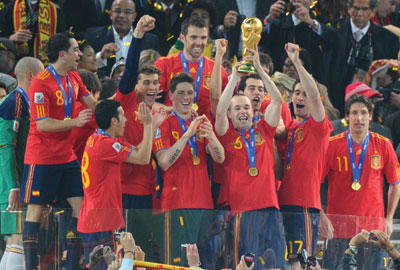
Having failed at the final hurdle in 1974 and 1978, Netherlands, under the fastidious management of Bert van Marwijk, had the chance to right the wrongs as they made the final of the 2010 World Cup in South Africa. Having conceded just five goals on the way to the final, knocking out Slovakia, Brazil and Uruguay on the way, ‘the greatest team never to win a World Cup’ looked almost certain to end their drought. A free-flowing, expansive style, akin to their predecessors’ ‘Total Football’, ensured the Netherlands would take on reigning European champions Spain. It was billed as one of the most exciting finals in World Cup history. Total Football v Tiki Taka. Except it wasn’t like that at all.
Van Marwijk sent his Dutch side out with a completely different game plan to the one that had seen them gain many plaudits throughout Africa’s first World Cup. Rather than try and play their way through and past Spain, Netherlands attempted to stop their opponents from playing, and in the most brutal and cynical manner. Kicking out at Spain’s players at every opportunity, the Dutch team disgraced themselves on the biggest stage – Nigel de Jong’s karate kick on Xabi Alonso the lasting memory of a truly dreadful final.
Disclaimer
Comments expressed here do not reflect the opinions of Vanguard newspapers or any employee thereof.