By Favour Nnabugwu
The pressure is on the insurance regulatory body, the National Insurance Commission, NAICOM, and the entire industry to gain a competitive edge by carefully considering ways to tackle the risks of terrorism in the country by providing cover for victims.
Until recently, terrorism-based risks were never part of the imagination of the nation’s insurance sector. Nigeria’s insurance industry now wants to deploy its skills and experiences to organise insurance products and services for terrorism.

NAICOM boss, Fola Daniel
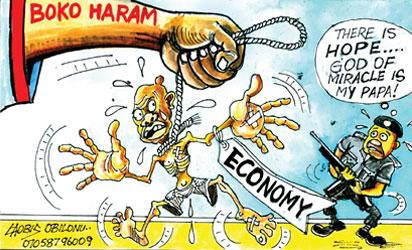
The first five months of this year have witnessed an increase in terrorist attacks in Abuja, Plateau, Borno, Adamawa, Kano, Kaduna and other states which Boko Haram Islamist group spearheaded since 2010 when it began the attacks.
In the light of the heightened insecurity challenges the country, some stakeholders believe insurance practitioners can provide cover for terrorism and kidnapping, alongside the usual liability cover and protection for personnel, property, shipping, crews and cargoes.
Commissioner for Insurance, CFI, Mr Fola Daniel, at a training organized by NAICOM in Akwa Ibom State for insurance correspondents based in Abuja and Lagos, confirmed that cover for terrorism was never in the mandate of the industry.
However, the NAICOM boss said the insurance industry has settled the claims of the military personnel and police officers who lost their lives during attacks under the group life of either the police or the army to date.
The CFI admitted that local insurers cannot bear claims arising from terrorism alone as a claim can send the whole of the sector into extinction just as he added that federal and state governments need to support the industry in that regard.
Having realized that majority of the victims of terrorism are common men, Daniel said underwriters will deliberate on terrorism and come out with tangible products in no distant time.
According to him, “Terrorism as insurance cover is what we do not have but it is possible now.”
He regretted the many houses in the communities that were burnt during bomb explosions were without any form of insurance that could ameliorate their plight.
Nonetheless, the insurance commissioner believes that the Federal Government will back the industry up on terrorism insurance, “so that where insurance industry stops, government will takeover”.
“If we could take the challenge of kidnapping insurance, we can as well provide cover for terrorism”, the CFI said.
“This is what we intend to achieve with the various initiatives incepted by the commission in recent times. I am encouraged that all of those and many other initiatives assured us of an evolving insurance model, a better insurance industry, a growing market and a brighter future”.
 Internationally, terrorism started with the terrorist attacks of September 11, 2001 in the US, followed by the 2002 Bali bombings, the 2004 Russian aircraft and Madrid train bombings, the London transportation bombings of 2005, and the Mumbai bombings of 2008 among others.
The impact of the September 11, 2001 attacks was substantial, producing insured losses of about $39.4 billion. Losses were paid out across many different lines of insurance, including property, business interruption, aviation, workers compensation, life and liability.
The loss total does not include the March 2010 settlement of up to $657.5 million announced by New York City officials and plaintiffs’ lawyers to compensate about 10,000 workers whose health was damaged during the rescue and cleanup at the World Trade Center.
A total of 2,976 people lost their lives in the attacks in New York, Washington D.C. and Pennsylvania, excluding the 19 hijackers. It remains the worst terrorist attack on record in terms of fatalities and insured property losses, which totalled about $23 billion. And nearly nine years after 9/11, insurers paid out billions of dollars for other catastrophes until Hurricane Katrina in 2005 when insurers paid claims that ran over $40 billion.
In the local market, terrorism risk is new in the local market as it is part of exclusion, and usually funded by government in some jurisdictions, on account of the size of risk exposure.
Terrorists attack targets oppor tunity and it is certainly possible that an attack can occur anywhere including cities, remote villages, markets, schools or shopping malls while the demand for coverage is higher in metropolitan areas simply because there is a greater concentration of exposures in those areas.
Terrorism attacks are the most devastating and expensive of events for the providers of insurance and can represent the most disruptive of events for the insured because of the substantial losses that could be suffered following an attack,
Assistant Director (Inspectorate) of the Commission, Mr. Sam Onyeka, in a paper at the training session, entitled: ‘Insurance Regulations as Catalysts for Market Development: Lessons for the Media’, made journalists to understand that risks from natural disasters such as flooding and activities of terrorists, among others, are considered high level risks not covered by insurance.
He pointed out that insurance companies in the country do not have the capacity to cover those huge risks while he urged government at all levels to make provisions for what he described as predictable risks.
“Most people affected in situations of natural disasters such as flooding and terrorism attacks are the vulnerable in the society. To ensure that money is pooled together for such, the federal, state and local governments should make provisions to pay insurance premium to cover them. This way, insurance companies will take responsibility of ensuring that victims of such disasters are properly provided for,” he said.
In the meantime, Nigerian Union of Teachers, NUT, wants underwriters to avail teachers and students policies that best suit their situations.
The Chairman of the union in Cross River State, Eyo-Nsa Itam, while addressing union members in Calabar during a solidarity rally for the release of the abducted Chibok schoolgirls, lamented that teachers and students have become endangered citizens in the current security challenge threatening the country hence the need for insurance.
“It is also important to take insurance cover for both students and teachers in the vulnerable political environment of the country”, Itam said.
Speaking to this reporter on the importance of terrorism insurance in the country, Mr Soni Daniel, Regional Editor, (Northern States) understood the fears of the insurance industry and also appreciated the bold step of the sector to take on terrorism insurance.
Soni commended the federal and state governments for doing quite a lot to compensate victims even amidst limited funds.
He believes that underwriters can find a way to build insurance for victims of terrorism without necessarily having to charge the victims directly, citing aviation insurance whereby insurance of airlines accommodate passengers on board at the time of mishap.
He said, “Good to know that practitioners are coming to absorb the shock by providing risk in these areas, would help stabilise the economy and make the environment conducive for local and foreign investments. If there is no insurance and an effective means of compensation in the event of loss, many would not feel comfortable to do business in Nigeria”.
Disclaimer
Comments expressed here do not reflect the opinions of Vanguard newspapers or any employee thereof.