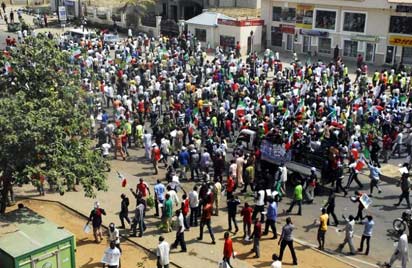
Protesters in Abuja
To cooperate with govts, employers, union
BY Funmi Komolafe
The International Labour Organisation, ILO’s latest report has revealed that forced labour generates about $150 billion annually and that about 21 million people are involved in forced labour worldwide.
The organisation is, therefore, set to work with governments, private employers and trade unions to enforce laws against forced labour.
Forced labour in Nigeria, which ILO noted generates more than three times the previously estimated profit, is illegal.
To tackle it, ILO Director-General, Mr. Guy Ryder, said the organisation will work with “governments to strengthen law, policy and enforcement with employers and strengthen their due diligence against forced labour, including in their supply chains, and with trade unions to represent and empower those at risk.
“If we want to make a significant change in the lives of the 21 million men, women and children in forced labour, we need to take concrete and immediate action.”
The report
The ILO report on Profits and Poverty: The Economics of Forced Labour said: “Two thirds of the estimated total of $150 billion, or $99 billion, came from commercial sexual exploitation, while another $51 billion resulted from forced economic exploitation, including domestic work, agriculture and other economic activities.”
It noted that over half of those engaged in forced labour are “women, and girls, primarily in commercial sexual exploitation and domestic work, while men and boys were primarily in forced economic exploitation in agriculture, construction, and mining.”
The report listed income shocks and poverty as the main economic factors that push individuals into forced labour.
Other factors, it stated, include lack of education, illiteracy, gender and migration.
Socio-economic solutions
Head of ILO’s Special Action Programme to Combat Forced Labour, Beate Andrees, suggested that “while progress is being made in reducing state imposed forced labour, we must now focus on the socio-economic factors that make people vulnerable to forced labour in the private sector.”
Andrees called for a series of measures aimed at reducing vulnerability to forced labour including “bolstering social protection floors to prevent poor households from abusive lending or indenture in the event of sudden income shocks.
“Investing in education and skills training to fortify job opportunities for vulnerable workers, promoting a rights based approach to migration to prevent irregular employment and abuse of migrant workers.”
She also suggested “supporting the organisation of workers, including in sectors and industries vulnerable to forced labour.”
Disclaimer
Comments expressed here do not reflect the opinions of Vanguard newspapers or any employee thereof.