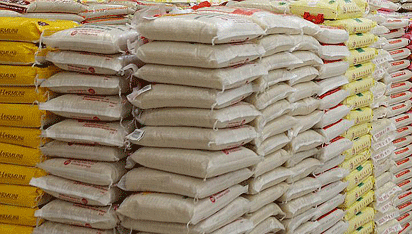
Bags of rice
By Franklin Alli
Controversy has continued to trail the allocation of higher import quotas to new investors in the nation’s rice sector.
 Specifically, existing millers in the sector are complaining that the allocation of higher import quotas to new investors who have neither paddy nor rice milling facility is a threat to the realization of the backward integration policy by the Federal Government.
Vanguard’s investigation revealed that in a bid to promote self-sufficiency in local rice production and milling, the Federal Government initiated a new rice policy.
The policy specifies preferential levy of 20 percent and duty of 10 per cent for existing millers and new investors in rice milling and a higher levy of 60 percent and a duty of 10 percent for other rice importers.
Consequently, an inter-ministerial committee was appointed to determine the national supply gap and the appropriate volume of import quota of the two categories need to close the gap.
Also a methodology of allocating quotas, which assigned weight to key criteria of self-sufficiency in rice production and milling in Nigeria, was developed by the Ministry of Agriculture in collaboration with the rice stakeholders and rice experts as supply gap of import grade was determined to be 1.5 million metric tonnes for 2014.
Subsequently, a letter was sent to existing rice millers and new investors, to submit their Domestic Rice Production Plan (DRPP), and based on their submissions a total of 1.3 million metric tonnes of rice import quotas was issued to 28 qualifying companies at the preferential levy of 20 percent and a duty of 10 percent.
The remainder 0.2 million metric tonnes of rice imports will be at the higher levy of 60 per cent and duty of 10 per cent for other rice importers.
Vanguard further learned that, however, to the disappointment of the existing rice millers, new investors without milling capacity or investments in paddy farms received the highest quota of the allocations to import, while millers did not receive allocations and in some instances received very low allocation.
Similarly, the list of beneficiaries of the preferential import quotas, quantities of rice imports approved and corresponding size of performance bond to be submitted shows that of the 28 beneficiaries, only 16 have mills, while the remaining 12 have no mills and account for higher imports than millers.
Investigations also showed that many of the new investors who got the import allocation quotas have only submitted expression of interests to invest in the sector without commensurable form of investments in the sector, and are already trading it to interested stakeholders at between 60 to 80 per cent levy having got the same at 20 per cent levy.
Disclaimer
Comments expressed here do not reflect the opinions of Vanguard newspapers or any employee thereof.