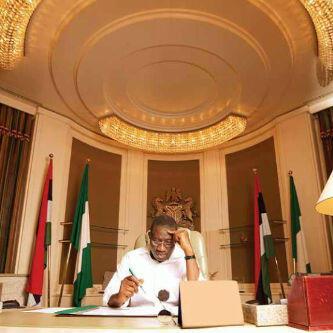
The leadership of Africa’s most populous country is not for the faint hearted. And despite the misgivings of many Nigerians about the capacity and the capability of President Goodluck Jonathan, he has continued to demonstrate capabilities that belie his humble roots.
Security
Although he inherited the menace of the Boko Haram from his predecessor in office, the ferocity of the attacks increased exponentially during the Jonathan presidency. In 2013, the sect appeared to have gained competences that appeared to have taken the security services by surprise.
Though the military’s capacity to contain the threat was significantly increased with more training and cooperation with other friendly countries, the brutal military tactics provoked an outcry from within and outside the country. In response to this, President Jonathan set up a committee headed by the minister of special duties, Tanimu Turaki to explore the possibility of granting amnesty to members of the sect.
Though a faction of the sect accepted the amnesty proposal, the leader of the sect, Abubakar Shekau rejected the offer out rightly and continued with its attacks on many parts of the Northeast.
The administration’s response was the proclamation of a state of emergency in the three states. Though pockets of attacks are still being carried out by the sect in Borno and Yobe States, its capacity to carry out attacks in other parts of the country has been seriously curtailed.

Politics
Even within his party, the PDP, President Jonathan had maintained a topsy-turvy relationship with some of its key members. The mini-convention of the party which was held in response to the non-recognition of some officers of the party’s executive committee by the Independent National Electoral Commission, INEC provided the needed platform for the emergence of a splinter group led by former Vice President, Atiku Abubakar and seven dissident governors.
The splinter group, which went with the name “New PDP,” had Governors Alhaji Sule Lamido (Jigawa), Dr. Rabiu Kwankwaso (Kano), Alhaji Murtala Nyako (Adamawa), Dr. Mu’azu Babangida Aliyu (Niger), Alhaji Aliyu Wamakko (Sokoto), Alhaji Abdulfatah Ahmed (Kwara) and Rotimi Amaechi (Rivers). The emergence of the group was partly a culmination of a bitter power struggle that began with the election of the chairman of the Nigeria Governors Forum.
Although majority of the governors (19) elected the Rivers state governor, Rotimi Amaechi as their leader, the leadership of the PDP and the presidency recognised Jonah Jang who was voted for by 16 of his colleagues.
Despite the deep schism created by the action of the new PDP, the president made attempts to paper over the cracks.
Series of meetings were held between the president and the chairman of the Board of Trustees of the Party, Chief Tony Anenih, on the one hand and the nPDP on the other to find a common ground. The defection of five of the original seven governors from the PDP to the opposition APC represents the spectacular failure of the reconciliation efforts initiated by the chairman of the BOT of the party which at a point even co-opted former Presidents Olusegun Obasanjo and Ibrahim Babangida to intervene on behalf of the president and the party.
But what perhaps shook watchers of the political terrain more than any other even in the preceding year was the 18-page letter written by Obasanjo to President Jonathan. In the letter which was devoid of niceties, the former president raised concerns about the state of the economy, especially the mismanagement of the oil and gas sector, corruption, security and the president’s yet-to-be declared second term bid.
He urged Jonathan to strive to be a national leader instead of allowing himself to be held hostage to power by his clansmen.
President Obasanjo noted in the letter that despite Jonathan’s assurances to him in 2011 and to other prominent Nigerians that he would only do one-term in office, there are indications that he is engaged in scheming for a second term.
“Knowing what happens around you most of which you know of and condone or deny, this letter will provoke cacophony from hired and unhired attackers but I will maintain my serenity because by this letter, I have done my duty to you as I have always done, to your government, to the party, PDP, and to our country, Nigeria,” Obasanjo wrote.
 “I have passed the stage of being flattered, intimidated, threatened, frightened, induced or bought… Death is the end of all human beings and May it come when God wills it to come.”
In a warning that was both foreboding and instructive, President Obasanjo told Jonathan pointedly that ”Nigeria is bleeding and the haemorrhage must be stopped, before it is too late.”
Dr. Jonathan’s initial response was conveyed in a press statement issued by his media adviser, Dr. Rueben Abati who acknowledged the letter that had been leaked to the media.
He said it was “highly unbecoming, mischievous and provocative that a letter written by a former head of state and respected elder statesman to President Jonathan has been deliberately leaked to the mass media in a deplorable effort to impugn the integrity of the president and denigrate his commitment to giving Nigeria the best possible leadership”. He however said because of the weighty nature of the allegations, the president was going to reply the letter personally.
For a man who is known to have written letters to his successors in office the consequences of which have almost always been dire, Jonathan did not take the letter lightly. After a week or two of contemplation, the president who had urged his aides not to respond to his one time benefactor on the ground that he would personally respond, replied in kind.
And in a reply that was both detailed and profound, President Jonathan gave ten reasons why he took the decision to reply to his benefactor turned adversary saying:
“The third reason why I must reply you in writing is that your letter is clearly a threat to national security as it may deliberately or inadvertently set the stage for subversion.”
Besides, Jonathan said: “The eighth reason is that it appears that your letter was designed to incite Nigerians from other geopolitical zones against me and also calculated to promote ethnic disharmony. Worse still, your letter was designed to instigate members of our party, the PDP, against me.
He said the former president’s ‘letter conveys to me the feeling that landmines have been laid for me. Therefore, Nigerians need to have my response to the issues raised before the mines explode.
“The tenth and final reason why my reply is inevitable is that you have written similar letters and made public comments in reference to all former presidents and heads of government starting from Alhaji Shehu Shagari and these have instigated different actions and reactions. The purpose and direction of your letter is distinctly ominous, and before it is too late, my clarifications on the issues need to be placed on record”.
The president also challenged Obasanjo to provide proof that he (Jonathan) was training killers to hunt down his political opponents ahead of the 2015 election, just as he raised the alarm that criminally minded persons may use the unfounded allegation as an alibi to perpetrate evil in the country as the general election approaches.
He also accused Obasanjo of having failed to resolve any of the politically motivated killings under his administration even as he pointed out that none of the perpetrators of several attempts on his life was arrested when his house was bombed by unknown men in Bayelsa. It was a reply that left no one in doubt that the otherwise cozy relationship that existed between the two men had gone irredeemably bad.
Corruption
One of the issues that stuck out as a sore point in the fight against corruption by the Jonathan presidency was the issue of the purchase of bullet proof cars by the minister of Aviation, Stella Oduah. The cars which were bought at a price of $1.2Million raised so much dust that the president was forced to set up an administrative committee to investigate the circumstances of the purchase of the cars.

Stella Oduah
The failure of the president to act on the committee’s report has given his opponents the necessary ground to peddle the allegation that the setting up of the committee was a mere window dressing.
The president was in the last year a target of relentless attacks from the opposition, who understandably played down much of the successes of the administration.
The unbundling of the Power Holding Company of Nigeria, PHCN which had remained almost unachievable was concluded last year, the airports have been modernised.
Disclaimer
Comments expressed here do not reflect the opinions of Vanguard newspapers or any employee thereof.