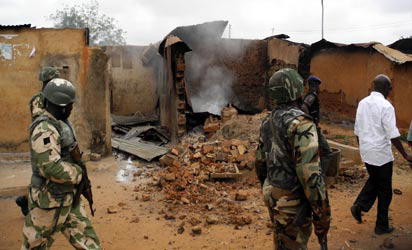
*No peace inspite of soldiers deployment
By Abel Daniel, Lafia
Nasarawa State, the home of solid minerals, used to be one of the most peaceful states in Nigeria where people from various tribes have lived together, inter-married, and shared beliefs and customs. However, recent events have proved that the state has sadly joined the league of states with records of communal violence.
Apart from the persistent clashes between farmers and Fulani herdsmen in the Southern Senatorial District resulting to wanton destruction of lives and properties worth billions of naira, the state recorded deadly ethnic clashes in Assakio in Lafia local government area and Agyaragu in Jenkwe development area of Obi local government. The incidents occurred in June and November, 2012 respectively.
The Assakio violence came when the Eggon ethnic group and their Alago counterparts who had lived together for years launched attacks on each other leading to destruction of property including the palace of the paramount ruler of Assakio.

*No peace inspite of soldiers deployment
The incident was not unconnected with the alleged marginalization of the Eggons by their Alago counterparts who are said to be the original owners of the land, an allegation the Alago Cultural and Development Association described as unfounded.
Investigations revealed that before the mayhem, the Eggon Cultural and Development Association, through its legal representative, Barr. S.A Ayiwulu, petitioned the paramount ruler of Assakio, Osula Inarigu, alleging illegal and unlawful seizure of farm lands as well as appropriation of food crops belonging to his clients (Eggons).
In the petition, copied to the Anambra State Commissioner of Police, Governor Tanko Al-Makura, the Director of the State Security Services SSS, the Emir of Lafia and other security agencies in the state, the legal practitioner urged the authorities concerned to rise up to the occasion to avoid possible break down of law and order that could result to bloody clashes between the two ethnic nationalities.
Critics alleged that the governor’s failure to respond to the “notice of attack” was a clear indication of his incompetence in handling security matters and the general administration of the state which led to the state House of Assembly serving him a notice of impeachment. But Al-Makura attributed the security woes of the state to attempts by the opposition to disrupt the peace in the state.
The Assakio mayhem prompted the constitution of a commission of enquiry to ascertain the immediate and remote causes and to identify persons or group of persons involved. The commission has submitted its report to the government. What however remained a matter of concern to the people is the non-implementation of the report which allegedly indicted some prominent personalities in the state.
Sources claimed attempts were being made to sweep the report under the carpet. It was alleged that those indicted include politicians and past governors.
A similar crisis erupted between the Migili ethnic group in Jenkwe development area and the Eggon ethnic nationality over a stolen motorcycle. The crisis, like that of Assakio, led to the destruction of houses as well as loss of lives. A district head, Zhe Meri, who was taking refuge in the community after being displaced in his Gidan Rail home town by Fulani/Farmers crisis, was also said to be a victim.
The incident led to the criticism of the governor by those who felt the non-implementation of the report of the commission that probed the Assakio crisis emboldened the perpetrators of the Agyaragu incident. The state legislators also blamed the Agyaragu crisis on Al-Makura’s refusal to assent to an anti-thuggery bill passed by the state House of Assembly and other resolutions that have to do with security matters which they noted would have gone a long way in addressing security challenges in the state.
Also speaking on the crisis, the Migili Cultural and Development Association (MCDA), through its National President, Mr. David Musha, observed that though the state government made efforts to maintain law and order through soldiers and policemen, it did not translate to protection of lives and property just as the administrator of Jenkwe development area, Hon. Wuduyamba Sam Agidi, decried that “with the heavy presence of the military and police, my people could not be secured”.
Meanwhile, the Eggon Cultural Development Association chairman, Barrister Chris Mamman, accused security agents in Nasarawa of being selective in the arrest of suspects after the Agyaragu feud, claiming that the arrest was targeted at the Eggon ethnic nationality. He lamented that such action would not help the situation but rather lead to more provocations.
Many indegenes believe effort toward ensuring peace in the state must be employed by the government and security agents.
Disclaimer
Comments expressed here do not reflect the opinions of Vanguard newspapers or any employee thereof.