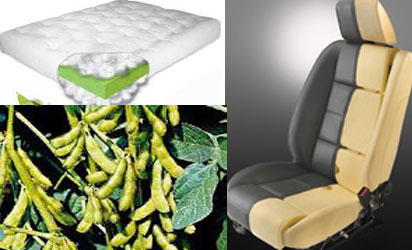
Pix shows Top – Soy-based mattress foam. Down – Soybeans and Right – Ford’s soy-based foam seat
BY EBELE ORAKPO with Agency report
Researchers in the US driven by the need for more environment-friendly fuel from renewable materials in order to reduce dependence on fossil fuel and its attendant consequences for the earth, have turned to soybeans.
A report published in the R & D magazine said researchers funded by the United Soybean Board (USB), a farmer-led organisation which invests farmer check-off funds into research, market development, and expansion, including research, development, and commercialization of new industrial uses for soybeans, have come up with amazing results.
The report said apart from using soybean as food for humans and animals, they have been able to make from it, products for everyday use such as foam, inks, coatings, etc.
Soy-based foam for car seats:
“Ford has partnered with USB to develop renewable soy-based technologies. Ford pioneered the use of soy oil in foam for seat cushions, seatbacks and vehicle headliners. There are over two million Ford, Lincoln, and Mercury vehicles on the road today with bio-based foam content,” and by so doing, “Ford has annually reduced its petroleum oil usage by more than three million pounds, and its carbon dioxide emissions by 11 million pounds,” said the report.
The company has also succeeded in replacing 25 per cent of the petrochemicals in rubber by using renewable soybean oil thereby “more than doubled rubber’s stretchability and reduced its environmental impact. Soy-based rubber parts, such as radiator deflector shields, air baffles or deflectors, cup-holder inserts, and floor mats, may be installed in future Ford vehicles,” the report added.
“Ford researchers found that soy fillers could provide an inexpensive and environment-friendly partial replacement of carbon black, a petrochemical-based material traditionally used to reinforce rubber. Used together, soybean oil and soy fillers could replace up to 26 per cent of the petrochemical-based content in automotive rubber applications,” it said.
Inks and coatings
“Soy ink, which is used to print more than 90 per cent of America’s 1,500 daily newspapers and recently celebrated 20 years in use, can be found in soy-based toners as well. The Battelle Memorial Institute in Columbus, Ohio, has worked with the Ohio Soybean Council (OSC) to develop a soy-based toner for copy machines and computer printers.
They are currently working with potential marketers to bring the product to consumers. Work continues with other research agencies regarding the possibility of soy ink in pens and other writing applications.
“Soy-based coatings, such as wood and concrete stains, caulking, and other building products are making a mark on consumers and have shown versatility in new applications, including ultraviolet and electron beam-curing roof coatings and faux finishing in building artwork.

Pix shows Top – Soy-based mattress foam. Down – Soybeans and Right – Ford’s soy-based foam seat
“For many years, soybean oil has been a major ingredient in making alkyd resins, which are dissolved in carrier solvents to make oil-based paints. The popularity of latex or waterborne paints has presented a challenge for soy-based paints.” USB is working with some companies to develop soy-based paints for consumers.
Other areas of development include: stable, waterborne architectural coatings; high-performance, volatile organic compound (VOC)-free coatings for industrial applications; and 100 per cent solid powder coatings.
Adhesives
Faced with increased prices for petrochemical products, environmental concerns, and human health issues, the researchers were able to develop new soy-based products for the wood adhesive industry.
PureBond, according to the report, “is a formaldehyde-free plywood technology developed with funding from USB. To date, 40 million PureBond plywood panels have been installed in the US.
The manufacturing company “uses approximately 15 million pounds of flour processed from U.S. soybeans annually,” said the report.
Plastics
“Soy-based plastics can be divided into two main groups: polyurethane using soy polyols and thermosets. As more manufacturers look for alternatives to high petrochemical prices, soy-based plastics provide a viable option. Soy polyols perform exactly like their petrochemical counterparts or better in some cases when it comes to total weight, strength and durability.
Plastic composites and polyurethanes, used for plastic body and interior parts for automobiles, boats, and agricultural equipment, could potentially replace an estimated 300m pounds of thermoset resins in a market totaling 2.7b pounds in North America,” stated the report.
Lubricants
The researchers were also able to meet the need for “high-performing and low-toxic lubricants in environmentally-sensitive areas” as they incorporated soy-based oils into lubricants.
“When compared to mineral-oil lubricants, soy lubricants have higher viscosity, lower evaporation loss, and a potential to enhance lubricity, which could lead to improved energy efficiency.”
The report added that soy lubricants are used in the Statue of Liberty and other structures in the US. “Other soy lubricants include cutting fluids, bar and chain oils, and soy-based transformer fluid.”
Green products
USB whose mission is to “increase soybean demand through advancements in soy-based research and technology, in conjunction with interested companies, has continued to review research proposals and partner with companies with promising new soy technologies.”
It will be recalled that the US entered the global market with soybean in the early 1960s and today, researchers have added value to the product making it relevant not just in the food industry but also for industrial use, reducing the US dependence on foreign petrochemicals.
A soybean farmer and vice-chair, New Uses Committee of the USB, Bob Haselwood, believes that “with the price of crude oil high, soy remains a cost-competitive alternative for many industries.
“Everyone continues to look for sustainable and ‘green’ alternatives, and soy will play a part of the sustainable movement for a number of industries.”
Nigeria, a mono-product economy which allegedly uses almost all her oil revenue on salaries with very little left for infrastructure development, could borrow a leaf from the USB. Instead of exporting eaw materials, researchers should be equipped and motivated to go to work on products like oil palm, cassava, cocoa, and groundnut.
As a US-based Nigerian, Dr. Ndubuisi Ekekwe, has rightly said, “application of technology could move millions of Africans from poverty to middle-class living standards.”
Disclaimer
Comments expressed here do not reflect the opinions of Vanguard newspapers or any employee thereof.