BY PROFESSOR DON BURNESS
Two recent African memoirs, both published in London and New York in 2012, reflect on the continent’s self-mutilation since the heady days when independence from colonialism was viewed as morning yet on creation day. What followed independence has been season after season of anomy, to use the phrase of Wole Soyinka.
Civil wars, the looting of national wealth by the few with power, economic decline, a culture of corruption and a mindless devotion to mediocrity – these are some of the roads Africa has traveled since 1957 when Ghana led by Kwame Nkrumah became the first African nation to gain so-called independence from European colonial rule.
Since then there has followed a staggering historical irony – Africans, for centuries victims of the slave trade, have willfully chosen to flee their villages, their towns, to seek a better life in the very West that has dehumanized them and denied them humanity! They have willfully chosen to cross oceans red with the historical blood of evil.
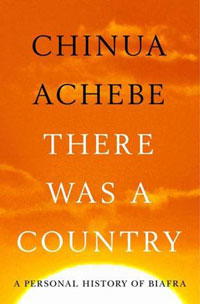
The two memoirs are My First Coup d’Etat and other stories from the lost decades of Africa by Ghanaian John Dramani Mahama and There Was a Country– A Personal History of Biafra by Nigerian man of letters Chinua Achebe. This is Mr. Mahama’s first book; on the front cover there is a comment by Chinua Achebe, “a much welcome work of immense relevance.”
Both writers cite African proverbs, Achebe an lgbo proverb, Mahama an Akan proverb, that express the idea that without an understanding of the past, it is not possible to effectively confront the challenges we face in the present. Both men know that today is a product of all our yesterdays.
New species of ugliness
In the West today we race at full speed led by the god Progress, heading God knows where — we are on a darkling plain with ugliness everywhere. In fact, we honor ugliness — in music, in language, in culture. We have created a new species of ugliness — homo obesus! And we build citadels of ignorance and call it “globalization.”
I am reminded of Bruegel’s painting at the Capidamonte in Napoli, The Blind leading the blind, Enlightened Europe, a center of art and music and literature and architecture, enlightened Europe with its great universities and technology not long ago built roads leading to Terezin and Auschwitz. The two world wars of the first half of the twentieth century cannot be passed off as several unfortunate chapters of recent European history.
After all Danish writer Jens Christian Grondahl in his insightful and wise novel An Altered Light, captures Europe’s historical identity in his simple phrase, “Vienna, city of Mozart and Hitler.” A continent that has spent century after century hating Jews, killing Jews while having the nerve to go around the world to bring “civilization” must look in the mirror to see its true face. Dutch writer Harry Mulisch does this in The Discovery of Heaven.
Hitler by himself did not kill the Jews. Hitler’s willing executioners, ordinary people, silently or not so silently applauded and acquiesced. Even today from Malmo to Toulouse, different excuses to rationalize hatred of Jews. Blind Europe cannot create societies of justice,societies of brotherhood, societies expressed by Beethoven’s 9th symphony until Europe, not just Germany, faces its past honestly.
Africa too has been unwilling to confront the darkness in the continent’s historical soul. What has happened in Africa since 1957 is a return to a centuries old pattern of madness and evil and intolerance and ignorance that seems to plague mankind nearly everywhere on this gloriously beautiful planet.
After all until Africa openly faces the fact that Africans exploited other Africans, capturing and transporting and selling Africans as slaves to North Africa, to slave merchants from Europe and America, until this ugly truth is examined and recognized and admitted, abominations will continue. Dehumanizing Africans, be it through slavery or killing fields of Rwanda or Congo or Sudan or Angola or Biafra – this is sadly a pattern rooted in history.
Europe at its best gives us French food, St. Francis, Mozart, Shakespeare and Michelangelo. Africa at its best gives us the magnificent bronzes of Benin, the elegance of the Makonde, the vibrant and celebratory colors of the marketplace, Nelson Mandela and Chinua Achebe. These two memoirs show the different faces of Africa and African history – and for this reason are seminal works. Mr. Mahama and Mr. Achebe dare to speak the truth.
When he wrote My First Coup d’Etat John Dramani Mahama had no idea that soon after its publication he would become President of Ghana. When democratically elected President John Atta Mills died of illness in July 2012, his vice-president, Mr. Mahama, became President. Mr. Mahama’s memoir is, in fact, both a series of personal reminiscences and a national history of Ghana since independence.
It is worth noting that he is a Christian from the predominantly Muslim North. Perhaps Mr. Mahama’s journey to wisdom and tolerance stems in part from his fluency in various languages including Ga, Twi, Gonga, Dagbani, Hausa, Russian and English. This is a man of culture and learning.
He was seven years old on 24 February 1966, when Ghana experienced its first coup d’etat. Kwame Nkrumah, who led the nation and the continent to independence, was in North Korea on a diplomatic mission when the military bludgeoned their way onto the national stage. This was the first in a series of military coups that promised stability and progress but produced terror, economic disaster and emigration.
Ghana’s story is narrated in large part through the story of Mahama’s father, a member of Nkrumah’s government. In return for his genuine commitment to his country, his father was arrested, tortured and frustrated at every turn. A rich and successful businessman, he fled Ghana — living in Ivory Coast and Nigeria before settling as a refugee in London.
John Dramani Mahama in his youth like Nkrumah was a fervent socialist. He majored in history at university and studied in a post graduate program in social psychology at the Institute of Social Sciences in Moscow.
A father in London a son in Moscow — Africa in the 1970s and 80s! John Dramani Mahama learned a lot in Moscow; he discovered the essential truth that the belief in absolutes is a road to disaster. His blind faith in socialism had come face to face with socialist reality in The Soviet Union. He returned to Ghana with a flexible mind and a desire to be of service.
Today Ghana stands as a success story in Africa, a model for the continent — there is a functioning democracy and a thriving economy. When a President dies, the vice-president takes over. No tanks in the street, no riots, no sense of crisis.
Today Ghana offers hope to the rest of the continent. Surely Mr. Mahama knows that things do not usually work out as one hopes, but here is a chance for the man who as a boy fell in love with history and with literature to lead Ghana on its journey to a human and just and tolerant future.
Nigeria, on the other hand, continues to be a failed state, a nation with enormous talent that can’t get its act together whether on the football field, in the political arena or the most trying and beleaguered road network on earth! In There Was a Country, Chinua Achebe recalls the paths of thunder that haunted and continue to haunt his country.
The title of Achebe’s memoir could well be My First Coup d’Etat and the Lost Decades of Nigeria! The coup of 15 January 1966 (just six weeks before the coup in Ghana) started a downward spiral that led to a slaughter of Igbos (Achebe is an lgbo) living in the North, a slaughter Achebe rightfully calls a pogrom.
When the Igbos, fearing for their existence, chose in 1967 to secede from Nigeria, they declared their new and independent country Biafra. The Igbos’ homeland lies in Southeastern Nigeria. The East is rich in oil and Nigeria refused to allow the East to secede. The Civil War lasted from 1967-1970. Millions of Igbos died.
Since the end of the war which Nigeria won but the whole country has lost, a traveling masquerade of coups, counter coups and a fake democracy have looted the national wealth and brought chaos on a scale that Nigeria is famous for! In addition the centuries old conflict between the Muslim North and Christian South continues to this day with fanatical extremist Muslims seeking the destruction of the country and the establishment of sharia law.
Nearly every Nigerian writer of importance – and there are lots of them, for this country seems to produce giant writers as well as giant yams – has looked at the Biafran War through novels, plays, poems and essays. Strangely, Nigeria’s and Africa’s most esteemed writer, Mr. Achebe, has been relatively silent.
A book of poems, some essays. For forty years this memoir has been swimming in his mind. Now that he is onye okenya, an elder, he has written There Was a Country for future generations. This is also a personal as well as a national history.
Achebe calls his book “a personal history”; it is and it isn’t. Achebe is a historian by instinct. The extensive footnotes give credence to the fact that There Was a Country is a scholarly work in the tradition of Igbo and Nigerian historians Kenneth Onwuka Dike (1917-1983) and Adiele Afigbo (1937-2009).
Chinua Achebe’s latest book is a long lament, a lament for the death of people he loved, for the death of millions he did not know by name, the death of Nigeria’s dreams and perhaps mostly for the Igbo people who continue to be alienated in the land and country of their ancestors. “The Igbo were not and continue not to be reintegrated into Nigeria, one of the main reasons for the country’s continued backwardness in my estimation,” observes the prophet historian-storyteller.
Excerpts from Prof. Don Burness review of There Was A Country by Achebe and My First Coup d’etat by John Dramani .
Disclaimer
Comments expressed here do not reflect the opinions of Vanguard newspapers or any employee thereof.