By Ochereome Nnanna
NIGERIA of today was not the Nigeria that Dr Nnamdi Azikiwe led Chief Obafemi Awolowo, Sir Abubakar Tafawa Balewa and other leaders to the Lancaster House conferences in London before independence.
The Nigeria which these founding fathers negotiated was a tripodal federation, even though the Minorities in each of the three Regions were yearning for self determination.
The Regions were internally strong, controlled their resources and paid taxes to the federal government. All that was required was for the Minorities to be accommodated in regions of their own in the East and North (just as the Midwest Region was created out of the Western Region) and Nigeria would have become a more stable and balanced federation. If the regions had shared power equitably at the centre, this country would probably be ahead of India and Brazil today in terms of development. But the fear of domination and the ambition to dominate other regions pitched all three in unhealthy rivalries.
Unhealthy rivalries
When Major General Johnson Aguiyi-Ironsi suppressed the Coup of the Five Majors of January 1966 (which overthrew the Northern People’s Congress (NPC) federal government) and assumed power, it was dubbed an “Igbo coup”. One would have expected that when Lt. Col Yakubu Gowon staged a northern counter-coup, he would correct all the alleged wrongs heaped on Igbo political leaders and Ironsi.
For instance, in line with military tradition, Ironsi had promulgated the Unification Decree No 34 of 1966, which abolished the Regions and converted Nigeria into a unitary state. The pogroms and riots in the North were intensified, ostensibly on the basis of this Decree, and northerners chorused that they wanted to secede from Nigeria.
Up till that period, the North had never believed in one Nigeria. The 17th Sultan of Sokoto, Alhaji Siddiq Abubakar, always maintained that unless the south “embraced the religion of the prophet” (Islam) there was no basis for unity.
However, the British allies of the North cautioned Gowon against yielding to the pressures to pull the North out of Nigeria because that would leave an oil-rich Biafra under an Emeka Ojukwu to emerge as the dominant regional power which the British could not control. Between Britain and Gowon a plot was hatched to force the Igbos into civil war with the objective of taking them out of political contention and give the North unbridled access to the oil wealth of Eastern Nigeria.
From that moment, the North suddenly became overnight nationalists. To keep Nigeria one became a task that must be done. The North’s logic was: we don’t want to be part of Nigeria unless we are allowed to dominate others and control the oil wealth of the Niger Delta. Lip service was paid to dousing of the pogroms and genuine national dialogue. The federal government signed accords and unilaterally backed out of them. At the end of the war the eastern war theatre was abandoned rather than rehabilitated.
Wickedness, vengeance and internal re-colonisation were the driving spirits in the foundation the military laid for what became today’s Nigeria. These have haunted us till date. The creation 12 states in 1967 was said to be a restoration of the federal structure, big lie. It only allowed Gowon to give away states to Minorities to buy their loyalty to participate in the war against Igbos to assert northern domination of the country.
When Obasanjo became the head of state, he was saddled with the responsibility of implementing a transition to civil rule programme that would not only ensure power was returned to the North but also guarantee northern domination permanently. Thus was born the so-called presidential Constitution of 1979. This Constitution was a mere affirmation of Ironsi’s unitary decree but with the North now comfortably in the driving seat.
For his enthusiastic completion of the political hatchet job, Obasanjo was picked again by the North to run for president in 1999 to prevent another secession; this time, by the Yoruba. But once in there, the masquerade turned its cane on the man that dressed it up. The North lost a faithful servant and ally.
They took away the sovereignty of Nigerians and deposited it in the Centre. This entrenched sectional domination and struggles against domination, thus unending violence across the country. Nigeria stopped working. The idle, ruling elite lost the capacity to think creatively. They formed the habit of waiting to share federal allocations every month. Centralised federalism
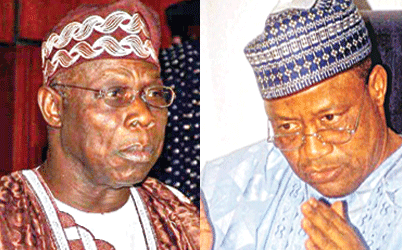
The centralised federalism puts a lot of power in the hands of the president. It even enables the president, rather than the people, to determine who becomes the next president. The only thing it has failed to achieve so far is to allow the president to stay in power beyond two terms. On the other hand, it does not permit the president to govern effectively. This explains why most federal infrastructure in the states are poorly run and maintained. But in spite of this proven failure, Obasanjo and Babangida insist that centralised federalism is one of the “settled” issues of the Nigerian polity!
The system that Gowon, Obasanjo and Babangida foisted on Nigeria is irredeemably doomed to failure. It is a system that can neither develop nor collapse. We have One Nigeria, but where are the One Nigerians? Unfortunately for us, there is no easy way of arresting the situation, as those who feel they have the advantages will always block our best efforts.
As failed leaders, Obasanjo and Babangida should emulate Gowon who now organises prayers for Nigeria.
Disclaimer
Comments expressed here do not reflect the opinions of Vanguard newspapers or any employee thereof.