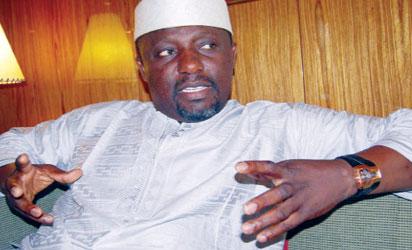
*Imo state Governor, Okorocha
By Ochereome Nnanna
WE read so much about the many new ideas that Governor of Imo State, Owelle Anayo Rochas Okorocha, has introduced since he mounted the throne vacated by Sir Ikedi Ohakim one year ago.
One of such innovations was the “commercialisation” of the Ministries, Departments and Agencies (MDAs), meaning they are to raise their own revenues and pay their own salaries in accordance with their efforts. I understand that most of these MDAs, used over the post-war years to sitting around and waiting for their salaries to come from the federation accounts, are unable to meet up with the commercialisation vision.
Since the 1970s when free oil money assured salaries for government employees and their political overlords, governance has continued to shrink, as government workers have lost the will or appetite to do basic work such as traffic control, sanitary inspection, teaching, maintenance of law and order, regulation of forestry and produce marketing, public works maintenance, agricultural extension services, taxation drives and what have you.
During the colonial rule and the early years of our independence, government used these activities of governance to raise revenue, assert government authority and make society a place worth living in. Government agencies competed favourably with private businesses for profit. Asking civil servants to return to this culture without any apparent retraining has come to many of them like forcing a person who has never seen a computer to log into a website; a beautiful idea forced down the throats of people ill-prepared for it. Asking civil servants to wear corporate uniforms to work sounds good but does the hood really make the monk?
Community tier of government idea
Another excellent idea introduced by the Rochas government, but which is causing ripples among the various stakeholders is the Fourth Tier of government, otherwise known as the Community Government Council (CGC) initiative. I call it an excellent idea because (as those conversant with my works over the years will testify) I am an enthusiastic exponent of the creation of community government. One of the series of articles I have written to support this idea was entitled: Create regions, abolish states, LGAs (October 31, 2011 and November 14th 2011).
In a nutshell, I argued that in the envisaged amendment of the constitution to restructure the nation, eliminate high cost of governance and take government genuinely closer to the grassroots, there should be three tiers of government: federal, regional and community governments.
I was (and still am) of the view that the current states and LGAs were military creations meant to (a) unite the country against Biafran secession and (b) reward the winners of the civil war with units of governance such as states, LGAs and electoral constituencies as well as access to the federation account.
That is why the North has the largest number of states, local government areas, senatorial and House of Reps constituencies. They are followed by the West, with the core of secessionist Biafra (South East) having the least number of each of these political/economic units. My position is that forty two years after the civil war, and with the overwhelming high cost of governance, corruption and ineffectiveness of the current structural configuration, we need to retrace our steps to the pre-war outlook.
The local government system is a failed experiment. A clear evidence of this is that 27 states in the country have no elected local government councils. Even where elections take place, governors illegally dissolve such councils to suit their political interests, and nothing happens.
Apart from that, the joint state/local government account enables state governors to tamper with the federal allocations to local governments. A governor who opposes the abolition of the joint account once told me in an interview that he pays contractors with money from the state/local government joint account. Besides, the local governments mostly exist for the benefit of the town housing the local government headquarters.
The adjoining communities hardly have a taste of these benefits, in terms of employment of staff, distribution of amenities and even production of council chief executives.
Many such adjoining communities are forced to seem like conquered vassals of the communities housing the local government headquarters whereas in many cases (as in the case of Abiriba in Ohafia Local Government Area) no such conquest ever took place in history. With a stroke of the pen, virile and culturally proud communities were permanently consigned to struggle under the domination of rival communities. Police stations, the courts, prisons, health facilities, educational offices and other primary amenities are concentrated to the disadvantage of those who do not have the LGA secretariat in their domain.
The community tier of government idea is the panacea to resolve this problem. And that is why I applaud Owelle Rochas for coming up with it in his state. When it is effectively in place, each community will have its own government. The money that comes from the federation account to the local government purse will now go directly to the community governments to take care of their health, educational, infrastructural, agricultural and social welfare needs.
Would check corruption and crime
Corruption will be effectively checked by each community using time-tested methods. The town unions experiment, especially in Igboland, has shown how difficult it is for elected town union officials to embezzle community funds and go scot-free. With governance at the grassroots, local policing and controls will bring down crimes to minimal levels.
It will be much easier for local communities to decide for themselves the means of raising internal revenue to augment federal largesse to out-compete rival communities in raising the standard of living of their people.
Most importantly, government at the community level will attract the more virile, active population back home because there will be more employment and economic opportunities. People will go back to their communities, enrol their children in schools around their communities, and the dwindling fortunes of our local languages, dialects, cultures and values will be reversed.
It is because people like us grew up in our local communities that we can speak our dialects so fluently. We grew up with people who have become our life-long friends. Some of us ended up marrying into families we knew right from our childhood and primary school days. It has helped in no little measure to foster strong family ties and values.
The same cannot be said for our children who are forced to live outside their local communities and have thus lost everything: languages/dialects, cultures and connection to their native roots.
Good development idea but….
However, the Rochas idea has its many problems. The Community Government Councils (CGCs) cannot co-habit with the current LGAs. The LGAs have to give way before the CGCs can take root. And the Constitution of the Federal Republic of Nigeria 1999 has to be amended to do away with the ineffective, corrupt, colonising and money-guzzling LGAs. The money from the federation account goes to the LGAs constitutionally. Stakeholders in the LGA system have the constitutional right to resist (as they are doing in Imo State) the idea of splitting their money and their staff to service the CGCs.
Secondly, the Rochas idea of making the tradition rulers heads of the CGCs may cause more harm than good, especially in republican cultures of South East and South South. It may work in the Muslim North where the village or district head or emir is the political as well as religious leader of the community. It might even work in parts of the South West where the Obas and their Baales (village heads) already have a measure of complete traditional control.
In the East, even where monarchies have been part of history down the centuries (as the case of Abiriba and Arochukwu) they are at best republican kings. Therefore, the traditional rulers should be ceremonial heads with power over the cultural heritage of the people. They should mann the traditional courts and settle disputes the traditional way. They should also be the chief security officers of their communities accountable to the Governor, while the Council Government should be elected to take charge of governance and held accountable to the people.
Rochas is having problems pushing through his noble idea because of some of these improperly chewed details. He is going about some of these measures as if he is running a military government. He will continue to run into obstacles unless he adopts democratically more viable ways of approach.
Happily, Rochas seems to me to have a promising future as a political leader. He has ideas, passion, drive and ambition. He is a man to watch, and many are watching. It will be better if he articulates these ideas into an All Progressives Grand Alliance (APGA) Charter of Structural Reform and lobbies other political leaders to support a constitution amendment to enable them to be put into practice.
These were the qualities that made people like Chief Obafemi Awolowo and Mallam Aminu Kano stand out as political leaders. They articulated their visions of society and continued to preach for socio-structural reforms till they made their exit.
Nigeria needs leaders like Rochas who have brilliant ideas, but the ideas have to be properly chewed and aligned to our constitutional realities.
Disclaimer
Comments expressed here do not reflect the opinions of Vanguard newspapers or any employee thereof.