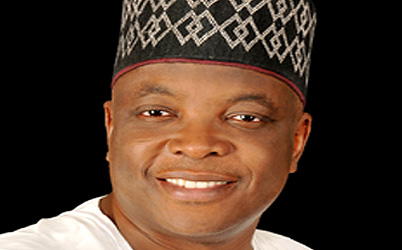
*Musa Babayo
By Jide Ajani & Henry Umoru
Dr. Musa Babayo is a banker and a founding member of the PDP. Babayo, presently the acting national secretary of the party, was first elected March 8, 2008 as deputy national secretary of the party.
In this interview, he bares his mind on issues affecting the PDP, why he wants to be the party’s national chairman, the removal of fuel subsidy and President Goodluck Jonathan administration, among others. Excerpts:
How has it been, first as deputy national secretary and now the acting national secretary of the PDP?
I have a rare privilege to serve in the National Working Committee, NWC, of this party in the last four years, first as the deputy national secretary of the party and now, by the special grace of God, the national secretary. The challenges have been quite exciting but, at the same time, I would say satisfying.
In the last four years, the opportunity that I have been given to serve at this level has given me some practical insights into challenges and opportunities before the PDP. And these issues, these challenges, I would say with humility, have given me an edge over others aspiring to lead this party after the national convention slated for March. So, by and large, I have, with the support of all my colleagues and other critical stakeholders of the party, been able to manage these challenges to the very best of my ability.

*Musa Babayo
When you said, challenging, do you mean managing the PDP?
Managing a political party as big as the PDP is a very daunting challenge taking into cognizance the fragile nature of our politics, the plural nature of our society and the size of the PDP as a political party. Today, the PDP, as we have always said, is the biggest political movement in the whole of black Africa.
No party has our kind of membership and therefore it is logical, no party has our challenges taking into cognizance the wider political environment. One of the major challenges facing us as a political party is the peak of collapse of internal democracy.
These is part of the negative realities on the ground and that has created so to speak some kind of a disconnect between the party itself, our membership and the generality of the Nigerian people. And this is the area which we will have to reform.
We have done so much in the last couple of years to put in place internal democracy, build the rule of law, transparency and integrity in our party management and administrative system, but we have not yet reached the desired level and our objective basically is to ensure that, in the next dispensation, we will totally address these problems so that the pillars which support the party itself, as a political party and as a party that is in power in Nigeria, will be transformed and begin to respond to the yearnings and aspirations of the people.
The second challenge basically is a challenge that is known to all because every organization that has a political party status has one fundamental problem: funding. Membership must rise to the challenge of funding the process.
That is when you will have virtually everyone moving in the same direction creating the kind of mass movement which Nigerians desire. And of course another challenge is an optimal strong intellectual foundation. You know party system needs to be managed by people who have skills and competency because whatever happens in the party system will be translated in the wider Nigerian political environment.
So you cannot afford to have a system that does not have a strong intellectual foundation because the chances are that you may have a level of disconnect between politics and polity and of course where there is that disconnect, it will have a great effect.
You want to be the chairman of the party but internal democratic structure of the PDP is questionable. How do you intend to address this when you become the national chairman?
There are two ways. The best way to begin a reform process is by building strong institutions. When the institutions are strong, the institutions that support internal democracy are strong, the chances are that people will begin to make a distinction between what is a personal opinion and what is institutional. If you begin to do it, the chances are that people might be hurt.
But if the focus at the initial state of the reform is building a strong institution or rebuilding them because the institutions are there, they have become comatose. In some cases, they are not there at all, you need to rebuild them.
When you rebuild those institutions, you define them for the generality of your membership and the critical stakeholders. People will really appreciate and understand that this thing is not personal and every change situation so to speak carries with it some elements of firmness because you are being asked to leave those things that you are used to, for something fundamentally new but something that, if you give it a trial, will impact positively on your life and the life of the organization and infact the entire country for which you are proud to be a citizen.
During the fuel subsidy crisis, you appeared grounded in the gospel of the subsidy removal. If you are to sell the idea of subsidy removal and deregulation to average Nigerians, some of whom will have to vote for you at the national convention, how will you want them to connect with that policy?
Some political tendencies have hijacked the process to achieve a satanic political objective. But I will talk of the economic factors before I talk about the politics. The economics of fuel subsidy removal has one underlining factor which, in my opinion, is the major policy thrust: The issue of equity, the issue of fairness in the allocation and distribution of resources among all the segments of the society.
The upper upper, middle middle, lower lower and down so that each and every person will that he is part and parcel of the resource allocation and distribution system of his own country. For example, in a typical family, maybe of 2 or 3, one has a car and the other doesn’t; the one who has a car is a member of this society with all rights and privileges compared to the other one by our constitution.
The one who has a car, each time he gets to the gas station to fuel his car, the fuel is being subsidized. Government pays him under the subsidy regime a certain equivalent. Maybe if he buys fuel at N2,000, he gets N2,000 subsidy. His brother at home gets nothing.
That is injustice. There is no equity in this, there is no transparency. You can expand that from a family unit to a ward level, to a local government level, to a town level and so on and so forth. The argument progresses like that.
On the political front, politicians hijacked the process because they wanted to demonize the government, they wanted demonize the PDP as anti-people. The objective was to make us unpopular, make Nigerians hate the policy of government which in the medium and long term is for their benefits and probably begin to make a decision for 2015 in 2012. The leadership is not about choices, but it’s about making hard choices.
President Goodluck Jonathan was not on a popularity contest with any other leader in this country during the fuel subsidy saga. He is a politician, he knows what the people want and do would do everything to prevent the economy from collapsing.
He staked his political leadership, his political potency, his popularity and everything to do what was required for the survival of the economy of this country and that clearly portrays him as a statesman. And I think if there is any litmus test about the seriousness and commitment of President Goodluck Jonathan to transform our economy and politics, it is the removal of fuel subsidy.
You will agree with me that there are still a lot of issues to be resolved in the PDP, crisis in the states, implementation of Dr. Alex Ekwueme’s report, Ike Nwachukwu’s report, among others. How do you intend to address these problems when you become the national chairman of PDP and how far have you gone with consultations?
The issues you raised about the party, the Ike Nwachukwu national peace and reconciliation committee, I had a singular privilege of serving in that committee as the secretary; so I have tremendous knowledge of the committee’s internal environment.
I know where we were, I know where we are now and I know where we are going. We have made tremendous efforts as I have earlier said to reconcile our various public, to reconcile our various chapters and other critical stakeholders and all our chapters nationwide. There is no zone of this country that the committee has not intervened.
We worked hard even in the southwest chapters to reconcile all the divergent opinions by bringing all the stakeholders together. What we had failed to achieve before election, I am glad to tell you that we have achieved after.
Like we mentioned, one of the critical reform elements before us now when I become chairman is to change some of those negative realities that I mentioned on the ground, the poor perception of PDP especially on election winning machine. We want to shift it to an issue based party that is based on first post and so on and so forth, in accordance with international best practices.
Painful that we lost our strength in the southwest, good that we considered them and we congratulated the winner and we have started the process of capturing them back by the special grace of God in the next election.
There is no chapter that I have not visited, there is no chapter that I have not intervened and analyzed the problems with various leadership and solutions that were recommended. On consultations, I have consulted widely and I am consulting on a continuous basis until after the elections and even beyond.
A party that we want to build is a party that is focusing on each and every membership. Of course we have critical stake holders both in the northeast and the national politics. Northeast was consulted and we have the required support.
It will be ill-modest for one to say I have everyone behind me, but substantial number of those who make critical decisions are with us, those that are not with us, we are working hard to bring them on board because only one leader can emerge at a time and looking at my antecedent even if it is limited to the party’s administration in the last four years, I am standing on a higher moral pedestal than the rest because as it is today by the special grace of God, and support of our leadership, we are managing the bureaucracy and general administration of this party on day-to-day basis. Advantage will hit the ground running.
One issue that is critical and I think important is in spite of all of the vilification of the PDP by our opponents and competitors, the party still stands in the best platform for the economic and political transformation of Nigeria.
And with the party’s leader, it’s the most visionary mode of President Goodluck Jonathan. The party now more than ever requires the leadership that has vision, that has courage, that has competence and character to complement the efforts of Mr. President in reforming and transforming this country.
Disclaimer
Comments expressed here do not reflect the opinions of Vanguard newspapers or any employee thereof.