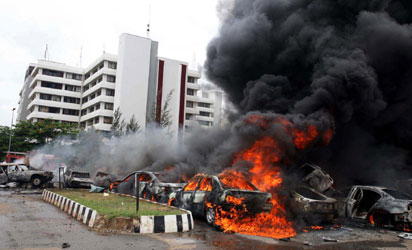
*The Nigeria Police Force Headquarters’ suicide bomb attack
By Ikeddy ISIGUZO:
SECURITY – everyone now talks about it, everyone seems to know what it is, everyone seems not to know what to do as the fear of the known dominates the land. Once, we dreaded armed robbers, kidnappers and a few mysterious blasts that our best experts could not explain.
Today security is about two words, Boko Haram. They meant nothing three years ago. Now, Boko Haram is everything about security. It issues threats and fires bombs as if that is the entire purpose of the sect’s existence. Boko Haram is enjoying the attention, hardly a day passes without it exploding a bomb.
People cannot go to church, to the market or have a drink without fearing a bomb would explode. Life has become almost impossible, not just in Maiduguri where it started but everywhere. It has adopted the propaganda to further its cause. Publicity is good for Boko Haram. Its precision in hitting targets is outstanding. Security officials on their part add to the Boko Haram mystery with their utterances.
Chief of Army Staff Lt-General Azubuike Ihejirika said at the opening of the Second Quarter Chief of Army Staff Conference in Abuja Monday, “The tactics they employ is relatively new to the country. The Nigerian Army have studied their method of operation (in collaboration with other security agents) and very soon the country will notice improvement and new security agreements.”
Boko Haram will cherish the credit from such high quarters. Nigerians may be frightened more. From the beginning, Boko Haram has benefited from loose security. It went ahead to instil fear in people. It’s purposely chosen targets served that aim. Strikes at the military and police were not mistakes. The freeing of more than 100 of its members from Bauchi Prisons was a show of the length it goes to protect its own and the vastness of its collaborators.
Fears of Boko Haram are pervading. Immediate past governor of Gombe State Danjuma Goje, a serving senator issued a prompt apology to the sect after one of its leaders mentioned him in a newspaper interview.
“As a true Muslim, who believes in peace and brotherhood, as entrenched in both the Holy Qur’an and the Hadith of the Holy Prophet Muhammad (SAW), I hereby tender my PUBLIC APOLOGY to the organisation for any wrong done to it in the course of performing my duty as the then Governor of Gombe State. We pray to Allah (SWT) to continue to promote Islam, peace and brotherhood for humanity throughout the world,” Goje’s recant read.
During the 2009 riots , Goje had said, “Anyone who kills must definitely die, no matter how. These people killed innocent souls just because they want everybody to be in their camp. I am a victim of their dastardly act as one of my cousins, a promising young man who was getting on top of his God_chosen career as a police officer, was killed by these people in Maiduguri. We should consider the tremendous work done by the security operatives and not over-stress the killings of the sect members.”
The security agencies cannot protect you; Boko Haram appears to be telling Nigerians. The security agencies need protection from Boko Haram.
“Who will guard the guards?” asked first century Roman poet Juvenal in his Satires (Satire VI, lines 347–8). The line was about marital rectitude, but has been used largely to question tyrannical governments for failing to apply privileges of position to the greater good.
More generous uses have extended to adoption of security measures to protect guards whose safety is critical to the security of others. We are at that point. We are throwing resources at a challenge we do not understand. Maybe, we do not want to apply the required measures for reasons of political survival.
When the first Boko Haram riot broke out in July 2009, residents of Maiduguri blamed the security agencies for ignoring reports to them on the sect. Has anything changed?
Maitatsine, a blend of religious zealots and remnants of the defeated armies in the Chadian wars, preceded Boko Haram. Its riots in Kano in December 1980 killed more than 4,000 people. The death of its leader quelled things momentarily. Other Maitatsine riots caused more deaths in Maiduguri and Kaduna in October 1982, in Yola in February and March 1984 and in Bauchi in February 1991.
When the army moved in, the matter was settled. There were no bargains, no committees, no dialogues.
Boko Haram arrives the scene with sophisticated weapons and bomb making technologies. Where is it getting them? Are the security agencies overwhelmed or the political leaders are unwilling to be decisive?
Committees will delay solving this challenge. Can someone ask former President Shehu Usman Aliyu Shagari how he dealt with Maitatsine? The times might have changed, but the need to make critical decisions remain.
Read more on how to combat Boko Haran by religious leaders
Disclaimer
Comments expressed here do not reflect the opinions of Vanguard newspapers or any employee thereof.