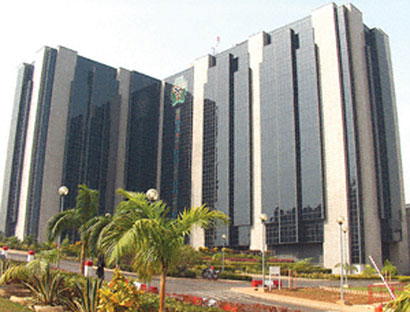
CBN Headquarters
By Innocent Anaba
When the Central Bank of Nigeria, CBN on August 14, 2009, announced the sack of the management of five banks, namely, Intercontinental Bank Plc, Union Bank of Nigeria Plc, Oceanic International Bank Plc, Finbank Plc and Afribank Plc and later three others, Nigerians reacted with mixed feelings.
The CBN equally said at the time it injected N620 billion into the eight banks. Barely two weeks of the CBN action, had its Governor announced moves to sell the affected banks to foreigners which was faulted by Nigerians, who raised serious concern over the implication of handing over key banks to foreigners. It had urged the banks to merge with other banks. Access Bank had initiated move to merge with Intercontinental Bank.
Some shareholders of the affected banks had gone to court, praying the court to protect them from the calamity that may befall them if the banks were allowed to be sold under CBN watch. In one of the cases, Justice Okechukwu Okeke of the Federal High Court, Lagos, on Monday, May 31, restrained the CBN from selling or taking steps or further steps to dispose of or sell in any manner whatsoever, Intercontinental Bank’s investments and other assets, including but not limited to the bank’s business operations and affairs to Access Bank Plc.
The judge also restrained Access Bank by itself or through its agents, servants, officials, privies or any of its associated company or companies or subsidiaries, whether directly or through any special or other purpose vehicle from howsoever acquiring or taking any step to acquire, buy or purchase or in any manner Intercontinental Bank’s business, operations and affairs or in any manner whatsoever having the shareholding structure of the bank altered in favour under and pursuant to the purported memorandum of Understanding said to have been executed or to be executed on behalf of the Bank and Access Bank and headed “Draft 06.02.11 or nay such like agreement and/or understanding pending the hearing and determination of a motion on notice for orders of interlocutory injunction filed by Dr Erastus Akingbola and Bayo Dada.
The judge adjourned till June 8, 2011 for hearing of the motion on notice.
The order by the court was sequel to a motion ex-parte by Onyebuchi Aniakor on behalf of the former Managing Director of the Intercontinental Bank Plc, Dr Erastus Akingbola and his aide and Director in the bank, Dada.
Defendants in the suit are Intercontinental Bank Plc, the Managing Director, Mahmoud Lai Alabi, Abubakar Sule and Gbenga Alade, Olusegun Osilowo, Suleiman Yusuf, Dr Raymond Obieri, Alhaji Isyaku Umar, Ikechi Kalu, Elder Sanni Adams, Access Bank Plc and CBN.
Akingbola and Dada in the substantive suit, want the court to declare that given the provisions of section 36 of the 1999 Constitution, the governor of the CBN or any other body or authority inclusive of the CBN cannot validly direct that Dada cease directly to serve as director of the bank without giving the plaintiff a hearing thereon.
They also want the court to set aside, nullify or invalidate all and any step or decision taken by the defendants, the CBN and/or its governor in the affairs and business of the bank from the said August 14, 2009 till date other than those in the ordinary course of the day to day business and operations of the Bank.
In another suit, a Federal High Court sitting in Lagos, on May 17, 2011, also restrained Finbank Plc and First City Monument Bank, FCMB, from taking further steps on a purported Memorandum of Understanding, MoU, for business combinations recently signed between the two banks.
The CBN appointed management of Finbank had gone into the MoU, which the shareholders are contending was injurious to their interests. Former Managing Director of Finbank, Okey Nwosu and a former Executive Director of the bank, Dayo Famoroti, brought the suit as shareholders of the bank. The court also restrained the two banks from altering the shareholding structure of Finbank in favour of FCMB and the order is to subsist pending the hearing of the substantive suit.
Even though Nwosu and Famoroti were among top bank chiefs removed by the CBN, in the wake of banking reforms embarked upon by the current management of the apex bank, they are challenging the propriety of the MoU signed by Finbank and FCMB without recourse to them as shareholders of Finbank.
They claimed that they were shocked to discover through newspaper publications that Finbank and FCMB had already signed MoU for business combinations under the active supervision of the CBN without recourse to them as shareholders of Finbank.
The plaintiffs added that when they made further enquiry, they discovered that it had already been agreed under the purported MoU that the entire capital of Finbank will be cancelled, and that the bank will be dissolved without winding up. They further alleged that ever since taking over the affairs of Finbank, the CBN-appointed management had been running the bank in an oppressive and illegal manner without recourse to shareholders and their shares.
They are therefore urging the court to mandate Finbank directors and CBN to render the account of their dealings in the bank ever since they took over the day to day running of the bank. They also want the court to direct that a general meeting of Finbank should be conveyed for the purposes of considering the account of the stewardship of the CBN-imposed management in the bank and also to elect directors out of the shareholders.
They are also seeking an order restraining the respondents from disposing the investments and assets of Finbank including but not limited to the business operations and affairs to FCMB or any other similar entity.
In another suit instituted by some shareholders and directors of Afribank they are challenging the take over of the bank by CBN, the court dismissed the preliminary objection by the apex bank and it’s Governor, challenging the suit. Trial judge in the matter, Justice James Tsoho, held that the plaintiffs have the locus standi to bring the suit, having established that action of the apex bank in taking over the bank was in bad faith, discriminatory and arbitrary.
Trial judge in the matter, Justice James Tsoho, referring to Section 309 of CAMA, said “it can hardly be denied that the 2nd-6th plaintiffs are covered by the definition in section 309 of CAMA. In view of this and the guarantee of fundamental rights under the 1999 constitution I completely agree with counsel to the plaintiffs that they should not be peremptorily chased from the temple of justice on the perception of not showing strong connection.
“Beyond this, however, is the question whether the 2nd-6th plaintiffs fulfilled the condition precedent for instituting this action. It is trite law that Section 53 (1) of BOFIA has put on the plaintiffs the initial burden of bad faith in order to provide the basis for the court to assume jurisdiction.
It has been held that by that section, it is to be presumed that an administrative act has been reasonably and honestly done until the contrary is proved. In the instant case, the 2nd-6th plaintiffs have asserted that the averments in paragraphs 7-18 of the affidavit in support of originating summons constitute strong evidence of bad faith by the CBN and its Governor, it is deemed pertinent to reproduce some paragraphs of the affidavit in support of the summons to enhance clarity.
In that regard, paragraphs 5, 6, 7 and 15 of the said affidavit are most relevant and are reproduced thus, that on or about August 14, 2009, CBN governor proceeded to claim to have removed the Managing Director and Chief Executive Bank and to have these persons replaced with the 3rd-13th defendants in the absence of any lawful order.
“That the conduct of CBN and its governor have been unfair, prejudicial and discriminatory to the Bank. The said Special Examination Report were claimed to have been conducted over and in respect of all the 24 Licensed Banks in Nigeria. In at least three of the banks, the management and the shareholders were allowed by CBN and its governor to have the benefit of considering and taking necessary steps upon the recommendations contained in such Examination Reports.
In the case of Equatorial Trust Bank, the shareholders were even allowed to inject additional capital. The foregoing in my humble view are strong allegations of arbitrariness, discrimination and lack of openness by CBN and its governor in the discharge of their duties towards the plaintiff bank, in which the 2nd-6th plaintiffs have interest.
“I am of the respectful opinion that this constitutes positive and particularized allegations of bad faith that sufficiently provides the basis for the Court to assume jurisdiction in the plaintiff’s case. I hold, with all due respect, that despite the powers given to CBN by Section 35 of BOFIA to regulate and control the business of banking, when the exercise of such powers would fundamentally affect interested parties, there should be disclosure.
Besides, protection given to CBN by Section 53 (1) of BOFIA is not absolute. In the present case, I am convinced that the 2nd-6th plaintiffs have discharged the burden placed on them to show lack of good faith towards them and the 1st plaintiff in the exercise of statutory powers conferred on CBN and its governor and therefore, this court has jurisdiction to entertain the plaintiff’s case.
“In conclusion, I most respectfully hold the considered opinion that the 2nd-6th plaintiffs herein have shown by the affidavit in support of the originating summons and the exhibits attached thereto that they have locus standi to sue, their action is justiciable and have met the condition precedent for the commencement of a derivative action and hence they have a reasonable cause of action,” the court held.
Disclaimer
Comments expressed here do not reflect the opinions of Vanguard newspapers or any employee thereof.