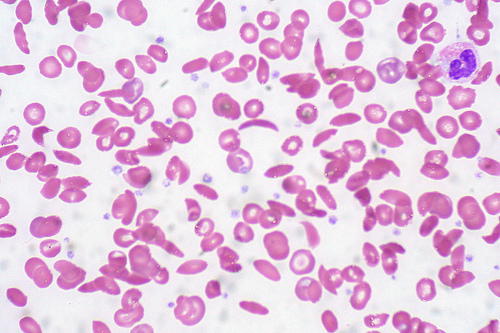
At last, one of the long-standing mysteries of biomedicine may have been resolved. A publication in the latest issue of the journal Cell tells of a study that challenges currently held views,about the molecular mechanism whereby sickle cell hemoglobin confers a survival advantage against malaria.
These findings open the way to new therapeutic interventions against malaria, a major disease of medical, social and economic significance.
Medically, the cause of sickle cell anemia was attributed unequivocally to a single base substitution in the DNA sequence of the gene encoding the beta chain of hemoglobin, the protein that carries oxygen in red blood cells.
Only those individual that inherit two copies of the sickle mutation (one from their mother and the other from their father) develop sickle cell anemia. If untreated, these individuals have a shorter than normal life expectancy and as such it would be expected that this mutation would be rare in human populations. This is however, far from being the case. Observations mid-20th century revealed that the sickle mutation is, in fact, highly, selected in populations from areas of the world were malaria is very frequent, with sometimes 10-40 percent of the population carrying this mutation.
Individuals carrying just one copy of the sickle mutation (inherited from either the father or mother) were known not to develop sickle cell anemia, leading rather normal lives. However, it was found that these same individuals, said to carry the sickle cell trait, were in fact highly protected against malaria, thus explaining the high prevalence of this mutation in geographical areas where malaria is endemic.
These findings lead to the widespread believe in the medical community that understanding the mechanism whereby sickle cell trait protects against malaria would provide critical insight into developing treatment or a possible cure.
Several studies suggested that, in one way or another, sickle hemoglobin might get in the way of the Plasmodium parasite infecting red blood cells, reducing the number of parasites that actually infect the host and thus conferring some protection against the disease. The IGC team’s results challenge this explanation.
In painstakingly detailed work, Ana Ferreira, a post-doctoral researcher in Miguel Soares’ laboratory, demonstrated that mice obtained from Prof. Yves Beuzard’s laboratory, that had been genetically engineered to produce one copy of sickle hemoglobin similar to sickle cell trait, do not succumb to cerebral malaria, thus reproducing what happens in humans.
When Prof. Ingo Bechman observed the brains of these mice he confirmed that the lesions associated with the development of cerebral malaria where absent, despite the presence of the parasite.
Ferreira went on to show that the protection afforded by sickle hemoglobin in these mice, acts without interfering directly with the parasite’s ability to infect the host red blood cells. As Miguel Soares describes it, “sickle hemoglobin makes the host tolerant to the parasite.”
Miguel Soares and his team believe that the mechanism they have identified for sickle cell trait may be a general mechanism acting in other red blood cell genetic diseases that are also know to protect against malaria in human populations:
Disclaimer
Comments expressed here do not reflect the opinions of Vanguard newspapers or any employee thereof.