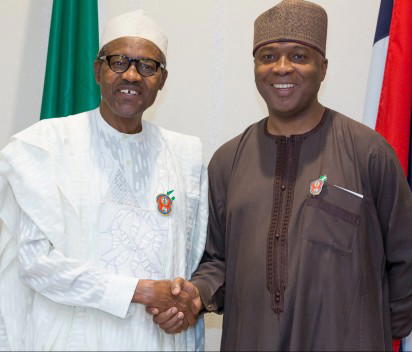
Dinner with Senators 1: President Buhari exchanging compliments with Senate President Bukola Saraki as he hosted Senators to Interactive Dinner at the Presidential Banquet Hall in Statehouse on 25th Nov 2015
By Chidi W Nwachukwu.
It is always common for analysts to recommend constitutional amendments virtually on every public discourse on Nigeria’s development, while they hardly discuss lack of open governance in our leadership, a culture that is impeding developments and hurting our people especially the poor. Agreed the constitution may require amendments sometimes to correct some anomalies, but what about compliance?. It supposes that even if we have the best constitution in the world, it still makes no sense if they cannot be complied with. The quickest that comes to mind is the fundamental Rights Provision under the chapter four of the 1999 Constitution. This provision has been observed more in the breach as suspects or accused are still been detained for as long as possible by the whims and caprices of powerful individuals with police collaboration. People are still been deprived of their liberty and many other provisions that are violated daily.
Even when courts grants bail to suspects or accused sometimes, they are still been held by security agents, this is evident in the cases of Dasuki Sambo and Nnamdi Kanu. Amending a constitution or any law may require some rigorous legislative process and endless political debates, but if people in charge of government business can be a little open and transparent, governance will do better without this pile of bills in the National Assembly daily.
Open governance principle require that government will be open in all its dealings with the people especially in an environment where majority are illiterates and may not have easy access to those that govern them. Governance is a collaborative engagements between the government and the governed for effective dividends delivery. It becomes even more than necessary in a multi-ethnic makeup as Nigeria with often flawed electoral process that produces unfavourable self serving representatives.
The people becomes partners who give information to government as it affects their immediate environment for effective policies either in the area of security or for the provision of physical infrastructures. It equally includes that elected officials and Government people should throw their doors open to whoever wants to interact with them on issues of importance, rather than build Chinese walls around themselves immediately after assumption of office.
Let me also state that open government policies no longer refer to those that only promote accountability. New modes of citizen engagement and new efficiencies in government services now share the spotlight with the older goal of governmental accountability, which once had this felicitous phrase all to itself. In an attempt at legislating for an open governance policy the Jonathan Administration passed the freedom of Information Act 2011.The Act generically empowers any Nigerian to access any information without hindrance from any government institutions.
What is left to be seen is the favourable collaborative efforts with those who will make these information available, in this case the civil servants and the likes. I recall that sometime ago someone requested from the budget department of the National Assembly, the National Assembly budget of the previous years, I was disappointed at the kind of response she got. For many who work in the National Assembly it is one document that is not in the public domain and demanding for it was like asking for the impossible. Even though she was asked to put her request in writing, she still hasn’t t received any response as I write even though its over two months now.
The importance of open governance cannot be overemphasized especially in Africa nay Nigeria. In 2015, South Africa became the co-chair of the Open Government Partnership (OGP), an initiative launched in 2011 to encourage governments to become more open, accountable and responsive to citizens . Growing from eight countries in 2011 to 66 countries in 2015, the OGP has an ambitious international agenda that chimes with evolving political theory and policy approaches to technology, governance and citizenship. Eligibility to join the OGP is determined by a country’s performance in four key areas: fiscal transparency, access to information, public official asset disclosure and citizen engagement.
Nigeria is not yet a member of the open Governance Partnership, OGP for reasons that are quite obvious especially in the area of citizen engagement and fiscal transparency using the constituency projects allocated to the Federal lawmakers each Budgetary year. This is particularly interesting to me given that Federal and State governments often attract mountainous criticisms for failing her citizens in the areas of minor infrastructural provisions such as Boreholes, solar powered electricity, primary health facility etc. while little or nothing is said about the legislators.
A cursory look at the previous appropriations reveals that each Senator or House member is allocated certain amount of money often in hundreds of millions for purposes of meeting their constituents pressing needs. Each project depending on the nature is domiciled in the relevant government Agency for execution.For instance, roads projects are usually domiciled at the Ministry of works. The ministry after due diligence, ie advertising the jobs, award them to the appropriate contractors who may have met all the criteria.
The unfortunate thing however is that the communities involved are never aware that such projects have been made to be executed in their communities nor disclose the names of the contractors to them for follow ups. And there are several cases where some of these contractors never executed the jobs or the jobs are implemented only about 15% which is almost nothing, and no questions asked. There is need for the National Assembly and relevant Agencies to ensure that Communities are made to know about projects allocated to them as well as the contractors involved so as to hold them responsible in event of failure.
There are several communities today still in darkness while they were meant to have had electricity long time ago , others for roads, boreholes etc. They had no one to ask especially when such a community don’t have strong political figure to speak in their behalf.
There is no doubt that if all the constituency projects since 1999 were implemented most of our communities will not be in the current terrible state they are today, no water, electricity, good roads, health facility. This is a huge challenge for the civil society organisations in Nigeria by educating the people and engaging both the Federal, State and Local Governments in this regard.
It will be recalled that in 2013, following contested consultations with civil society organisations, the South African government made a commitment to addressing the ‘grand challenge’ of open governance by adopting an OGP Action Plan. Specifically, it made a commitment to strengthening public integrity by improving public services, creating safer communities, effectively managing public resources and increasing accountability.
The concept of Open governance was first coined in the 1950s,however it has recently gained momentum in political theory and policy as a result of shifts in technological innovation and the corresponding generation of data; understanding the relationship between development and open governance has also gained importance in international political and policy discourse, and Nigeria must key into it to address the country’s stark socio economic inequalities as well as strengthen its democracy.
Nwachukwu,a Lawyer and Development Strategist is the Senior Legislative Aide and Special Adviser on Research and Strategy to Senator Ben Murray-Bruce
Disclaimer
Comments expressed here do not reflect the opinions of Vanguard newspapers or any employee thereof.