By Obi Nwakanma
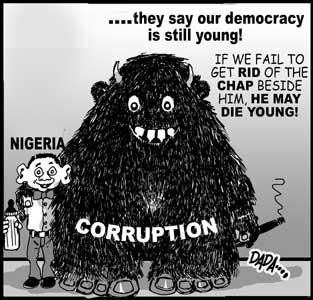
Stealing is not corruption. Stealing is a crime punishable in law. Corruption is logically the inability of the institution, or the perversion of the institutions established by law to prevent stealing, or punish it when it happens.
Although they constitute the same sense of an aberration, they are nonetheless mutually exclusive in the sense that one is the act itself, and the other is contingent upon the act. In other words, corruption is a condition a posteori to the a priori act of stealing.
For the benefit of the less philosophically minded, I’d like to put it as simply as possible. Take the question of stealing: by definition, it is the illicit dispropriation of the individual of property, either by force or by stealth, or the appropriation by stealth or guile of the commonweal in the furtherance of an individual’s property stock, and usually at the expense of the other.
Privatization of Nigeria’s public property is stealing sanctioned and sanctified within an inner circle of government. Were the regulatory and institutional powers of the state forceful and active, those who supervised this massive dispropriation of Nigeria’s public wealth without regard to consequence, and in the furtherance of narrow interests, should have been brought to trial, sent either to long term prison or to the gallows.
 But because these institutions are fundamentally weak, complicit, and in many regards are themselves designed to be subversive of their own intentions, it is impossible to investigate, sanction, and enforce laws that ought to prevent crimes against the state or against the individual citizen.
This is the meaning of corruption. The corruption of the institutions of the state is the question – a far more fundamental question – that we as citizens ought to engage with because it is the basis of the criminalization of the public mind. It is also the basis for the loss of what we call “national consciousness.” National consciousness simply is that situation of profuse and perhaps even sometimes inarticulate sentimentality, when citizens collectively and individually agree with, or “buy-in” into the idea of their nation as the protector, provider, and defender of their rights and privileges; their common interests; and with that consciousness comes “duty and obligation.”
Most Nigerians today are cynical about the meaning of Nigeria because Nigeria is fundamentally a corrupt state, and are therefore willing to subvert it by any means necessary. This includes the Nigerian intellectual, who speaking in a foreign radio, calls for the external invasion of Nigeria. Such an intellectual is profoundly corrupt. Part of the means by which individuals subvert the state is by corrupting its systems. In other words corruption is a crime against the state. The Chinese for example take it seriously: they put corrupt people before the stakes and shoot them. Corrupt people are those who pervert the civic institutions of nations.
The Chinese understand that corruption is a virus that grows quickly and could only be contained radically. Again, let me make clear distinctions: a corrupt state is that state where the institutions designed to protect the state itself are fundamentally, and perhaps deliberately subverted or limited; made so in other to create leakages and leeway for the few operators of the system to appropriate and enjoy undue advantages of power over the rest of the people. It invests power on the individual rather than the institution which the individual supervises.
These leeway and leakages create gaps of meaning and a chain of actions that subvert the capacity of the state to regulate and punish diligently and to prevent autarchy. Nigeria is corrupt because its judicial system is weak and arbitrary. Its civil service is byzantine and obtuse. Its institutions of law enforcement are predatory and introverted; and its entire social fabric has been weakened by poverty and alienation.
The democratic system is conditioned by the rule of law, and the government itself is designed around three epicenters of common action: Law making, the highest attribute of the republic; the interpretation of the law, the very foundation of justice itself, and its execution, the basis of all responsible governance.
But responsible and responsive governance are impossible where the three function arbitrarily, or where, either is weakened, or dismantled by the other. Official corruption is possible – meaning government officials can only get away with stealing from the state – because the Nigerian system is too weak and distorted to prevent this. Indeed, the system Nigerians designed to govern themselves encourages the individual to be corrupt.
For example, the approbation to the office of the President and the offices of the Executive Governors of the states in Nigeria of what we now call, “security votes” – a slush fund that is sealed by legislation – is an exact example of state sanctioned corruption. It is the misuse of the rules of appropriation. A legislature that appropriates public fund without requiring an open account of such a fund, sanctions stealing.
In other words, if the Lord Jesus Christ were to return and be elected to an executive position in Nigeria, he too will be mandatorily corrupted by the Nigerian system. Buhari’s supporters, for instance retail his “anti- corruption” bona fides. But for as long as the system itself is corrupt, Buhari will be corrupt, if he is elected to run that same system – because it will be in spite of him. A system of laws that grants absolute immunity to the executive office of the president or the governors, basically provides legal grounds for corruption.
Meanwhile, though Nigeria has requirements for public officials to declare their assets publicly before a magistrate or notary prior to assuming public office, the same law prevents public access to such declarations, nor grants a magistrate the investigative powers and autonomy to open independent inquiry into issues of illegal acquisition. That is the meaning of corruption.
Government officials may not want to steal, the system makes thieves of them. Nigerians, who out of sheer idealism, attempt to live above the corrupt state are often portrayed in the public imagination as “fools” or “idiots” because they refuse to participate in the systemic subversion of civilized values. Let me also note this: corruption is not unique to Nigeria.
What is unique is the willingness of Nigerians to tolerate and even themselves generally participate in processes that undermine their own general interest. If the enforcement of the rule of law is weakened, the state whether under a military or civilian leadership, becomes arbitrary. A judiciary that cannot deliver judgment on a simple election dispute four years after the fact, is corrupt.
A court system that makes no provision for a jury of one’s peers is a tyrant’s court. Nigerians like me put our lives to risk in the struggle for a return to the democratic system only on the single principle that there will be checks and balances of the institutions of power that might limit executive overreach and the corruption of the system through clearer legislative oversight. And this is the point of this article: if Nigerians wish to contain corruption, they have a chance to elect incorruptible law makers who must see the fuller picture of the impact of the subversion of the state as a result of systemic corruption.
Only an active and forward looking legislature can rebuild Nigeria, and contain executive excesses. A president may not personally be corrupt, the institution which he runs may be and that will ineluctably corrupt the individual. Nigerians should therefore focus on the larger question of systemic corruption as a means of containing individual corruption of the system. The answer lies in law making and law enforcement. We must elect people into parliament in this election cycle, who deeply understand the implication of these issues in public governance.
Disclaimer
Comments expressed here do not reflect the opinions of Vanguard newspapers or any employee thereof.