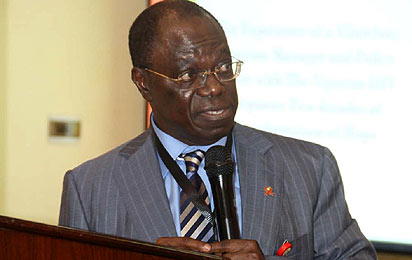
*Professor John Idoko.
By Victoria Ojeme
Almost 15 years after Dr. Jeremiah Abalaka’s claims of developing curative and preventative vaccines for HIV/AIDS were rejected, the ruling by a Federal High Court sitting in Makurdi, Benue State, that the ban on the vaccine was illegal and inconsequential, has reopened a new wave of commentary on the controversy.

*Professor John Idoko.
In May 2000, Nigeria was caught in the grip of controversy over Abalaka’s unproven claims that he discovered a cure for HIV.
Although several stakeholders have commented on the development since the ruling in January 2015, reactions continue to pour in from a widespectrum of the society.
Director General of the National Agency for the Control of AIDS, NACA, Prof John Idoko, in a reaction, dismissed the issue. “My comments here are very short. In science discoveries are not disclosed or promoted in the court.
Judgment: “I have never heard in my history of several years in medicine that a new discovery was endorsed by a court. That is not the way science goes.
“My feeling is that we have gone past that as a country. Talking about Abalaka is taking us 10 years back,” he asserted.
Asked if the judgment is not acceptable, Idoko said: “ I am not interested in judgment. I am interested in science. And I am telling you that there has never been any time scientific discovery came out of a court.”
On the Agency’s plans for 2015, Idoko said they were preparing for a budget defense.
“We have not done any national survey beyond NASS which was in 2012 when the population prevalence was 3.4 percent. I understand that the result we have is the one of 2010. We have also been doing a lot of testing far more than the number of people tested in these surveys.
“This year under our MDG programme where we do multi-disease campaign. We tested 43,000 people in 13 states the most burdened states in the country and we had a prevalence of 2.8 percent.
We have 43,000 people in the most burdened states, giving us an indication that the prevalence is indeed coming down.
Two, NACA supported the development of the concept notes for global fund. The global fund has approved, (though I am not sure of the figures) some new funding that will take us to 2017. I think it is in the region of over $300 million.”
Idoko recalled that the Agency supported the launch of the plan for the elimination of mother to child transmission.
“We have a new plan which will take us to 2016 and we hope to start implementing that plan. A total of 2.4 million people were counselled, tested and received result, and 673,000 people, adults and children received anti-retroviral treatment in June 2014. So by now we have over 700,000 people on drugs because this result is for June. A total of 34,589 women received ARVs for the prevention of mother to child transmission as at June 2014.”
Idoko observed that the call centre was very active in 2014, was accessed by over 47,000 users and it helped during the Ebola crisis.
“During Ebola, thousands of people called the Call Centre. We started implementing the President’s Comprehensive Response Plan, PCRP, using funds from Sure-P.
Under the NACA Sure-P programme, we did the HTT outreach which commenced in December last year and we did community outreaches to six states. Sure-P has four main interventions. HTT, treatment, PMTCT and maps.
Òn HTT, the target is five million. We want to test five million people. For ART, we are working in two states. We are almost there and just at the point of signing the agreement.
Challenges: “One big challenge is funding, it is recurrent. Two, is insecurity. This is because we have not been able to provide services in some of these places. Other issues are structural in nature. For example, it is very difficult to reach women to bring them to ANC, it is a big issue for us.
State ownership and leadership is still very poor. You know everybody is expecting the federal government to bring money. The Federal government cannot do everything. The states are not bringing money. We have not been able to source money from even the private sector and all that.
Ownership and leadership
But very importantly, the state must take ownership and leadership. Ownership and leadership is not just with mouth. They have to contribute money, human resources and all that, but that is lacking. That is a major thing for us.
Idoko described the research landscape as poor. “We need evidence to be able to achieve that. Another issue for us is that, unlike previous years, money coming for funding from foreign donors is declining. They are not withdrawing but the amount of money is declining and that is a big issue for us given that 80 percent of the response is supported by donors.
“We intend to continue to put more people on drugs. For example, we got our money late for Sure-P. So this is what is going to happen. We got the money like November/ December. So all those things we were supposed to do last year, are going to happen in this New Year.
“That is why I am saying our hope is to put 50,000 people on drugs. We will test five million, we have started, and we will just continue to test people.”
Disclaimer
Comments expressed here do not reflect the opinions of Vanguard newspapers or any employee thereof.