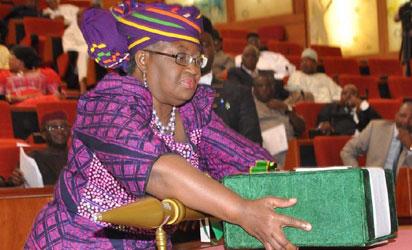
File: Okonjo-Iweala
By Dele Sobowale
“The Debt Management Office has advised commercial banks against offering short term loans to state and local governments across the country.” Everest Amaefule, PUNCH, October 24, 2014, p 32.
Although we cannot give the specifics of what the government should do, we can at least give an indication of what should be done. They should let Nigerians know that hard times are coming. How will the government carry us along?” Mr Segun Oshinowo, D-G, Nigeria Employers Consultative Association NECA.
For close to a year now, warnings have been given on this page regarding the impending economic reversal which will affect Nigeria – starting now. The reaction from my Fellow Nigerians had ranged from absolute indifference to a collective snooze. The man speaking in the wilderness, apparently to weeds, had a better audience than this columnist writing in the VANGUARD. I might as well be talking to trees myself. But, suddenly, everybody, except President Jonathan, the Federal Minister of Finance and other card-carrying members of the PDP have come to the realization that we are headed for deep economic trouble –starting now.
The directive to banks, to refrain from lending on short term to states and local governments, amounts to a death sentence on those two levels of government. In fact, the Board of Directors of commercial banks need not have waited for the DMO before restraining their managers from granting such loans –especially to states whose governors are on their way out. The incoming governors might be forced to disclaim those loans. Most, if not all, the states of Nigeria had been existing on over-drafts granted by banks for most of the year as crude oil revenue fell consistently below projections. As at this month, several states are owing their staff one or two months salaries – even as they head to the end of October when there will certainly be another shortfall in the allocated revenue from the Federal Government. Without short term loans from commercial banks, civil servants across Nigeria can only expect a bleak fourth quarter of the year.
As everybody knows, with the exception of four states — Lagos, Rivers, Kano, Kaduna – all the other states of Nigeria are federal allocation revenue dependent. They are all what I classify as “Civil Service States. None can, like Lagos under Bola Tinubu, defy the Federal government and operate for two months or more without funds from Abuja. Well, Abuja funds are declining. APC Governors, irrespective of their motives, have joined in raising the alarm that trouble is brewing. Their PDP and APGA colleagues, obviously for political reasons, have not joined the chorus. They delude themselves. States like Ekiti, Gombe, Taraba, Adamawa, Kwara, Ebonyi, Kebbi, Cross River and Kogi will soon become so cash-strapped nobody can keep their civil servants from joining the revolt against the conspiracy of silence being championed by Jonathan and Okonjo-Iweala.
Once again, let us recapitulate the reasons we find ourselves in this predicament – none of which will go away in a short time and some of which will get worse over time.
First, global demand for crude oil is falling on account of slow GDP growth in the nations which constitute the engines of global economy. Despite recent improvements, the US economy is still not as robust as it should be. That ordinarily should have resulted in lower demand for crude. Unfortunately, the USA, once Nigeria’s largest customer, no longer imports crude oil. The world’s largest economy had become a big exporter of crude and refined oil and its producers are not in the global market for the short-term. They are here to stay and to expand and dominate the market. To dominate the market they will have to gain market share; meaning dislodge existing suppliers of crude. Nigeria is a prime target for that attack.
Second, it would have been bad enough if we have only the US as a new competitor. But, several countries, which were oil importers, as late as five years ago, have now joined the league of oil producers. They not only reduce the market potential for export for good, they contribute to the glut which is responsible for the current plummeting crude prices. Some of them are just starting and they intend to increase the supply to the global market over time.
The Middle East had been in turmoil for several years and that had curtailed supply. But, nations like Iran, Iraq and Libya, which had lost out, on account of political turmoil are eager to beef up their depleted foreign reserves – even if the have to sell at deep discounts. That again will take some time.
Mr Godwin Emefelue, Governor of the Central Bank of Nigeria, CBN, in an address to the Chartered Institute of Bankers, on October 18, 2014, admitted that the drop in oil prices “presents some risks to the country”. That is understandable under-statement from the person charged with the nation’s monetary policy. Nobody, in his right senses, expects the CBN Governor to raise an alarm because that will certainly trigger capital flight. The man is doing his job. However, Mr Emefelue will understand that members of the Fourth Estate of the Realm, the Media, also have a job to do. We cannot wrap in diplomatic language truth which is stark and unrelenting until it hits Nigerians like a hurricane suddenly. We have a duty to warn our people that danger looms and state as well as local governments, and their workers, will feel the impact first starting NOW.
Disclaimer
Comments expressed here do not reflect the opinions of Vanguard newspapers or any employee thereof.