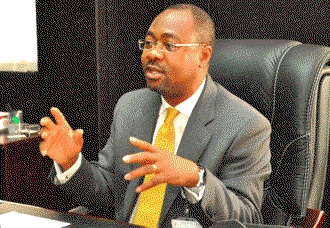
Professor Sylvester Monye, in line with the guidelines of the Peoples Democratic Party, PDP, resigned, last week, as Special Adviser to President Goodluck Jonathan on Performance Monitoring and Evaluation to enable him contest the 2015 gubernatorial election in Delta State.
 In this interview, Monye bares his mind on the achievements of the Jonathan administration and the president’s endorsement for re-election, among other issues. Excerpts:
By Umoru Henry
You just resigned as the Special Adviser to the President on Performance Monitoring and Evaluation. How was the office while your tenure lasted?
I had a very good run. I enjoyed every single day of my assignment. The job of Special Adviser to the President on Performance Monitoring and Evaluation is a particularly exciting one, it gives you a helicopter view of how this country has evolved over the last few years.
It gave me the opportunity to put substance to some of the plans government has developed over the years and track the processes as well as the outcomes.
And I am very delighted that the president gave me the opportunity to play this very important role to the extent that, today, one is able to tell you what is happening across the length and breadth of the country. So it has been excellent.
Where are you going from here?
I am going to Asaba in Delta State having picked my form.
What form?
The governorship form.
You have worked closely with Mr President. How do you describe his kind of person? And the three organs of the PDP; the National Caucus, the BOT and the NEC, plus the governors at the 66th NEC endorsed him as the sole candidate of the party ahead of the December 6 national convention. What is your take on the endorsement?
First of all when the President started, he took his time to make the right decisions. If you start from the quality of his cabinet and the capacity therein, you will see that this cabinet must rank as one of the best ever put together by a Nigerian president.
What that tells is that for you to achieve anything, you must have the right people. He started by putting the right people in place, there has never been any question whatsoever as to his decisions vis-à-vis the quality of his cabinet.
Now, where you have that caliber of cabinet that has been painstakingly put together, it was only a matter of time that you begin to see the results of that decision. Today, Nigeria ranks as the 26th largest economy in the whole world.
It is the number one economy in Africa. It is one of the best managed economies in the world. In fact, it is the third fastest growing economy in the world after India and China. So we have a formidable team that has delivered on that.
Now you can say that I would probably give you this answer because I work for Mr President. But the truth of the matter is that everything that I said has been validated by credible international institutions like the World Bank, the IMF, Standard and Poor’s and Fitch Rating agencies. So it is not a case of whether it is correct or it is not correct. It is correct, it is undisputed.
Two, agriculture. You cannot have a happy population if they are hungry and the President said that, in a few years time, we will no longer import food, we will have surplus; in fact, Nigeria will export and we are very close to achieving that, particularly in rice production and cassava and the processing of the whole agricultural produce.
As a matter of fact, one of the major things that have been introduced by this administration through the effective work of the Minister of Agriculture is the value chain concept.
So we no longer talk about agriculture from the point of view of producing cassava or producing rice, but the processing and the packaging to the consumer along the line. So that is being achieved and the result is being acknowledged to the extent that recently the Minister of Agriculture was acknowledged as the best performing public servant by Leadership Newspaper.
In the area of education, the president has done exceptionally well in establishing about 11 or so new universities across the country because part of our challenge is illiteracy and ignorance.
And for us in PDP, education is crucial and therefore the president has done very well. For the first time, he has gone out of his way to address the issue of Almajiri education.
If you come to our road infrastructure, this is the first time that people are having visible evidence of serious works going on our roads.
If you permit me, I will highlight possibly five areas that are outstanding; Abuja-Lokoja road which is almost completed; Lokoja-Okene, Okene-Auchi, up to Benin City, are all on-going at different stages of completion.
We have Benin-Ofuso road which has been completed. We have Ofuso-Ore road which has been completed. We have Ore-Shagamu road which is under serious attention.
You have Benin-Ibadan road, it is receiving serious attention. We have Kano-Maiduguri dualisation, which has achieved over 55% completion rate. We have Onitsha-Akwa-Enugu road that is under construction.
We have Enugu-Umuahia-Port Harcourt road which is also under serious attention. We have road interventions in almost every corner of this country. This is t\ change a winning team.
PDP National Chairman, Alhaji Adamu Muazu, recently set up the zonal integration committee and your state was part of the states that met with the Senator Iya Abubakar-led committee for South-south.
Do you believe that Muazu is doing well and the committee will address the problems especially before and after the primaries.
First of all, the party has done very well under the leadership of Alhaji Adamu Muazu. He came in at a very difficult time for the party; when the party was drifting and he has since arrested that drift; he has been generally acknowledged as a game changer.
His emergence has changed the course of events for the PDP; the fortune of PDP is on the ascendency. But as successful as he may be as Chairman, he is not resting on his back side.
What he has done is to say as we go into this election season, let us do self-assessment, let us have platforms to talk to ourselves, to begin the process of healing the wounds so that people will have the opportunity to ventilate themselves and express their disquiet or frustration if there is any.
Now if there are challenges, it is better these committees come up with their report.
The mandate of the committees is not for them to solve problems or deal with issues. It is to collate views and challenges state by state, region by region. So when all that is done, the party will now synthesize the information, identify the problem areas and address them before the elections.
And that is the only way to ensure peace and harmony within the party. Because sometimes you may think there is peace when in fact something may be simmering underneath.
In order to bring whatsoever that is underneath up to the surface, he needed to do this. So it is a brilliant initiative and I believe ultimately the party will have the opportunity to address any challenge that may be simmering before the next elections.
On your gubernatorial bid, how has it been in the area of consultation with the stakeholders and the people of Delta?
First, let me tell you how we have come to where we are today. Over the last two years, people have come to me from the length and breadth of the state, encouraging me to consider and run for the office of the governor of Delta.
I have had representations from all manners of people, traditional rulers, businessmen, civil servants, trade unionists, interest groups of different tribes, they all came to me, encouraging me, based on my work record in this country.
As you well know, I was a Director of Marketing and Promotion for the Nigerian Tourism and Development Corporation for a period of four years. I was the Director of International Economic Relations at the Federal Ministry of Finance for two years.
And I was the Executive Secretary for National Planning Commission for five years. And of course I have been Special Adviser to the President on Performance Monitoring and Evaluation for the past three and a half years.
Based on my antecedent and my record and in particular record of accomplishments, people considered it important for me to come to Delta and do some work for the good people of that state.
It is a state that we are all very proud of. Of course it is exciting and humbling when people come to you to ask you to consider the governorship of a state as important as Delta.
After a series of these invitations, I decided to go round the state in subtle consultation to different segments of the state to actually ascertain whether the feeling of that is being expressed by those who come to me, represent the feelings of the generality of the people.
So I began the process of private consultations to traditional rulers, businessmen, government officials, students, trade unionists and all manner of people across the length and breadth of the state.
At the end of that process which is long and tedious, I came to one exciting conclusion that my acceptability as a candidate for governorship of Delta, is not in doubt whatsoever. I also came to the conclusion that my electability as the governor of Delta is actually quite good.
And it is against that background that I have decided to offer myself to the good people of Delta to be considered for election to the office of governor come 2015.
You are a technocrat and going into an environment that could be described as new and that is politics. What magic do you have to wrest power with the established politicians?
First of all, I am a techno-politician. What that means is that a lot of people don’t appreciate my background in politics. I was president, Nigeria National Union in the UK, so I have been in politics for as long as I can remember.
I was the first Chairman, UK branch of National Conscience Party; I was secretary of NADECO Abroad for three years. As a matter of fact, I registered NADECO Abroad at the time it became necessary to confront Abacha and I still have the certificate of incorporation up to today.
I have been a very active member of PDP since 1999. Therefore I am not new to politics. In addition to being part of the PDP since 1999, during the presidential election in 2011, I was a key member of Neigbhour- to- Neighbour campaign.
As a matter of fact, I was the head of the economic team of Neighbour – to- Neighbour campaign that played a crucial role in the election of Mr President. So, I have been active in politics for a very long time.
This is the first time that I am going for an elective position, but it doesn’t necessarily mean that I am new to politics. Well, yes I have done the work of technocrat because of my training and experience, I have also been engaged in partisan politics for a long time.
During the consultation, did you meet with your governor, some political gladiators in your state to intimate them of your intention to contest and especially wooing those from Delta central and Delta south?
Actually I started my consultation with the governor of Delta State. I can tell you that I am one of the few aspirants that have gone to the governor to say this is what we would like to do and I did this in January 2013; that was the first meeting I had with the governor on this project.
Secondly, I have met with also every interest group in Delta. I have met with UPU, I have met with Delta elders Forum, I have met with traditional rulers across the three senatorial districts, I have met with religious leaders, I have met with trade unionists, I have met with the women groups, I have met with all the groups.
I have met with party officials; I have met with PDP establishments from federal, state, local government, even the ward level.
I have even consulted with non-PDP stakeholders. I have even consulted with some stakeholders who belong to other political parties because when you become the governor, you are not going to be governor of PDP members only. So I have done extensive consultation in and outside the party.
The position is zoned to Delta north and you have an array of aspirants coming from the zone. And because of this array of aspirants, the Asagba of Asaba set up a committee and marshalled out some criteria. Did you agree with that?
I agree with that and it was a very bold attempt to do a very difficult job. The difficulty in the job is not only getting it right, but sticking to the criteria and achieving the results that you require.
The intentions were completely honourable. And I must tell you that in August last year, when the committee was set up, I was at the meeting and I totally endorsed that initiative because we thought it would be a good idea and so I endorsed.
Issue of zoning, issue of consensus and endorsement, all these we have been hearing. Coming from Delta and the body language is that the governor has somebody to hand over to from your area.
Against this back drop, some local governments have been removed and it has to go to two local governments. What is your take on what we are hearing in Delta? First of all, I believe zoning is good and of course it is enshrined in the Constitution of the PDP as a party.
So it is an accepted principle that is used to achieve some balance, equity, fairness and justice in the course of the distribution of offices and indeed power. What I also know is that there is an emerging consensus that power shift in Delta should go to Delta North. The reason is simple.
The first executive governor of the state under thr present democratic dispensation was from the Central, the second governor is from Delta South. The issue therefore is that it should now go automatically to that third senatorial district that has not produced a governor.
So it is important that we put this in context because I have heard some people argue that whereas the first attempt that produced James Ibori, everybody was in the race. Of course everybody must be in the race. At that time, nobody had emerged to represent any zone.
So everybody threw his hat into the ring. In the second attempt, some people in the Central Senatorial District didn’t want to let go, so they threw their hat in the ring again. People from the South did and also people from the North did and eventually the current governor from Delta South emerged.
Now in a state where you have three senatorial districts, you have had governors from the Central and the South, it is only natural that people of Delta North should really vie for the position in the next election.
But people also said that in the previous elections everybody contested, nobody was stopped from contesting. But of course the PDP is a very experienced party.
They have been in power since 1999 and they know how to do things, and I believe at the appropriate time everybody would be satisfied with the result of the election once somebody emerges from the process from Delta North.
Now, the second component of your question is what happens if some local governments were removed and all. I don’t believe that any local government has been removed from the process. In fact I don’t know of anywhere, anybody of sufficient authority in the party who has pronounced that.
I know that the governor has never said it and I know that the party leadership in Delta has never said it. I am not aware of any meeting where it was decided that some local governments should be excised within the Delta North area.
Disclaimer
Comments expressed here do not reflect the opinions of Vanguard newspapers or any employee thereof.