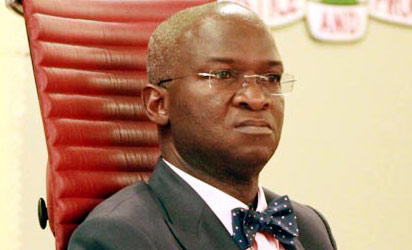
Fashola
By Ochereome Nnanna
BABATUNDE Raji Fashola, BRF, a barrister, is one of the front liners among the 36 governors, especially the outgoing class of 2007 – 2015. There are those who like his handling of Lagos, especially his determination to recreate the mega-polis from a sprawling former federal political capital of the 20th century to a new, modern city; a befitting economic capital of the biggest economy in Africa.
This has been the vision of the political platform created by Senator Ahmed Bola Tinubu, BRF’s immediate predecessor and political godfather. Lagos is a perfect example of how to make a seamless transition from one regime to another within a political movement, with the flow of governance and direction of policy firmly on course. Attempts in other states to achieve the same purpose failed. The case of Abia, where Tinubu’s friend and co-conspirator (during the roughneck days of President Olusegun Obasanjo), Chief Orji Kalu, also handed over the baton to a well-chosen godson, Chief Theodore Orji stands out.

Fashola
Tinubu dumped the party that brought him to power – the Alliance for Democracy, AD and founded his own Action Congress, AC, when his fellow South West governors of AD decided to dine with Obasanjo on the ground that he was their tribesman needing a home base. Obasanjo flushed them out but Tinubu survived and transferred power to his Chief of Staff, BRF.
Almost the same thing happened in Abia. When Peoples Democratic Party, PDP, leader, President Obasanjo decided not to give his party man in Abia, Kalu, ticket for a second term, the latter formed a new party, the Progressive Peoples Alliance, PPA and grabbed his second term. He used it to also transfer power to his Chief of Staff, TA Orji. But while Tinubu was able to keep his party and even grow it in the South West, Kalu, after an initial modest expansion to two states, lost both due to greed and inability to know where to draw the line in power and human relations. Tinubu nearly made the same mistake when he was about to deny Fashola a second term, but he came to his senses just before it became too late.
The reason was that Fashola went headlong into his assignment and before long won hearts across the state – and the nation at large – due to his ability to produce desirable change. His transformation of Oshodi and opening of the Lagos – Badagry superhighway for integrated road and rail transport impressed me most. I also liked his removal of commercial motorcycles from major trunk roads in spite of the odds, and his unbending efforts to create a new economic zone in the Lekki axis. Even little children sang the praises of Fashola, and it became political suicide when Tinubu contemplated dropping him for second term.
But since Fashola went into his second term, the technocrat started giving way and the politician started showing up. And the new deal wasn’t always a nice one. The decision to deport people from Lagos, a former federal capital built with our commonwealth and sweat really exposed his feet of clay. Fashola clearly allowed himself to be misled by the inner circle whispers that those who call themselves Lagos indigenes engage in, which most of the time, go against the interests of the non-indigenes.
Areas mostly populated by non-indigenes, such as the Ajegunle/Orile/Amuwo/Ojo/Alimosho, were simply abandoned. Another unwise decision his regime took was the astronomical raising of the tuition fees of the Lagos State University, LASU, an anti-poor policy that put a public institution beyond the reach of struggling Lagosians. The stark reality of Ekiti loss by APC to PDP has forced a number of policy reversals, some of them tending to the other side of the ridiculous. Students had asked for a moderate raise, but Fashola returned to old fees. Now they are rethinking the Lagos Traffic Law, based on which many people who came to look for a means of livelihood in Lagos became victims of a rampaging Lagos State Traffic Management Agency, LASTMA and other task forces, including the one that was used to execute the ignoble “deportations”, Kick Against Indiscipline, KAI.
In the past couple of months, Fashola has been competing with Alhaji Lai Mohammed, the APC chief propagandist, in squaring up to the PDP and the President. He was the inventor of the term: “Stomach Infrastructure”, in an article he wrote on the back page of THISDAY after APC lost the Ekiti election. He berated the Ekiti electorate for the decision they made, only for APC states to start deploying “stomach infrastructure” policies in order to retain Osun and prevent the loss of Lagos, Ogun and Oyo.
The Lagos action governor also went to Bayelsa and accused President Jonathan of sleeping for three years only to wake up now, hoping to use “rice” to get votes in 2015. That was not vintage Fashola. It is a new Fashola who has fully donned a political toga with nine months to hand over. It is no coincidence that since Fashola became more political, his general perception as a performer and beacon of hope in the APC at the national level, has taken a dip. It does not have to be so.
Fashola has made quite a few avoidable mistakes in his second term in a city-state where non-indigenes have large stakes, including the capacity to change the electoral fortunes of any incumbent. Perhaps, they are only now beginning to realise this, so close to election. What will they do after the elections if they remain in power? That is the question on many lips.
Fashola is welcome to the political turf. But I hope that he, along with people like Waziri Tambuwal, Fola Adeola, Chris Ngige, Chibuike Amaechi, Adams Oshiomhole and other credible intellectual performers within the APC will give that party a future after 2015. By then, Muhammadu Buhari, Atiku Abubakar and Bola Tinubu might have to take the back seat and allow a new national party, not just a North versus West alliance seeking to dethrone the ruling party, to stand as the alternative to PDP.
Disclaimer
Comments expressed here do not reflect the opinions of Vanguard newspapers or any employee thereof.