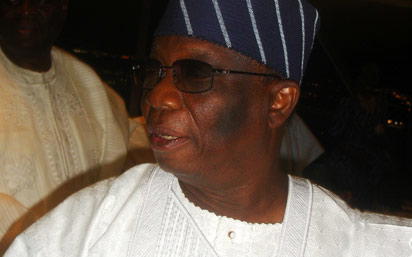
*Dr. Adejuwon
By JIMOH BABATUNDE
Dr. Franklin Adejuwon means different things to different people. He was Minister of Agriculture in the government of the late General Sani Abacha. Before then, he served as Commissioner for Home Affairs in Lagos State under Mike Akhigbe and Raji Rasaki military administrations.
Adejuwon is at home with tourism and aviation, helping in the setting up of the National Tourism Board and drawing the nation’s Tourism Master Plan, a feat he achieved in collaboration with the United Nations World Tourism Organisation under the Obasanjo military government.
He clocked 70 recently and, as he was being celebrated by his family and friends in far-away Las Vegas, United States, he took time out to share his life story and experiences.
Excerpts of interview:
On what it feels like to be 70
I don’t see any difference. The only difference is that you thank God that you are able to hit the age of 70 which to many of us would have been impossible going by what one went through in life.
We have to thank God that one is able to hit it at last.
On the memories of growing up
I have quite a lot of memories and I don’t know how I can explain everything.
My early life by the records passed to me by my mother, I must have overstayed by nine months in the womb, that is nine plus nine months; so my age should have been over 70 if I came direct. I came in through serious circumstances and I don’t want to say too much about this. It is all within me and the family.

*Dr. Adejuwon
I started very well. When I was young, I had a lot of health problems. At the age of six months, I had small pox; at that time, any family that had it was an abandoned family, the person was seen as evil and such person is discarded in the society. By the special grace of God, I was able to overcome that but my mother went through a lot of problems.
I grew up and started schooling; my education was relatively fast; my primary was very fast. I grew up as a very big rascal anyway, but my rascality was positive, so many people liked me for that. I became famous right from a child.
On schools attended
I finished at Emmanuel Anglican Primary School, Ado Ekiti. One of my colleagues is Prof. Jide Osuntokun. Primary school was an interesting adventure for me, because I started out as a hunter. I used to have traps that I used to hunt for rats.
What actually drove me away from that adventure is that one morning, as I was about looking whatever my trap had caught, I encountered a very big snake which had eaten up my catch and decided to pursue me. From that day, I left that adventure. That was the end of that.
Terror group
It was also a very interesting life to be part of the masquerade group; we called them Ara Orun, those from heaven. We had a gang then and I was one of the youngest in the gang. The seniors in the group then were mature and they used to pursue girls and any girl that did not give in, we would be asked to fight them.
We will come in under the guise of masquerade and beat them up; but one day nemesis caught up with us generally. It might interest you that my father, who was an organist in the church, did not know his son was part of the gang.
Every Sunday, the bishop will be talking about people coming in masquerade to beat up people in the girls’ schools not knowing that the son of the organist was one of those beating up the girls.
The costumes we used to wear as masquerade then were highly inflammable. One day we were caught and they put fire on one of us. You could imagine how I escaped. I had to pull off and managed to get a wrapper somewhere to dodge back home. My father did not know what happened. That ended my adventure in the masquerade.
Prisoners let loose
In Ado Ekiti, there was a pool built by prisoners. They fetched water there every day and it was also a fish pond. Every time the prisoners finished working, there we will go there to catch their fish. They noticed that we were doing it; so when our group went there to catch fish at about six one evening, the wardens let loose the prisoners.
Some of us were caught that day. I was also lucky, I escaped; those who were caught were imprisoned for a day. So growing up was all full of rascality.
I had admission to Christ’s School. My brother also had admission and my father did not want both of us to go there, so I went to Oyemekun Grammar School.
It was one of the best schools in Ondo State at that time and some of my class mates are here (at the occasion marking 70th birthday) today: Chief Familugba, Prof Kole Omotosho, we used to call him mosquito then, because he was very tiny at that time, Engr. Adejuyigbe.
During our time, there was nothing like science subjects. The best we could do was rural science; you could not imagine my set of 57-61 was an exceedingly good set. Many of us went out and finished as engineers, doctors, planners. We took science after we had finished secondary school.
We excelled in it and our set was one of the most dynamic and pragmatic. We are together up till now, those of us that are alive.
In secondary school, everything went well up till class three when I started having financial problem and, by and large, I struggled, people will not know what people went through in our areas at that time to get things done.
When I finished secondary school, we had the opportunity of going for Higher School Certificate (HSC). I wanted to do law, but my father wanted me to improve on his job as a teacher.
Parting ways with dad
Unfortunately for me, I took the exam to the Ohio University educational system in Nigeria at that time, which is now Olunloyo College of Education, and I was one of those who passed and given scholarship.
At the same time, I had the option of going to Christ’s School for HSC, or Hussy College, even Ibadan Grammar School, but my father insisted that I should go to the college of education. Since I didn’t want to go, I rebelled and got out of the house.
I had actually been independent from the age of 16plus, which was the time I left home and started exploring life myself.
I got a job as a teacher at Ayede Ekiti Primary School. From there, I moved to Ago Iwoye as a teacher in the Modern School. Meanwhile my class mates at Oyemekun had already advanced in their HSC. So I got so upset with myself, asking why such should happen to me. I went ahead to take three papers in GCE A Level. I read for it for nine months and passed the three papers straight away.
From there, I moved to Lagos. I got a job at Bojsons, and then started exploring the chances of going further in life. I had admissions in the universities but there was no money to go then. I was living in Agege and working in Isale Eko. So it was really a tough life.
Scholarship
Then came the issue of scholarship for foreign students by the governments of United States, Canada, Russia, Britain, Bulgaria, among others.
I put in an application and, good enough, I had a scholarship to go to Soviet Union to read economics. My mother was in Ibadan on her sick bed in one of the Aladura churches.
I thought I should go and tell her, because, at that time, none of my parents knew where I was. As a matter of fact, I got to Europe; my father did not know I was alive until three years later when I sent my picture home.
Fatal accident
As I was going to Ibadan to tell my mother, our vehicle had an accident in Sagamu that claimed the lives of about seven people. If not for the then governor of Ogun State, the late Chief Bisi Onabanjo, I would have been dead.
He was the one that saved my life. He stopped along the way when he saw the accident and went under the debris of the car where I was pulled out and taken to hospital at Sagamu where I was treated.
I had head injury. All these stitches you see on me were the marks from the accident. I remember there was a girl sitting close to me in the vehicle from Saint Theresa College I was trying to toast. She was trying to give me guinea egg before the accident. Her head was severed from her body.
So in the process of treatment for this accident, I lost the scholarship, because, at that time, they will lead you to the plane, give you your passport and you board. The Soviet government used to bring their planes to take us.
My then girlfriend, now wife, was also involved in the scholarship, because I was waiting for her all along. She had to leave me to go. I was dejected thinking that was the end of life. I lost hope completely.
Silver lining
About two weeks later, I was still on the sick bed when I was called that I had another letter from the Federal Ministry of Education giving me another opportunity to go to Bulgaria to do industrial economics.
I got the letter, though still very sick, but I prepared myself for the journey. So, on the day of the trip, I had no money to even get to the airport to meet my friend, Mr. Jinadu, who brought me to Lagos.
I was living with him then. I could not tell him I had no money, I had only a pair of patched trousers. So, I got a friend’s bicycle that I rode to the airport. Along the airport then was a bank where I parked the bicycle.
I got to the airport in my bandaged head and, knowing that the officials of the Ministry of Education will not allow me travel in that condition, I took my seat as they were about giving out our travel documents.
Then there was no direct flight, we needed to travel to Ghana before jetting out. As the officials were coming, I told the person next to me my problem and that he should help collect my document, I left there.
When he got his documents, he told the official that I had gone to the toilet and he was asked my name; he told them and he was asked if he could keep the passport for me and he collected it. That was how I managed to enter the plane.
Trouble in the plane
Once I got into the plane, I told myself that it was only death that could get me out. We took off. Mid-air, the two engines of the propeller plane packed up. We thought that was the end of life again. The pilot battled to revive one of the engines and he managed to land in Ghana from where we took off straight to Bulgaria.
We landed in Bulgaria late at night and, as soon as the Bulgarians saw me, they knew this one was already dying; so they rushed me to a quarantine hospital where they started treating me. It took about almost eight weeks before I was released to the other students.
That was how we started. I moved on with my education very well. I knew what I went through and I knew what I came for. Some my colleagues at that time were running after Bulgarian girls. I did not think of anything like that but how to pursue my education and catch up with my colleagues.
‘I want this course’
After my preparatory, I realized there was something they called geography of tourism. I was interested. So I went to the university to find out about it; that was the first time I knew geography was split into many areas.
My best result in A Level was geography, so I went to the Bulgarian government that I wanted to change my course. They said they were not allowing foreigners to take that course as it was meant for the communist children, because it involved the spending of foreign exchange as they needed to send you abroad.
As for other courses like medicine, engineering, they said they were ok, but geography of tourism, foreign relations were meant for their children. But because they liked me, they said if I could convince my government to request for change of course, they could do that.
I started pursuing it, got in touch with our ambassador in Soviet Union overseeing Bulgaria, who said he did not have the power to do it.
Encounter with Enahoro
As God will have it, Chief Enahoro, then a minister, was on tour of Eastern bloc. He was coming to Bulgaria. As soon as he came; I went to meet him in his hotel.
I told him ‘this is my problem sir and my intention for wanting to study geography of tourism’. Enahoro asked who gave me the idea; I said geography was my best subject and that our country has a future in tourism.
He was the first person to tell me that tourism was the industry of the future. He promised to do all his best that the government allowed me to change my course and, as soon as he got home, signal went to our embassy in Moscow and then Bulgarian government. That was how I got the course.
On career growth
It was very interesting. In the first place, I did very well that by the time I finished my second degree, I had already landed three scholarships in Bulgaria. I had the Afro-Asian; I had the federal and the Bulgarian scholarship.
So, after I finished, I had many options. First of all, I was invited for PhD programs in some universities and I had some jobs in Europe before I left. I was in Switzerland, I was in England before I decided ‘let me come back home and find out’ what was going on.
At that time, University of Ife had linked up with me. We have had some exchange. I had brought some professors from Bulgaria to Ife and they had also come to Bulgaria. So, University of Ife had already started planning for me to come and start the Environmental Resource Unit.
By the time I came to Nigeria, I landed four jobs straight away. University of Ife, Federal Ministry and a firm working for the World Bank, Messer Vehan Dasan, a consultancy firm. They were multi- disciplinary. They were mainly focused on World Bank project. This job I got under three hours. I saw their advert looking for experts in different fields; so I went there, along Awolowo Road, Ikoyi, and the man said ‘you are lucky that the senior partner is just from New York and he will want to see you’. So, I saw the man. He interviewed me and said I should see him at three in the afternoon. I went and came with my documents at the appointed time; all I got was a letter of appointment straight away. That was how I started. They gave me a big house, a car and so many projects.
So, we started with town planning. I did about 44 town planning in Nigeria and then went into regional planning. I went into storm water drainage of Lagos with my own basic area being the usefulness of the storm water drainage for internal waterways for Lagos.
We created Tin Can Island. Our own position was to drain Lagos gravitationally; it was to get the canals from the lagoon straight away to the airport. That was my own project and getting to the airport, people can now use the inland waterways straight.
But we were only able to get it up to FESTAC. That was what opened up FESTAC. By the time we got it up to FESTAC, because we were using the Westminster dredger, we created the bridge at Mile Two as government had started preparing for FESTAC 77 then.
We linked up Mile Two with FESTAC and by the time FESTAC 77 was approaching, government had already started eyeing me.
Meeting Obasanjo
I was in Morocco working on a resort when I was called upon by Obasanjo, who was visiting Morocco then, to come and work with government; moreover, they felt having used federal scholarship, why should I be working in another place? I fought against it because I never wanted to work with government because of the bureaucracy. I wanted to help my country, but not as a civil servant. Anyway, government invited me to prepare a blueprint for tourism; tourism was just under the Nigeria Tourism Association at that time. It was a quasi -government body, it had no serious relevance.
So, I prepared the blueprint. It was
it that government used to get me in; General Shua was my minister. I wanted to bolt out at that time too because my company gave me another job to head the regional planning in London. I wanted to use that to go out, but I was stopped.
That was how I started the Nigeria Tourism Board and then moved up, but, to be fair, government gave me all the support. Obasanjo, as then Head of State, gave the ministry the mandate to give me anything that will enhance my job. I was given a house which was unusual, because I came in as a Senior Research Officer.
They did all that for me to remain. That is why I can’t forget Obasanjo easily, because once he believes in you, he will support you. People might find fault in him, but, from my side, he did everything to make tourism grow in Nigeria.
On how he became commissioner
I was in Tourism Board and when politics came, they translated the position of Chief Executive, which I was holding, to political position. When things turned that way, we professionals didn’t like it. They brought in a junior colleague of mine to be in charge and I took a sabbatical to allow them sort out things. When this was going bad, the minister, Alhaji Jega, at that time, had to call me and started pleading that I should come back, but, in the process, the military took over. I was abroad in Utah, US, delivering lectures when my wife called that they were looking for my CV at home.
I told her I was not interested in government work again; I just wanted to pursue my profession internationally. But when she kept bordering me, I asked her to release the CV. Later she called and said it was like they were about giving me an appointment in Lagos State, that I needed to come back home.
I came back and that was how I found myself as a commissioner. The governor, Mike Akhigbe, called me and was happy that I came back home as he had read about me. He wanted me to join his cabinet.
I ended being a commissioner for six years in Lagos State and everything went well. I was the first Commissioner for Home Affairs and Tourism. We tried to make our own mark in the state which, hitherto, remained the landmark of tourism.
We did a lot of projects. Lagos State was the first to establish a tourism policy in the country and it was launched by President Babangida. We also went into socials. I started the Sun Splash which was a hit. I then moved to taking over all the water fronts. At that time, the governor was such a wonderful person who loved tourism, probably because of his background as a naval officer; he also gave me full support.
Though we never had money in my ministry, we were prominent than other ministries because we were always introducing new things, things that could boost the image of the state quickly. So, I took over the waterfront from Ozumba Mbadiwe to Lekki.
I schemed up the area, because, before you get to 1004, it was all markets, rubbish along the coast. When I took over the stretch, Governor Raji Rasaki had been appointed.
He will say Bar Beach commissioner, ‘what do you want to do with this?’ I will tell him, ‘Don’t worry sir; you will see in future. Just give me the right to take over’. He did and that was how we did everything.
I told him, ‘Give this land to the people at no price, let them invest their money and, after they would have invested their money, they would not take their investment away and the state will start enjoying’. That is what is happening today on that corridor.
We also created the awareness of cruises, the usage of waterways. I bought a boat, called Eko Touris; it had the capacity to carry 500 people. Throughout my five and a half years after we had bought it, there was never a weekend it did not work.
We will cruise with it to Badagry with live band; diplomats liked it and they were always using it.
On his appointment as minister, could it be because he worked with the military in Lagos?
Not necessarily. I think it was my work that took me to federal level, because I did not bargain for that too. After my tenure in Lagos, I was handling projects for the World Tourism Organisation as a member of the International Institute of Scientific Experts in Tourism. The Federal Government wanted to pursue what I had started in Lagos and in the National Tourism Board; so they looked for me. I did not expect to be a minister under that regime of Abacha.
But when I came back from England, I went to my sister’s place only to come back to my house to see a lot of people. I thought maybe someone had died among my relatives only for my wife to say they had announced my name as one of the ministers. I said ‘for what?’
So we listened to 9pm news and it was shown again. I wanted to reject it but one of the military boys called me very late in the night telling me not to go out of the country as they had been monitoring me right from when I left England.
That was how I got to Abuja.
On his experience working with the government of Abacha
I later found out that a lot of sycophants were involved. When you look at the other side of it as a Christian, one needs to open his mind. I was in the cabinet more or less a lone ranger, but I was one of the most respected by General Abacha.
I was always against anything I knew was going to cause more problems for the nation. I was blunt and anytime we finished any executive council meeting, my colleagues will come to me saying ‘Dr. Adejuwon, we don’t do like this here’.
On any regret in life
I, honestly, will have regretted and will not regret anything, because I got to where I am by the grace of God. My early life was rough and tough. So there is no reason I should be looking down on anybody , there is no reason I should be ambitious for anything.
So, anything I did, I did it from my mind and from the way God directed me. There was never anytime I lobbied for any appointment in my life. All that came my way came through my professional recognition and I don’t think there is anything to regret.
All I need to do is to continue to give glory to God for all He has done for me. I was so shy and two I had been moving with a lady before who I got so much involved in but I had lose her because my father wanted me to be a teacher. She did not want all those things as we had already planned our lives to something. I saw that I could not be useful to her as she was mature and I had no future at that time.
So that did not give me all the sense of pursuing girls, but a friend, Foluso Jinadu , was the one who actually did the whole work. He was always leading me there in the evening and that was how we started.
I think love and relationship was completely natural. She had better options than me who had only a pair of patched trousers and without future. I mean she just got interested in me, we loved each other and so, by the time I got the scholarship line, I told her because she had finished at Saint Anne’s College and was already in agriculture.
I told her ‘you are a brilliant lady and these chances are available; why don’t we pursue it’, and she got scholarship to study medicine in Soviet Union. While she was there, we were communicating and I asked her to move to Bulgaria when I got there.
Again we had to pursue the government to do so and the Bulgarian government supported me because they knew I was doing very well and was not running after their girls like most Nigerian students. They wrote to the Federal Government of Nigeria and it was granted and so we moved her to Bulgaria.
She was to do medicine which she started quite alright. Then the two of us sat down saying if she was to do medicine, how would we take care of our children? So she agreed to change. That was how she ended up studying veterinary medicine.
On words of wisdom from his father
There is one that my father used to tell every one of us. My father grew up as an educationist, but you know teachers don’t have money. My father was one of the early students of Saint Andrew’s College, Oyo. He graduated in 1934 and was one of the people that established education in the whole of Western Region with the likes of Papa Alayande.
One thing he was always telling us was, ‘Live your life the way God has created you to live it, don’t ever let me be in my grave and have a reason to lower my head in shame that my son has done this.’
Disclaimer
Comments expressed here do not reflect the opinions of Vanguard newspapers or any employee thereof.