The Petroleum Industry Bill and the Quest for a New Nigeria
By Obadiah Mailafia LAST week, Thursday July 1, the Senate finally passed the long-awaited Petroleum Industry Bill, PIB. A milestone in the history of our legislative affairs. Too many interests had repeatedly scuttled it over the years. According to the auditing and advisory firm, KPMG, previous attempts in 2009, 2012 and 2018 failed “because of […]


Venezuela – a Lesson on how not to manage an economy
WE all like the idea of revolution. The first great revolution of history was the Glorious Revolution of 1668 in England, which led to the establishment of Magna Carta. The second was the 1776 American Revolution of Independence. Historians are agreed that the 1789 French Revolution drew much of its inspiration from the American experience. Every thinker of that epoch eulogised it, save for one lone voice – that of the Anglo-Irish conservative political thinker Edmund Burke — who reasoned that the costs by way of violent bloodletting were never worth the benefits.

The real isues before the Nigerian electorate
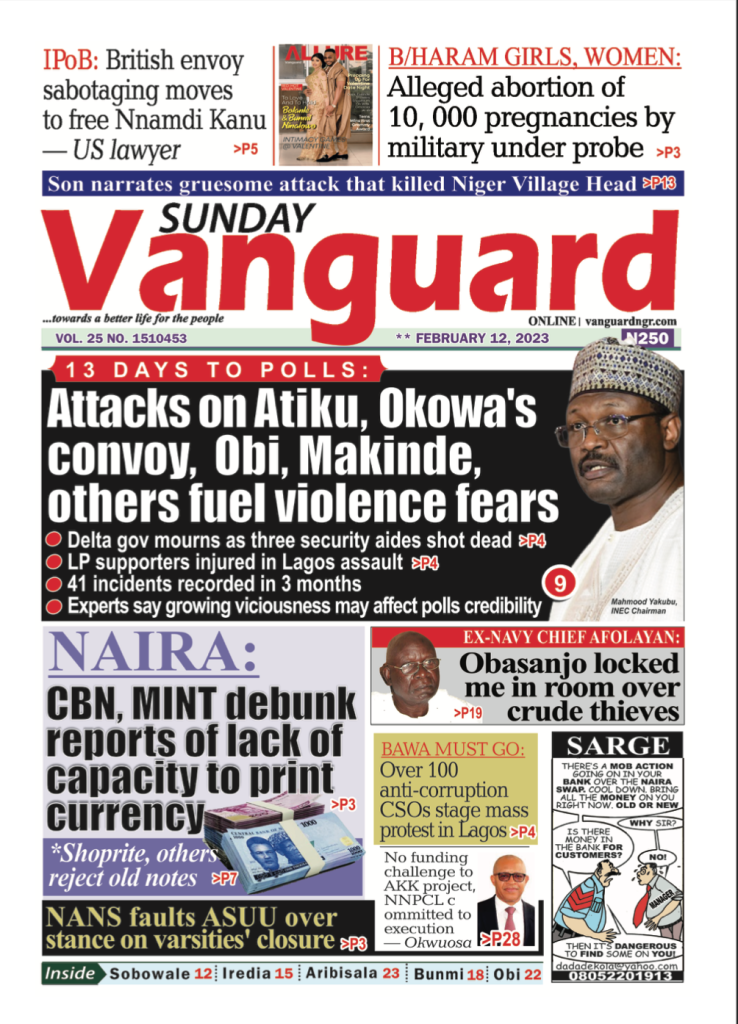
AS we march towards the presidential elections on Saturday February 16 , there seems to be palpable tension everywhere. This has not been helped by incendiary comments from some high quarters, to the effect that international observers will return home in “body bags” if they continue to “interfere” in our domestic affairs. The EU has reacted, while I believe the rest of the international community have taken judicial notice of those interahamwe who are trying to upturn our fledgling democracy with their dangerous hate speech. I appeal to all Nigerians to remain calm. Ensure that you exercise your full electoral franchise on Saturday. But remain peaceful and calm

How France Underdeveloped Africa
A FEW centuries ago, France was the leading continental power in Europe. After the 1789 French Revolution, Napoleon Bonaparte became master of Europe. A man of great ambition, he aimed to bring all of Europe under French hegemony. He almost succeeded until his defeat at the Battle of Waterloo in 1815. Bonaparte had invaded Egypt in 1798 with a legion of soldiers and scientists. It was in fact one of his scientists, Jean-François Champollion, who deciphered the hitherto closed world of Egyptian hieroglyphics, thereby opening up a new vista for the discipline that we know as Egyptology today. His soldiers, we are told, often used the face of Egyptian mummies for their shooting practice. They aimed to destroy their noses, the better to prove that the ancient Egyptians were not Africans.

A London café conversation
I AM writing this piece from cold, wet London. Last night it rained cats and dogs. Yesterday late afternoon a friend invited me to a café in the old Borough of Richmond where I once lived and lectured in the nearby American University. As we sat to reminisce on the good old days over tea and scones, some two African guys next to our table picked interest in our conversation. Smiling, the younger of the two, turning in my direction, asked me point blank if I came from South Africa. Smiling, I answered No.

The persecution of Justice and the end of democracy
THE news came as a shock to some of us that the Chief Justice of Nigeria, CJN, His Lordship Justice Walter Onnoghen, is to appear in a court on charges of non-declaration of assets. He is also accused of allegedly operating some dozen bank accounts containing varying amounts of local and international currencies. He is expected to hand over the reins of office to the second most senior colleague as he goes on trial. There has been no precedent for a serving justice being compelled to appear in a lower court to answer charges for a misdemeanour, real or imagined.

So long a letter
FOR more than a year I have been in communication with a young and well educated Hausa-Fulani Muslim woman. The remarkable thing is that we have never met. But she always responds to my writings, often in praise, but sometimes in criticism. What I admire about her is her honesty. I shall call her Zuwaira.

The quest for peace in an Age of Extremes
I DID not invent the phrase “Age of Extremes”. It is actually the title of a book by the leftist British historian Eric Hobsbawm. When some of us were children, we were least concerned about religion or tribe. During Christmas, Christians and Muslims celebrated together.

A plea for economic planning
DURING the economic recession of the 1980s the doyen of Nigerian economics, Pius Nwabufo Okigbo, delivered a lecture at the National Institute for Policy and Strategic Studies, with the title, “Sorcerers, Astrologers and Nigerian Economic Recovery.” Yours sincerely was among the audience during that steamy 1986 summer afternoon in Kuru. It was a brilliant performance. The late economist gave that dramatic title to his erudite lecture to drive home the point about how bereft we are in terms of serious critical thinking about the economy.
The meaning of political leadership in an age of pessimism
OURS is a confused and illiberal age. Our people have become so pessimistic about the future it’s alarming. My experience with politics so far has even deepened my sense of pessimism. A few days ago I found myself in a room with some of the greatest movers and shakers in the political arena. There was not a single discussion of how we could take Nigeria forward. I felt as if I was in the midst of gangsters.

Emmanuel Macron and the new France
THE outcomes of the French presidential elections were announced on Sunday, May 7, with Emmanuel Macron, the centrist political leader, having 62 per cent of the votes as against ultra-nationalist Marine Le Pen’s 38 percent. It had been a bitterly contested election. So much was at stake – no less than the future of France and of Europe itself. Marine Le Pen, the candidate of the far-right Front National, campaigned under the banner of xenophobic nationalism. She promised to act tough on immigration; to pull France out of the EU, revoke the citizenship of naturalised citizens with known terrorist sympathies. For her, it would be “les français d’abord” – the French first!
Planning for Growth and Structural Transformation
THE Nigerian growth story has been a rather topsy-turvy one. During the early years of independence, growth was moderately positive, averaging over five percent annually. The lowest rates were during the crisis years 1966-70 when growth went as low as -17 percent. The country emerged after the civil war with impressive growth results, reaching a peak of almost 30 percent in 1970. From the 1980s to the 1990s – the dark years of military tyranny – growth was a moderate annual average of 3.5 percent, undulating between negative and positive figures during that decade.

Let no-one deceive you
MY gentle readers, let no-one deceive you. The stakes we face today are of a destiny-changing order. The coming elections will decide whether our country will survive or will be thrown to the dogs. Sunday November 18, was announced by INEC as the date for the official commencement of the national electioneering campaigns. We are back to the colourful and exciting era of the soapbox and the hustings. It is a race that will not be for the fainthearted.

Issues, personalities and 2019
MANY of our chattering classes have been going on as if the presidential elections are all about the big gladiators. Nobody is talking about the issues that really matter to most Nigerians. I humbly submit that such people are profoundly in error. And it is too premature to conclude that the whole thing is a contest between two recycled dinosaurs.

Governing by Decree
BETWEEN July and this month President Muhammadu issued two decrees aimed at further curbing corruption, money laundering and tax evasion: the first, Executive Order 6, and the other, Executive Order 008. An executive order is a decree issued by the executive without necessarily seeking approval of parliament or the judicature. Most constitutions do empower the executive to take all such measures as would conduce to sound government and public administration in the interest of the overall common good. Donald Trump probably set a world record by the number of executive orders that he dished out during his first week in power. The current incumbent of the high magistracy of the American republic has issued no less than 42 Executive Orders in his first year alone.

Why Human development matters
THE World Bank/IMF Annual Meetings were recently concluded in the paradisiacal island of Bali in Indonesia. It was attended by more than 3,000 delegates, among them finance ministers, central bank governors, high civil servants, international officials and the lot. IMF Managing Director Christina Lagarde likened it to a successful wedding. Weddings take a lot of preparation; and then the grand occasion arrives. Then the merriment follows and all guests eventually depart, taking with them fond memories of everything that transpired.