Where are the campaigns for 2027? By Tonnie Iredia
As soon as a new president was sworn into office in Nigeria on May 29, 2023, politicians began to campaign for the 2027 elections that were 4 years away establishing clearly that they are in power for personal gains only. Political analysts shouted in vain that the continuation of electioneering at the end of one […]




Kwankwaso’s Transparency: A challenge to other Governors
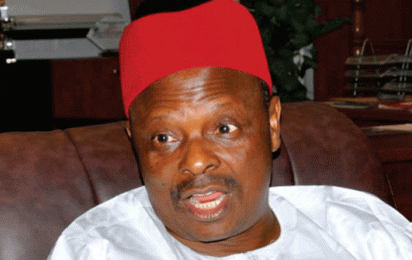
Exactly one week ago, the Nigerian Union of Journalists (NUJ) decorated Governor Musa Kwankwaso of Kano State as the best Nigerian Governor in the area of Fiscal Responsibility- a concept which refers to openness, discipline and accountability in governance. This writer was proud to serve as guest speaker on the occasion because it was a remarkable award that was specific, credible and indeed verifiable. It was obviously not purchased like the ones that are given to those who had donated huge sums to the issuing body. In the case of Kwankwaso, the several memorable developments in Kano State for which he was honoured are exceedingly persuasive. What are these developments and what challenges do they pose to other State Governors?
ASUU crisis: It is time for commendations
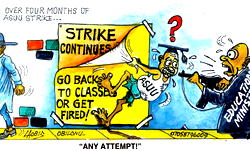
The strike action embarked upon by the Academic Staff Union of Universities (ASUU) since July 01, 2013 will probably go down in history as the best ever well-organized action of the union. Although the action lasted longer than many Nigerians envisaged, it is to the credit of ASUU that it was fully ready for business. The union had in fact made it clear that only a complete resolution of the issues at stake would bring the strike action to an end. Hence, it was also ready for any eventuality. Consequently, when the government introduced the ‘no work, no pay’ rule into the game, the union responded by resorting to providing other welfare strategies such as distributing food items, giving out soft loans and cash advances to members to cope with the effects of the policy.
Kudos to Governors Oshiomhole, Fashola and Orji; but…
The ideal role of a critic is to serve the best interest of society through constructive criticism by drawing the attention of leaders of society to issues which are begging for redress. It is however not enough to enumerate and propagate what is wrong. A good critic ought to, in addition, proffer solutions to the problems or articulate alternative options for handling identified concerns. More importantly, a critic should be charitable enough to commend leaders in those areas where they have made efforts to right their wrongs. The latter is the premise of today’s article which identifies 3 state governors whose recent activities deserve some measure of commendation. The governors are Adams Oshiomhole of Edo, Babatunde Fashola of Lagos and Theodore Orji of Abia.
Corruption in Nigeria: Is it a perception?
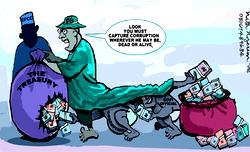
There appears to be some measure of unanimity among analysts both within and outside Nigeria that the nation is a highly corrupt society. The country’s successive governments since the return of democracy in 1999 do not quite agree. This can be deduced from certain viewpoints that are usually officially canvassed on behalf of the nation. The first is that there is corruption everywhere, making it obvious that it is not peculiar to Nigeria. Some say, if the British knew nothing about corruption, the term would not have evolved as an English word.

Inconclusive INEC!
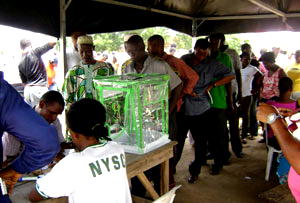
The Independent National Electoral Commission (INEC) has since 2011 established for itself; certain constant canons of behaviour which Nigerians need to appreciate whenever they seek to participate in an election in the country. One of them is that no matter the election; be it nationwide or in only one state or indeed in just a single constituency, election personnel and materials must arrive late for the event. The present INEC opened its tenure with it in April 2011 when it postponed the National Assembly elections because of late arrival of materials. Since then, that principle of lateness “due logistics reasons” has become part and parcel of INEC just the same way, our airlines run permanently delayed flights “due operational reasons”.