Where are the campaigns for 2027? By Tonnie Iredia
As soon as a new president was sworn into office in Nigeria on May 29, 2023, politicians began to campaign for the 2027 elections that were 4 years away establishing clearly that they are in power for personal gains only. Political analysts shouted in vain that the continuation of electioneering at the end of one […]



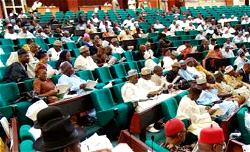
What exactly is the meaning of constituency project?
One of the puzzles yet unraveled in the Nigerian game of politics is why our annual budget has been a source of quarrel between the legislature and the executive since the nation’s return to democracy in 1999. With the 17-year old quarrel operating as a yearly matter without exception, it seems obvious that how to grab money is a prime objective of the squabble. Following the inability of the Federal Executive Council last Wednesday to say when the 2016 budget would be signed into law, hopes of many citizens looking forward to the budget have been dashed. The current phase of the usual cat and rate game does not show that even an early submission of the budget in the future would resolve the matter. It appears obvious that irrespective of when it is submitted, the budget will always be delayed for as long as it takes those hustling for personal gains to achieve their targets. What keeps the hustling game alive is the claim by the legislature that it has the power of appropriation. Citing relevant provisions of the constitution, legislators insist that they can alter, reject or even rewrite the budget. Of course, such a claim of the legislature that every other contribution to the budget depends on its own whims and caprices is incorrect because that would injure the spirit of checks and balances.

How wrong is Governor El Rufai?
For some time now, there has been ample opposition to the policy initiatives of the governor of Kaduna State, Mallam Nasir El Rufai. The Christian Association of Nigeria (CAN) is perhaps the governor’s fiercest critic with respect to a proposed law to regulate religious activities in the state. The bill is aimed at banning the usage of loudspeaker for religious purposes “other than inside a Mosque or Church and the surrounding areas outside the stipulated prayer times.” Governor el-Rufai wants to legally stop the playing or circulating of “all cassettes, CDs, flash drives or any other communication gadgets containing religious recordings from accredited preachers other than inside one’s house, porch, Church, Mosques and other designated places of worship.” The bill also seeks to ban sales or playing of any cassette containing “religious recordings in which abusive language is used against any person or religious organisation or religious leaders (past or present). Any person found guilty of preaching without a valid licence and other offences under the proposed law “shall be liable to two years in prison or a fine of N200, 000.”
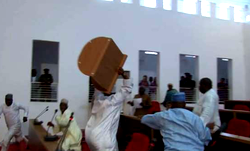
Let’s remove fighters from our legislature
The latest incident of fighting in a House of Assembly took place last Monday when Nasarawa State legislators engaged themselves in a free for all fight inside what is often called their ‘Hallowed’ Chambers. According to media reports, the “lawmakers punched each other while glasses were shattered, tables and chairs were also upturned in the violence that engulfed the House for hours. Some legislators sustained injuries during the violence while some had their clothes torn.”
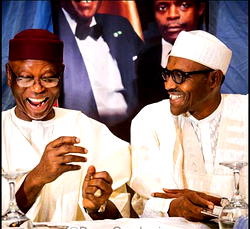
How selective is Buhari’s anti-corruption war?
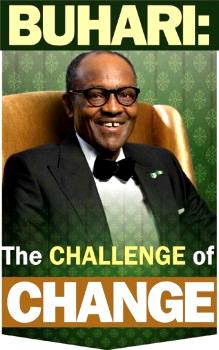
During the 2015 electioneering period, it was easy to see how corruption was established as Nigeria’s most intractable problem. Hence, the then opposition party, the All Progressive Congress (APC) vowed to deal with it head-long, if voted into office. Many people believed that the party could in reality fulfil its promise because of the antecedents of its flag bearer, General Muhammadu Buhari. In fact, many of those who opposed Buhari were ignored because they were seen by the public as corrupt officials who feared the likelihood of the exposure of their corrupt practices. Having won the election against that backdrop, one would expect that Buhari’s anti-corruption war would be fierce and that it would in turn be appreciated by all. Today, the situation is inexplicably shifting as those being interrogated have succeeded in convincing some people that the war is selective. Almost on a daily basis now, the criticism is getting louder as corruption is fighting back with groups being mobilized to condemn the policy
NTA’s problem is not structure but govt control
Nigerian veteran broadcasters must have been amused by reports in the media last week that Government was making efforts to restructure the Nigerian Television Authority (NTA) and other publicly-funded media establishments to enhance their performance. According to the reports, the nation’s Information Minister, Lai Mohammed made a request to the Doha based Al Jazeera Television to collaborate with his ministry in the area of capacity building for journalists in public-owned media organizations, especially the Nigerian Television Authority (NTA). It is not a new attempt. During the Obasanjo administration the BBC was similarly mobilized. But are ‘Structure’ and ‘Training’ the problems of the NTA?