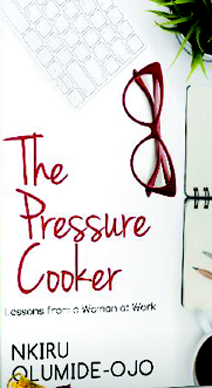
By Toni Kan
The Pressure Cooker is an agenda setting book. One that seeks to help define a path for the career minded woman. It is not as much a map as it is a navigational tool, a wish more than a command, one that expresses the hope that the author’s personal choices and experiences can help influence a younger woman’s choices and experiences as she navigates the mine-laden corporate landscape.

Nkiru’s former boss, Sola David-Borha has described this book as a gift. But it is a unique gift, a labour of love if you will, because the author has looked at her own life and experiences and in an unselfish act of indirect mentoring, decided to use her life as case study for what to do and not do as a young woman intent on climbing up the rungs of the corporate ladder. Besides this book, there is The Lighthouse Network.
What makes Nkiru Olumide-Ojo, the tall Port-Harcourt girl with an Igbo mother and Edo father, an expert on women in the corporate arena? Well, as my old English teacher used to say at St Patrick’s College Asaba: “Experience is the best teacher.”
And Nkiru has loads of those. She has worked in a hospital and in advertising, in banking and telecoms, aviation and an FMCG and every job has seen her climb a rung higher but while we have celebrated her strides as friends and family and co-workers, many of us have not been privy to her struggles and battles to, as she writes – “take space, knowing that you belong, and not wait for it to be handed to you.”
Those words echo, in many ways, a quote attributed to the French thinker and Nobel Laureate, Jean Paul Sartre, who said “there is no given freedom.” Freedom maybe negotiated but it is often taken by force.
This is at the heart of Nkiru Olumide-Ojo’s slim volume; this book of 9 chapters with a title that came from her long running column in BusinessDay. The Pressure Cooker is her own way of capturing what it is to build a career despite having 3 strikes against her – Woman, Wife, and Mother.
I did say at the beginning that this is an agenda-setting book and I will explain. It sets an agenda for the woman intent on making a success of her career in the dog-eat-dog corporate environment and to that woman, Nkiru says – to get ahead you must learn to add value and to add value you must focus on quality over quantity.
It also sets an agenda for the successful female executive who wishes to mentor a younger woman. Here, Nkiru’s agenda is unequivocally female (or feminist). Referring to the glass ceiling and what she calls “The Boy’s Club” she declares – “men support their fellow men. It is time women started doing the same.”
The book also sets a psychological agenda with its well-presented thesis on how working mothers suffer guilt emanating from feelings of abandonment of their children. Nkiru’s insights demand further psychological enquiry. She writes in her book of feeling “mummy guilt” when she had to leave her young children and go to work. She also writes about two pitfalls young women starting out must avoid – the “pride trap” and the “pity trap.”
This book sets an agenda for the human resource professional in how to engage with and hire female staff. Management and human resource professionals will find a treasure trove of insights in The Pressure Cooker, especially in the second chapter – “Get Over Yourself and Get Ahead” where she points out clearly that “when it comes to getting ahead, it has been my experience that the first and greatest battle you will fight is yourself.”
And to prepare for that battle, Nkiru like a true General, sets out parameters. She says you must pay attention to “Self-Development”, carry out periodic “Self-Assessment”, then learn how to “Collaborate” and “Communicate” effectively.
Having shown us how to get in, Nkiru spends several chapters showing us how to get up to the C-Suite and how to manage our bosses. These are critical chapters because they help make a big difference and provide the glass ceiling-shattering answer to the question Nkiru said she got asked as a precocious girl – Don’t you know you are a girl?
A girl she might be but she wanted it all and to want it all she came up with a set of rules – overcome mind barriers, be competent and add value, soak up knowledge, communicate, collaborate and manage people, then have faith.
Nkiru Olumide-Ojo does not believe that women are their own worst enemies. She believes, however, that some women can be tentative in helping other women because, as she writes, they do not want to be seen as “gender-biased; yet we cannot achieve gender balance if we do not actively create spaces for those who have been disadvantaged for centuries.”
And there lies the conundrum at the heart of Nkiru’s feminist agitations. An overt female agenda can be seen as gender insensitive and biased (a charge women often make against men) but a gender-neutral approach will perpetuate the male dominance. So, what to do?
Nkiru Olumide-Ojo (2017) The Pressure cooker: Narrative Landscape Press Limited
Disclaimer
Comments expressed here do not reflect the opinions of Vanguard newspapers or any employee thereof.