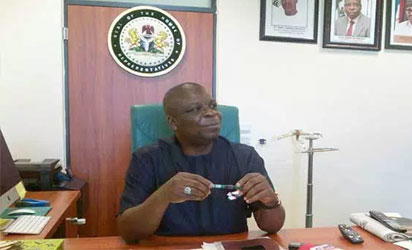
Daniel Reyenieju
Daniel Reyenieju, former Chairman House of Representatives Committee on Inter-Parliamerntary Relations in the 7th House is a member representing Warri Federal Constituency in the 8th House of Representatives. In this chat, he spoke extensively on intrigues militating against the non-passage of the PIB, its importance to the governance of the oil sector, fuel scarcity and other related issues, excerpts…
YOU were a member of the Ad-hoc Committee on PIB in the 6th Assembly, the only returning member who still retained his membership of the Committee in the 7th Assembly as well as member, House Committee on Gas Resources what’s your view on the perennial non-passage of the PIB that happens to be the oldest bill in the parliament after 17years?

Daniel Reyenieju
I really feel very sad and also disappointed, but that will not make me give up on my agitation for the quick passage of the PIB. The PIB was not structured or it wasn’t a law that was brought in to favour any section of the country. It has to do with good governance of the oil sector which has to be economic wise and the development of this country which is predicated on oil. And if your survival unit is not structured in a way that it can sustain itself, then at the end of the day you have what we call, crumbling survival.
And when you have a crumbling survival,what does it mean? The nation goes down. So, that is what the PIB is structured to solve. So coincidentally, and fortunately for me, not just wanting to enrich my knowledge of the PIB, I was in the 6th Assembly when the PIB was introduced under the chairmanship of Hon. Tam Dieffy Bricks from Bayelsa who was chairman, Petroleum Upstream as at then. He was removed and Bassey Ottu was brought in as chairman and the PIB was transferred to him. We did all we could; the last minutes of the 6th Assembly, we were about considering it clause by clause but we lost it because we couldn’t push it through and the Assembly wound up.
And in the 7th Assembly, it came up again. It had to be started de novo, completely afresh. And I was lucky to have been returned. So I became the only surviving member of Petroleum Upstream and I was conscripted into the Special Ad-hoc committee on PIB and we started it all over again. All over! And I must tel you, it was a battle when the committee was put in place and headed by the then Majority Whip of the House, Hon. Isiaka Bawa from Taraba. A perfect gentleman who saw nothing wrong in having a PIB just like every other parliamentarian, we all wanted it.
We did an excellent job, concluded everything, it took us a while. It was a battle, argument for argument. Constructive engagement and we got the PIB completely done. And incidentally again, it came to a point where it was considered at the committee of the whole house. Most Nigerians don’t even know that we actually passed the PIB on the last day of the last Assembly.
On the last day of the Assembly, we hit the gavel on it. Whether you like it or not, it passed through. So ordinarily, what I expected the parliament to have done is to bring the PIB again, and go under order 12, on bills from preceding Assembly and then it goes to the committee of the whole for hearing. And that I have done in collaboration with some few members and it has been put there. But I got some information from the government, I mean the executive that they are trying as much as possible to unbundle the PIB itself.
Striking difference
What that means I do not know. And the point is this: we have come a long way with the PIB, this is the twelveth year of the PIB in the parliament and almost about 16 years of the PIB in Nigerian domain and public discourse, and I’m yet to find out which of the reknown consultants in the nation’s petroleum industry that has not made one or two contributions to the PIB in the past.
So I’m still waiting to see what they are still consulting about and how they hope to come up with a different language. Except if the PIB will be re-crafted in another language which is different from the English language that we used. I want to see such difference from the consultants. Anything that is going to be drastically different from what we had in the past 12 years. So what I’m saying in essence is that in as much as we are waiting to see a striking difference from the consultants from the Ministry and whatever, I want them to be quick about it so that we can even see what they have to put on the table and if it comes out the best, why not?
But when will the bill ever pass if we have to wait. Because this is almost two years has gone in the administration. And by next year we will be politically jostling again. And the moment you go into political jostling in Nigeria you lose some good time of parliamentary works even that of the executive. So what I’m saying in essence is that the PIB, we need it in whatever form, whether it is going to be unbundled, we are waiting for it.
You have been a member of the ad-hoc committee in two different Assemblies, what factors do you think are responsible for the intrigues characterising the passage of the PIB, either from within or from the outside?
Yes, that is a very good question. But I must tell you. We are talking about the sector that sustains the nation, that attracts heavy foreign direct investment. Don’t forget that apart from structuring the Petroleum Industry Bill to suit Nigerians, there is the economics of it, sometimes we call it the commercials, how we release leases, the OMLS, the rental value of it, and all of that.
So that cannot really go freely without some intervening forces whether negatively or positively, which ever way you want to look at it. So, I think that’s where we have our challenge; but then that’s not an issue. It shouldn’t be an issue.
What parliament needed to have done was take the bull by the horn and pass it the way it’s being done and return same to the President for assent. And then expect at some point, what we call amendments where necessary.
And I tell you, the Local Content Bill was passed in 2010. I was a member, and one of the sponsors of the bill in 2010 when it went through. But in 2015, there was an amendment to it. There is no law anywhere in the world that’s absolutely perfect.
Issues of unbundling
What you do is the in the course of implementing, you find out those areas you feel have some ups and downs and forward such for amendments. Virtually all our laws right now are being amended, that’s the way it should be. So you cannot talk about amending a law that has not been passed. What you do is to allow the old PIB to go through, and wait for consideration of clauses after which it can be passed for assent; then you wait for about three months or less and introduce your amendments where necessary.
So what exactly are we waiting for? How can we be waiting for a new PIB when we already have a PIB that had witnessed all the storms for the past 12 years? So you think what is going to be brought now will not equally face those challenges that this one faced?
In that old PIB, there are issues of unbundling: the office of the GMD, the office of the minister, you have the gas resources, the Frontier, 10 percent Host Community Funding, you have Upstream, Downstream, you have the Inspectorate, and all of that.
These were all crafted and were made independent. And we used the parameters from other civilised countries where oil and gas are found, and where they have made substantial progress with their oil resources. We have the commercials, we came out with everything. So, I do not know what difference they are going to make with this time wasting. I’m not saying that Nigerian consultants are not good enough, but I’m really not sure of that thing that they will introduce that will make any sharp positive difference from what we already have, and that’s what I’m waiting to see.
The impression is that the House has been more committed to the passage of the bill because in the last Assembly, while the House was able to weather the storms arising from various disagreements you had; the Senate at a point dropped the PIB. Now, after the House passed the bill, they couldn’t concur too. The question is that now that you are also preparing for the next stage of reviving the bill, is there any connection between the House and the Senate to ensure that both Houses work together to pass the bill on time.
Yes! You see I’m not going to speak specifically on the Senate. But I know that we do not have to depend on the Senate to do what we think is right for Nigeria. And the Senate also does not have to completely depend on the House to do what’s right.
At the end of the day, if you do what’s right as an arm of the National Assembly which is the House, what you need to do is to seek the gavel of the Senate for concurrence. And if the Senate takes it up, what it needs to do is to seek the gavel of the House also for concurrence. Either way, you should allow the law to go.
So, I would want to appeal or advise the parliament of which I’m a member that we shouldn’t go back to the days where we had mutual distrust as we can re-introduce the bill as passed by the Seventh House and take things from there.
That’s what we have tried to do in the House, where I brought in the Minority Leader, the Majority Leader and all other stakeholders who supported the re-introduction and made sure that it went through the first reading. I don’t want to see it as an unwholesome thing; it’s a thing that is in the interest of the entire country.
So what I did was to carry both the Majority and the Minority Leaders along and some other very prominent members of the House from the last Assembly and some very new ones who are also in tune with the PIB. So that’s what we have. We were about twenty-something and I was the lead sponsor of it.
Coming back to your question, we do not have to actually be on the same page at the same time, both the Senate and the House. So whichever comes first will seek the concurrence of the other.
The Senate in the Seventh Assembly rejected the PIB. And when asked in an interview, former Senator Smart Adeyemi said the Senate gave conditions upon which it would support the bill, one of which was that government must explore oil in the Northern part of the country.
And that a certain commission must be set up and the amount of money to be spent in exploring oil must not be a burden on Nigerians. Don’t you think that PIB will continue to encounter the same opposition in the Senate, especially from Senators from the Northern part of the country?
Yes. That was one of the biggest challenges we had in the Sixth Assembly and it’s also rearing it’s head again in the 7th Assembly. Like I always say, it’s nothing personal, it’s neither regional nor is it religious. It’s about a law for the good governance of the good people of Nigeria.
Good governance
That issue was adequately addressed in the PIB that we passed and that is why you have Frontier Agency. It was created as something that we needed to do to ensure that nobody feels cheated. You can’t run away from it. How are we even sure that there’s no oil in the North.
I took a trip to the desert of Niger Republic and I’ve been to their oil farms; you really can’t even differentiate where Nigerien territory ends and where that of Sokoto begins. So you don’t even know where Sokoto ends and where Niger begins. It’s virtually the same terrain and topography.
It’s just that maybe we’ve not done enough. We’ve not been too committed to actually explore it. That is why when the Northerners came up with the argument that yes, we need a frontier, we said no problem, why not? If it happens that the agency goes to the North and finds oil, good and fine for all of us, and everybody would know that we have done what was necessary for that to happen; and if they did not, then we know that we have tried and it didn’t work.
Disclaimer
Comments expressed here do not reflect the opinions of Vanguard newspapers or any employee thereof.