…Fault FG revoke of mother tongue
By Elizabeth Osayande
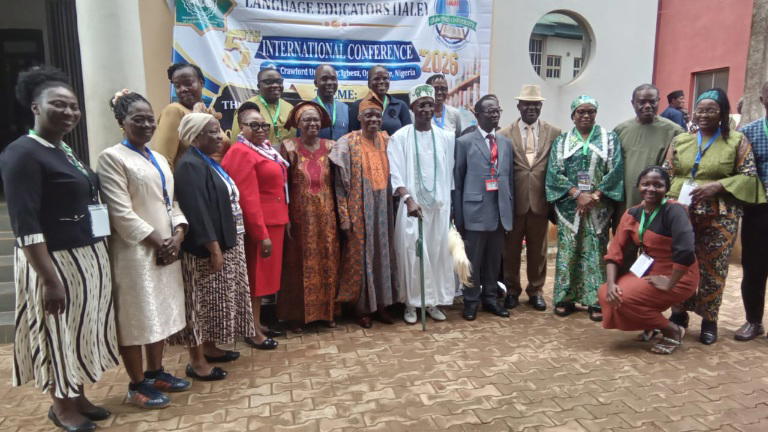
Nigeria is blessed with multilingual wealth which should be harnessed as educational capital and not seen as a problem, stakeholders at the 5th Annual International Conference of the International Association of Language Educators, IALE, have said.
The keynote speaker at the conference, Prof. Graceful Onovughe Ofodu, Professor of English Language and Applied Linguistics stated this in her address at Crawford University, Igbesa, Ogun State, on Monday.
The Dean, Faculty of Education, Anchor University, Lagos, reiterated that: “Nigeria is wealthy, linguistically. We are blessed with the concept of multilingualism. Although some people conceptualise multilingualism as a problem or a challenge, we know from the linguistic perspective that it is a wealth,” Ofodu said.
Ofodu, who spoke on the theme “The Question of Medium of Instruction in the Quest for Sustainable Education”, lamented that policy somersaults have prevented Nigeria from utilising the educational capital attached to its multilingual nature.
She described the Federal Government’s recent revocation of indigenous languages as a medium of instruction in schools as short-lived and counter-productive, calling for the adoption of phygital strategies such as translanguaging, semiotic and digital language pedagogy.
“The question of the best language that facilitates sustainable quality learning depends on resolving some 21st-century fundamental challenges. The question of Medium of Instruction involves deliberate personal, institutional and government efforts that must not be short-lived by revocations,” she said.
“The effects of the recent mother tongue revocation are apparently here with us. It behoves this association to leverage on this and do something. Our duties are beyond holding conferences and publishing.”
The conference also faulted the Federal Government’s policy reversal, describing it as a grave error.
Delivering the welcome address on behalf of the President of IALE, Prof. D. O. Fakeye, Prof. Oyenike Adeosun said the theme was apt given the heated debate generated by the announcement by the Minister of Education, Dr. Tunji Alausa.
“Nigerians woke up to the news of the reversal of using indigenous languages as media of instruction at the lower level of education with shock. The Nigeria Academy of Education vehemently opposed the position of the minister against the backdrop of research-based evidence that points to the facilitative role of indigenous languages as media of instruction at the lower primary education levels,” she said.
In his remarks as Chief Host, the Vice-Chancellor of Crawford University, Prof. S. O. Makinde, said cancelling the 2022 National Language Policy was unwise.
“When it was released in 2022, we were all jubilating. It was a negative shift in the development of our indigenous languages. It was a grave error,” Makinde said.
“When a language is not used in communication, that language is lost. The highest promotion that can happen to any language is for that language to be used as a medium of instruction. Our languages must be developed in such a way that we can use them in education. Apart from that, they have to be used in the Houses of Assembly; even the President needs to speak them.”
In her plenary paper, Prof. Nkechi Christopher of the Department of Communication and Language Arts, University of Ibadan, challenged the sincerity of the elite class on mother tongue education.
“How many of you will put your children in a school where they are teaching in mother tongue? Once we can answer that, it will be solved,” she asked.
Christopher noted that lack of investment remains the bane of both English and mother tongue instruction.
“If you are teaching only in English, you are not even investing in it. You want to teach in mother tongue, that is even worse. We don’t have any investment in these things. If you want this to work, you have got to give it all the energy it deserves. We should start by determining what we want to be the outcome. What do we want a child to have acquired after primary school, after secondary school, after university? Let’s start from there and walk backwards to the beginning,” she said.
Earlier, Chairman, Local Organising Committee, Dr. Sola Aina, said the conference hopes to address what is ideal as a medium of instruction and provide a communique that will help improve national growth and development.
The conference ended with a call on government not to destroy Nigeria’s natural linguistic wealth bank and urged language teachers to improve their proficiency and adopt global best practices.
Disclaimer
Comments expressed here do not reflect the opinions of Vanguard newspapers or any employee thereof.