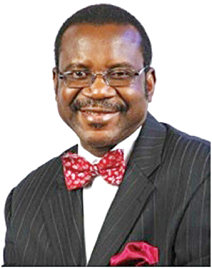
Layi Babatunde, SAN
Continues from last week
WITH the lawsuit filed on 8 February 2011 at the Federal High Court in Abuja by the PCA, Ayo Salami, against the CJF, Aloysius Katsina-Alu…
…Nigerians everywhere deserve a dispassionate and tidy conclusion to this and anyone proved guilty should face proper sanctions. The legal profession especially has a moral burden to ensure this.

Layi Babatunde, SAN
…Our judicature, our democracy, and our country are at stake. If it is right to insist on the due process for public officers accused of corruption, the rules cannot be different for judges.
Prior to that time, some highly respected Jurists have not been silent, on the debilitating effect of corruption on the administration of Justice in Nigeria; if allowed to thrive.
One that readily comes to mind, is that of that erudite, courageous one time Justice of the Supreme Court, Honourable Justice Chukwudifu Oputa (of blessed memory). In a lecture delivered at the Nigerian Judicial Institute (NJI) in 1990 on Judicial Ethics, Law, Justice and the Judiciary, the Law Lord clearly stated that it is a calamity to have a corrupt judge. Let us quote him in extenso:
Conscience comprehends honesty and moral rectitude. Both virtues should form the badge of a good Judge. They should be his uniform. It is a calamity to have a corrupt Judge. Money they say is the root of evils. The Judiciary is not a place to make money. There is no doubt the salary structure and conditions of service in our Judiciary both need complete and total overhaul. Our judges deserve the minimum of comfort to enable them perform their arduous duties attaching and pertaining to the judicial officer. But the poor conditions of service are no excuse for any Judge to be corrupt and dishonest, for one thing, no one is forced to go to the Bench. And no one should go to the Bench to amass wealth, for money corrupts and pollutes not only the channels of justice but also the very stream itself. It is thus a calamity to have a corrupt judge.
The passing away of a great Advocate does not pose such public danger as the appearance of a corrupt Judge on the bench, for in the later instance, the public interest is bound to suffer and elegant justice is mocked, debased, depreciated and auctioned. When justice is thus bought and sold then, there is no more hope for society. What our society needs is an honest, trusted, and trust worthy judiciary.[73]
Now that we have come to this unfortunate pass in the annals of Nigeria’s Judicial history, it is hoped that both the Bench and the Bar will rise to the occasion beyond name calling. It presents another opportunity as unfortunate as the circumstances are, to take stock and take steps to address the future of our profession. It is in the interest of us all and our country that we acknowledge our failings and make amends, without which our role, with regards to the anti-corruption Laws will become suspect. The quote below is quite instructive:
“Your laws are ineffective,’ Wen declared. ‘Why? Because no system of control will work as long as most of those administering the law against an evil have more than a finger dipped into it themselves.”
Han Suyin, Chinese physician and writer Destination Chungking (1942)
8.0 INTERNATIONAL LAW AND PRACTICES
It is important to note few instruments and institutions relevant to control of corruption globally. I do not have the luxury of time and space. So, I will be very brief.
8.1 United Nations Convention against Corruption
The United Nations Convention against Corruption (UNCAC) was adopted by the General Assembly on the 31 October 2003 and entered into force on 14 December 2005. It is the first global legally binding instrument in that field which covers public and private, domestic and international corruption. The convention basically rests on four pillars: corruption prevention, law enforcement, international cooperation and asset recovery.[74]
8.1.1 International cooperation
In this context, State Parties agreed to cooperate with one another in every aspect of the fight against corruption, including prevention, investigation and the prosecution of offenders. Countries are bound by the Convention to render specific forms of mutual legal assistance in gathering and transferring evidence for use in court and to extradite offenders. Furthermore they are required to undertake measures, which support the tracing, freezing, seizure and confiscation of the proceeds of corruption[75].
8.2 The United Nations Global Compact and its 10th Principle on Corruption
On 24 June 2004, at the UN Global Compact Leaders Summit, the addition of a 10th Principle against corruption was announced, sending the signal that the private sector shares responsibility for the challenges of eliminating corruption. Specifically, the principle states that “businesses should work against corruption in all its forms, including extortion and bribery and joins the nine other principles promoting good corporate practices in the fields of human rights, labour and the environment[76].
8.3 Transparency International
Transparency International believes that one of the root causes of poverty is that foreign aid does not reach the people in need. Corruption prevents the allocation of resources, originally planned for the poor to never reach the people in need. Furthermore, corruption impairs programmes aimed to improve the lives of the very poor to be effective. Transparency International believes that the accomplishment of the Sustainable Development Goals (SDGs) is severely hindered, maybe even to the point of being made impossible, if corruption continues to exist in such an extreme form.[77]
To be continued
Disclaimer
Comments expressed here do not reflect the opinions of Vanguard newspapers or any employee thereof.