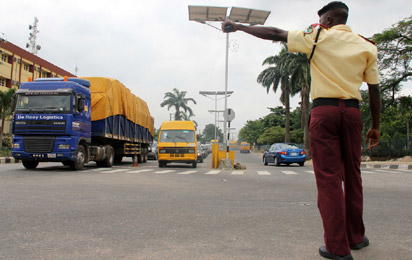
File Photo
By Muyiwa Adetiba
There was a tap on my window. I wound down a bit out of politeness and curiosity—or stupidity as it turned out—to see who it was. We—my driver and I—were on Town Planning Way in Ilupeju and were about to turn left into Coker road. We had been stopped at the junction by a man in mufti who acted like a traffic warden. A couple of cars were in front of us and a couple were behind. I was taken aback by the sternness in the voice of the man I wound down my glass for. He had appeared from the side.

File Photo
He wanted to know why my driver was driving recklessly and dangerously. I explained that we were behind cars in a crawling traffic. The opportunity to drive dangerously was not really there. He then turned to the driver and asked, again in a stern, authoritarian voice, why he crossed a lane. The driver denied the accusation. He asked him to wind down the passenger window.
The driver complied. Then like a school teacher, he proclaimed that but for the elderly man—me—that the driver was driving, he would have asked him to park and wait for 30 minutes as punishment. I was about to thank him when he put his hand through the open window and unlocked the door. In that smooth, practiced but illegal gesture, the equation changed. I became a captive.
The next thing, he was sitting on the passenger seat. Immediately, his instruction changed. ‘Go and park in front…’ he barked. I pleaded with him to reason because in punishing the driver, he would also be punishing this same elderly man he earlier deferred to. His reply to my plea was that the driver had to be taught a lesson. So I told the driver to move forward and park.
He said he would show us where to park so as not to disturb traffic. On the way, he changed his mind and said he wanted to be sure the driver was a first time offender. To do that, we needed to go to their Local Government office along the Town Planning Way. As soon as he verified that, he would let us go. Since I was sure the driver was a first time offender, I agreed.
But there was another twist to the tale
as soon as we got to the Local Government office. Somebody approached him to ask what the problem was. He said everything was under control. I was co-operative but the driver was ‘difficult,’ he said. He led us to where to park, opened the door and disappeared. An ‘officer’ came and called out to nobody in particular to deflate all the tires. At this time, I knew I had been had. I was so angry at how easy it was for me to fall a victim to what was obviously a well-rehearsed scam that I resolved not to beg any ‘official.’
I knew I was not going to leave there without paying any money and I was not about to humiliate myself further or lower my self-esteem by begging for leniency for an offence I was not sure I had committed, and which nobody had taken the pain to explain. This ‘officer’ now entered the car and sat on the same passenger seat that had been vacated without as much as ‘excuse me’ by my ‘arresting officer.’ He turned to me and asked what happened. My first reaction was to tell him he was asking the wrong person and to ask his colleague who had arrested us.
Instead, I kept quiet and stared at him. He turned to my driver who tried his best to explain to him. ‘Ah! That was bad driving,’ he exclaimed almost as if he was an eye witness. He then summoned another ‘officer’ who had been hovering around with a booklet. He gave a coded message to him and our man with the booklet wrote something down and went to the front of the car to get the plate number.
He then handed me a bill with fifteen thousand, five hundred naira on it with another paper that had five hundred naira as gate pass. It was all a well-rehearsed but duplicitous script that they played right in the premises of one of our symbols of governance.
Fortunately, I had a cheque book with me— this happens so rarely that it must have been fortuitous! I asked where the bank was and again it was a walking distance. In 30 minutes it was over. I was 16,000 naira lighter but richer in experience. My resolutions—and they should be yours too—are:(1) Not to acknowledge anybody that knocks on my window—officer or no officer—on the street. (2) Not to entertain anybody who does not identify himself.
(3) To treat anybody who violates my space by opening my car without permission as a burglar. Each time I wind the script back and realise the depth of deception that was involved, I lose another measure of respect for anybody that works for a Local Government and traffic officers in particular. I have narrated my experience in detail so as to show the number of lies that had to be told to get me to their lion’s den.
If you have to serially lie to lure your victim to your station in order to book him, then you are not a law enforcement officer but a thief and an extortionist. If you cannot face the accused and tell him what he has done wrong in the presence of a superior officer then you are a coward and a fraud. And an institution that does not hear the side of the accused in the presence of the accuser before pronouncing guilt and punishment must stink to high heavens.
Three weeks earlier, a veteran broadcaster was accosted on the same street. She had a call and parked to answer it. She heard a knock on her window and before she could react, the door was opened and in came a burly man. Her fear of being robbed was assuaged when she was told she was obstructing traffic and had to go to their office.
She calmed herself down and explained that she was too far off the road to obstruct traffic. But the officer insisted and so to the office they went. Unlike me, she neither had money nor her cheque book so she had to spend almost half a day before they could reach some settlement.
I am all for sanity on our roads. But traffic signs must be clearly and boldly stated because they are primarily for ease of traffic and not as booby-traps. But lurking in the shadows to catch someone for taking a one way street that has not been clearly stated or for crossing a lane that has not been clearly demarcated are despicable ways of extorting money and should be discouraged.
This is not the way to maintain the local government officials who serve as thugs during elections. May I suggest the use of parking metres on busy streets where people park carelessly? This will not only generate revenue, it will keep them gainfully employed while encouraging orderliness. More importantly, the money will not be proceeds of extortion.
Disclaimer
Comments expressed here do not reflect the opinions of Vanguard newspapers or any employee thereof.