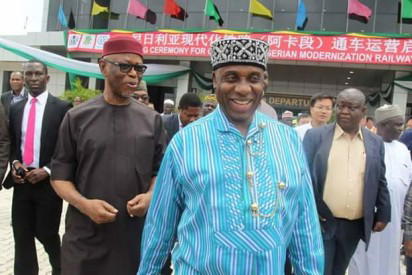
All Progressives Congress (APC) National Chairman Chief John Odigie Oyegun and Minister of Transportation, Mr Chubuike Amaechi
By Favour Nnabugwu
Nigeria needs more time to negotiate a railway concession project with U.S. company General Electric, the country’s transport minister said on Wednesday.
Both sides have confirmed talks on GE being granted a railway concession in Nigeria worth around $2 billion but no details have emerged yet.
The Minister of Transport, Mr Rotimi Amaechi said in Abuja Wednesday that, “GE is proposing a two-year rehabilitation of the rail tracks to be carried out by them and to have a concession period of 25 years within which to recover their investment,”

All Progressives Congress (APC) National Chairman Chief John Odigie Oyegun and Minister of Transportation, Mr Chubuike Amaechi
“The government has not agreed and that is what our advisers will sit with GE to agree,” he said.
Nigeria has been looking for partners to overhaul its aging passenger and freight railway system, which was mainly built by British colonial rulers before the country’s independence in 1960.
The government, suffering from a slump in crude exports, wants to boost exports of food and other non-oil products but the country lacks roads or functioning railways.
The West African country has already signed two deals worth around $5 billion with China Civil Engineering Construction Corp (CCECC), part of China’s state-owned railway construction firm, to modernise and build railways in the north and south of the country, the Nigerian transport ministry said last month.
Economic growth in OPEC member Nigeria has been hampered for decades by lack of investment in roads and railways.
Africa Finance Corporation and Greenwich Financial Advisors will assist the government in the talks on the railway concession.
GE said the railway concession project came on top of around $150 million the firm was currently spending on capital expenditures in Nigeria as cited by a senior company executive last week.
Disclaimer
Comments expressed here do not reflect the opinions of Vanguard newspapers or any employee thereof.