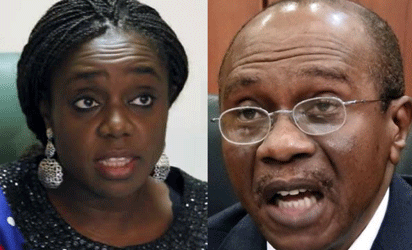
Minister of Finance, Mrs. Kemi Adeosun and Governor of the CBN, Mr.Godwin Emefiele,
By Emeka Anaeto, Economy Editor
Private sector and market reactions at the weekend turned positive to the position of the Central Bank of Nigeria, CBN, in the aftermath of last week’s divergence between the apex bank and the finance ministry over interest rates.
Finance Minister, Mrs Kemi Adeosun, had wished that CBN’s Monetary Policy Committee, MPC, meeting last week would reduce interest rates as a measure for stabilising financial markets and the economy; but the MPC retained the rate hike it had effected three months ago.
Some analysts have, however, indicated that the apex bank would sooner, than later, toe the line of the ministry given the economic trend.
But at close of trading weekend money market, capital market and foreign exchange market recorded positive results week-on-week, WoW, for the first time in the last three months.
Contrary to deficit opening balances throughout the previous week, aggregate system liquidity improved last week as liquidity levels opened in a surplus position on all trading sessions save for Monday (a day before the controversial monetary policy decision that pitched CBN against the finance ministry) when opening balance stood at a deficit of N123.1 billion.
Money rates turn positive

Minister of Finance, Mrs. Kemi Adeosun and Governor of the CBN, Mr.Godwin Emefiele,
Consequently, despite the liquidity mop up by the apex bank during the week, pressures on lending rates at interbank money market eased with Open Buy-Back (OBB) and Overnight (O/N) rates dropping to 13.5 per cent and 15.3 per cent respectively on Friday as against 36.3 and 37 per cent respectively previous week.
But treasury executives in banks said that barring any unexpected cash inflow, they expect money market rates to adjust in tandem with liquidity dynamics as dictated by additional mop-ups by CBN this week.
Also contrary to previous weeks, activity level in the bond market picked up last week amid bullish sentiment, resulting in moderation of average yield across benchmark bonds on all trading days on the back of increased buying interest, particularly at the longer end of the yield curve.
Similarly, the Nigerian equities market closed in the green as the broader index appreciated on three days of the week while declining on two. Accordingly, the benchmark index, Nigerian Stock Exchange All Share Index, gained 1.4 per cent WoW to close at 28,247.11 points.
The week had started on a negative note, with the Index losing 7.0 bases points as investors anticipated the outcome of the MPC meeting.
However, the downtrend was bucked on Tuesday as gains in market heavy weights drove the index up by 1.3 per cent and further rose on Wednesday. On Thursday the Index slid slightly by 0.2 per cent but gained 0.3 per cent on Friday.
Market capitalisation improved with investors’ gains rising by N133.5 billion to settle at N9.7 trillion while year-to-date, YtD, loss trimmed to 1.4 per cent.
Activity level strengthened during the week as average volume and value traded rose 43.2 per cent and 48.1 per cent to settle at 291.9 million units and N2.7 billion WoW, respectively.
Investor sentiment remained positive, as market breadth, measured by advancers/decliners ratio, stood at 1.3x following 33 stocks that advanced while 25 declined.
The foreign exchange market was not left out in the positive trend as Naira appreciated 0.3 per cent WoW at the interbank market following the MPC decision which was largely focused on exchange rate stability.
The domestic currency rallied in the interbank to close the week at N307.79/US$1.00 on Friday, as against N313 previous week.
Activities in the futures market however improved as the total value of open contracts rose to US$3.4 billion from US$3.2 billion in the previous week, indicating more foreign currency inflows from private dealers.
However, parallel market rate tumbled 2.3 per cent WoW as the domestic currency closed the week at N435.00/US$1.00 on Friday relative to N425.00/US$1.00 in the previous Friday.
Currency dealers commended the decision of the MPC to maintain policy rates at their current levels during the week as this demonstrates determination of the monetary authority to prop up liquidity in the currency market notwithstanding calls for a reduction in MPR.
Financial experts, economics comments:
Analysts at WSTC Financial Services Limited said, ‘‘despite the presence of cost-push inflationary pressure and the crowding out effect of high policy rate, we believe that the preference for forex stability, and the need to maintain consistency in policy pronouncements informed the decision of the MPC. Although the potential upward pressure from volatility in the forex market still requires policy attention, we however believe that a reversal of the current restrictive policy stance of the CBN may occur in the near term.
‘‘Our opinion is hinged on the imperative need to stimulate growth, consistent month-on-month moderation in inflationary pressure across all measures of inflation and expected inflows from foreign borrowings’’.
For analysts at Afrinvest West Africa, a Lagos based investment house, the MPC’s decision was a balancing act as hiking rates further would have done little to thwart inflationary pressures which remain largely structurally driven, while easing rates in response to political pressures would have communicated policy inconsistency and worsen capital account position.
They stated: ‘‘The CBN has further demonstrated its commitment to the policy tightening stance by aggressively mopping up liquidity in the financial system this week through open market operation, OMO, auctions at rates similar to previous auctions.
‘‘We believe that the decision of the MPC to maintain policy consistency and resist political pressures to cut rates will reinforce the independence of the CBN which has come under scrutiny over the last few months, whilst also emphasizing priority policy objectives necessary for businesses and markets to reasonable form expectations.
‘‘In the medium term, we think it is also positive for financial assets as capital inflows are returning, albeit tepidly, to the market’’.
On the on-going public debates and policy disagreements Professor Pat Utomi believe it was a healthy development for the economy.
In his word: ‘‘We not viable conversations to stimulate robust ideas and game plan of where we are going, convince investors that Nigeria is ready with prime time for investments’’.
Against the backdrop of allegations that most of government reactions to the economic crises were panicky, Suleiman Abubakar, Executive Director and Chief Financial Officer of Sterling Bank Plc, stated that policy positions should be sector specific.
In his word: ‘‘If we look at the macroeconomic indices of recessions we should note that some of the sectors are showing resilience which should be addressed differently from those in trouble.
‘‘We should have different sets of rules to react to certain market developments and these should be clearly communicated to the investors.
Chairman of First Bank of Nigeria Limited, Mrs Ibukun Awosika, was concerned about policy inconsistency on the part of government.
She stated: ‘‘The challenge is that when you believe and invest going by the story or policy of the authorities only to be changed mid way forcing the investor with short end of the stick, this ends up with adverse consequences in banks.
‘‘It is important we have a long term investment policy, if possible a law that would be difficult to reverse. Nigeria needs to wake up giving all the resources that are available but not put to proper and full use due to either lack of policy or policy flip flops.
For analysts at CardinalStone Partners Limited, another Lagos based investment house, what is of paramount importance is fiscal and monetary policy alignment and the need for both authorities to complement each other especially in the area of foreign exchange and investments inflow.
They stated: ‘‘We believe that to further pique foreign interests, fiscal and monetary policy will need to show a strong commitment towards stabilising the forex market and as such should urgently proceed with plans towards borrowing from external sources.
‘‘We are optimistic of increased foreign capital inflows into the country in the coming months and therefore align with the MPC on its expectations of stability in the forex market’’.
Disclaimer
Comments expressed here do not reflect the opinions of Vanguard newspapers or any employee thereof.