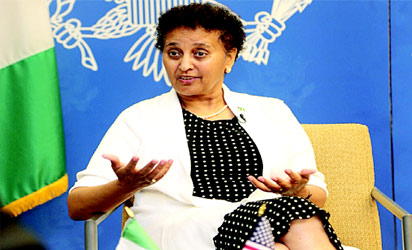
Dehab Ghebreab
Retiring US Consulate’s Public Affairs Officer and one time Acting Consul-General, Mrs Dehab Ghebreab has described her relationship with Nigerians as friendly and instructive, saying that she unquestionably admires the strong will of Nigerian women, while sharing some of her exciting moments working in Nigeria as a US expatriate/envoy. In this interview with Vera Samuel Anyagafu, Prisca Sam-Duru and Funmi Ajumobi, Dehab relates the most impressive aspect of her diplomatic service in Nigeria, her passion for women and girl child welfare and life following/after retirement.
Read on…

Dehab Ghebreab
EXCITING moments working in Nigeria?My years in Nigeria, particu larly Lagos has been exciting and when I got
here, I found it was a lot of fun and I loved it. We did so many exciting things with the former US Consul-General, Jeffery Hawkins. He had big dreams and it has been a credible assignment. My first assignment in the Foreign Service was in Abuja and my last assignment in Lagos, so I feel like it was meant to be and I would not have changed that for anything else, because it’s been wonderful.
Retiring in Nigeria, how it feels
I feel Nigeria is unique in many ways because of its people. Nigerians are very friendly, very open and candid. They tell you what they feel and how they feel and I did not find that to be the case in other countries. Also, Nigeria is a very dynamic country, whether it is in politics, business sector, civil society, and or Nollywood. It has been a lot of energy and excitement. All these and more make Nigeria unique, coupled with being the largest economy too.
Passion for women and girl child welfare, issues, empowerment
The fact is, I was born and raised in Eritrea and my father who worked for the US Army had provided for everybody. My mother however, did not finish high school and I know what that meant. However, I came from a very modest family of 11 children and I understand such background, but looking inside, I feel that I was also a bit different from my siblings, because I like to explore and try new things. I was not afraid, and took daring and bold steps than my immediate elder sister. For me, I think that was instructive in how I handled myself moving forward.
I looked at opportunities and did not stay back. In all these, I feel that if we reach out to young girls at an early age and make them believe deeply that they can become whoever they want to be , because in life, for the most part, where we come from does not really affect or tell where we want to go. Based on my example and based on what I have seen in life, there are women who have reached the highest levels and they came from a very modest background and I think we need to show example to young women and possibly give them hope and deliberately too, do whatever thing that we can do within our power to touch lives. It is a struggle, it is not easy, especially in the rural areas where it is very tough for girls, but we do what we can with the limited capacity that we have to inspire and encourage girls.
You seem fragile but very strong and bold. What makes you express the kind of love you show to Nigeria?
I do not believe that a woman has to be tough and aggressive and mean to get what she wants. Obviously you have to be strong to say no when you have to. I feel that life has been really good to me because I have not had any serious challenges in life. Well, as I feel good about it and I know is tough out there for women and I know a lot of friends who have gone through very difficult and depressing situations and it breaks my heart. But you can be there to support people and move them on and say you can do it.
Then in principle also, you got to say no, I cannot do this, you have to have principle, regardless of the situation. Even if it comes to losing your job, whatever it is, you have to have the principle to say you cannot do this or that and move on with your life from there. In my 4 years here, I see women who have faced adversity and have really built themselves up and these I have them in Nigerian women.
Maybe I had it better compared to my mother’s situation, but I feel that my mother who is not that well educated raised 11 children and all the 11 children did really well and that is common sense. I was educated, but she did not have the kind of education that I have, but I respected her common sense, her strong will and I see that in Nigerian women every-day. You know it is hard and tough but regardless, they are struggling to make ends meet. When I look at all the young girls on streets peddling stuffs, I say God, these are young women that if given an opportunity they would do well for themselves and future families and for the nation.
African women career
I think African women joggling work and family is very tough. Although in some cases they get help to raise the children by hiring someone to help you in the house. In developed countries, like in United States, I raised 3 children and it was a struggle for me because only wealthy people can afford to hire house keepers and nannies. So for, raising children and going to work and doing all the things we have to do at home, like waking up early, preparing breakfast and sending off children to schooling, going to work, coming back and preparing dinner was really tough. It is like a circle that every hour you have to account for.
So maybe here, because of the social network, it is not as difficult. But what I know is that in some countries, women are doing well both politically and economically more than others and it seems to me that Nigeria should be the leader, because I like the strong will of Nigerian women. I also hear about women in Rwanda who do really well, about 30 per cent plus and then we have the President from Liberia, Ellen Johnson Sirleaf, who is now finishing her second term. She is a very strong willed woman, tough and remarkable, and these would be good examples for us.
On poor percentage of Nigerian women in politics
When we had the Women’s History Month, we had Professor Remi Sonaiya speak on politics in the country and when we have official visiting from Washington DC, we bring young women or politicians to talk just for us to understand the Nigerian women’s stand in politics. There are challenges and we hear that the culture itself constraints women from running in addition to many other factors. When I was in Abuja for the first time, after the 2003 elections, we brought women to talk about the election, experiences and why women are not rising to run for offices.
A woman from the North, had ran for an office and lost. She said she saw what men were doing and then the next time she ran, she gave out bags of rice and reached out and she got elected. She also said her first supporter and campaigner was her husband. Her husband worked with her and then her brother and other supporters as well. So politics is very tough, but I think you will get there.
Relationship with the media
It is been wonderful working with the Nigeria media and I feel that without them, my work here would have been very difficult. I am talking boldly of the media in Nigeria, because they are very robust and engaged.
Although the freedom of Information Act is yet to make an impact in the work that they do, it is there. We try to do professional development as much as we could. Whether it is sending people to the US or bringing trainers here and I think that will continue. Certainly the media has grown over the years compared to when I was at Abuja the first time. It is quite a change.
PAS impact on Nigerians
In my office, we have 2 Americans and 14 Nigerians working and our job is to increase mutual understanding between Nigeria and US through exchange programs, cultural programmes and we do capacity building for the media.
Increasing mutual understanding
And with our exchange programs, the numbers have increased over the years, especially the Mandela Washington Fellowship Programme, which is President Obama’s initiative. Although, we have not increased staff members, it takes lots of time and energy to run the program, and Iast year, we received 14,000 applications from Nigeria and I was involved in the processing and interviewed about 150 people from different states. The kind of work that the Fellowship people are doing is gratifying and very creative. They are not waiting for governments, but they are creating jobs, using technology in health sector, agriculture, in education and business entrepreneurship.
What I have seen amazes me and I hope that people will get the chance to see these things and as long as there are young people who are confident, who are saying we can do it and they are looking for opportunities to develop themselves, and when they come back, especially the Mandela Washington fellowship, they are going to reach out to other young people.
They are developing a network and they are looking at what problems do we have and how do we solve these problems and I think we are going to see a turning point, a very dramatic change in Nigeria. We invest in capacity building, especially when it comes to young people and women’s welfare.
Life after retirement
I have not had time to think this is exactly what I want to do, but when my children grew up, went to college and graduated, I felt liberated. I felt like I have all the time in the world to focus on work and development. And now I feel like this is my time 100 per cent. I am not tied to a job and so I can do whatever I want, whatever my husband and I want to do. And that is a new world that has opened for us and I want be constructive in using it to do something with a purpose.
I want to have a purpose and not just using it watching Television, sleeping or relaxing. I want to do something that will reach out to people. My passion for education and women will definitely remain there and I might just want to do short time assignments abroad through the State Department but for the rest of my time, writing a book will be an option that I will like to consider very seriously.
Managing home and work
It is not easy task. I would be lying if I tell you that it is easy. But the most important thing is the family. You have a goal together, because you cannot do it without them. Everyone has to contribute and share in the burden of families, including the children. I am fortunate that my husband contributes more than I do in many ways and we train the children to be independent and do certain things at a given age and that takes some responsibilities away from you. And for individual families, we should look at ourselves as running a small country with different characters, different needs and so on and try to work it out somehow.
Gender equality in Nigeria
One thing that comes to mind is that women’s associations are not prevalent here. Making impact is enough, reaching out, advocacy and so on is needed, yet there is still a lot to do in terms of getting the support that you need in passing legislation in support of women and the girl child.
Things to be missed most about Nigeria
I plan to be very close to Nigerian friends and anytime Nigeria is mentioned, I would want to know what is going on, what is happening and beyond these, I miss just being here and working. However, traffic is a challenge here and it makes it difficult for me to manage my time, because as much as we want to reach out, the traffic surrounds us and you spend time waiting for events to start. I think young people here will need to learn about these things when they are still in school. It is not acceptable for anybody to go to an event and wait for two hours for the event to start.
Disclaimer
Comments expressed here do not reflect the opinions of Vanguard newspapers or any employee thereof.