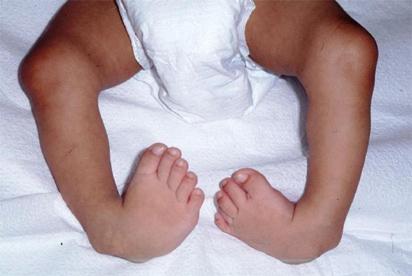
Untreated clubfoot results in poverty, niversal newborn hearing screening and management is desirable for early detection and treatment of hearing disorders.
By Chioma Obinna
An expert in club foot management, Dr. Olayinka Adegbehingbe, has urged Nigerians not to take the club foot as fate, but rather seek ways of correcting the health condition. Clubfoot is a general term used to describe a range of unusual positions of the foot. Although clubfoot is painless in a baby, treatment should begin immediately.

Untreated clubfoot results in poverty, niversal newborn hearing screening and management is desirable for early detection and treatment of hearing disorders.
Clubfoot can cause significant problems as the child grows. But with early treatment most children born with clubfoot are able to lead a normal life. Speaking during the commemoration of the 2016 World Club Foot Day in Nigeria, Adegbehingbe explained that progress was being made to get other ways to correct the condition apart from invasive surgery, which was expensive.
“Club foot is a worldwide synonym for Talipes Equinovarus, a congenital limb deformity that has added to the burdens of families and communities. The need for a cheaper management of this condition has necessitated the adoption of the Ponseti method of treatment, which is a low-cost, low- technology, non-invasive method of club foot treatment that is known to have recorded excellent success rate globally.”
Adegbehingbe who is also the Coordinator of Nigerian & West African Clubfoot Study Group, noted that the congenital deformity affects almost 150,000 children annually, stressing that about 80 per cent of the children live in developing nations, including Nigeria.
According to him, many experts are now willing to use Ponseti method; a technique that corrects club foot without invasive surgery. He said the treatment of club foot was based on the inherent properties of the connective tissue, cartilage, and bone, which responded to the proper mechanical stimuli created by the gradual reduction of the deformity.
He stated that the ligaments, joint capsules, and tendons were stretched under gentle manipulations and a plaster cast was applied after each manipulation to retain the degree of correction and soften the ligaments. He said the displaced bones were thus gradually brought into the correct alignment with their joint surfaces progressively remodelled.
He explained that; “After two months of manipulation and casting, the foot appears slightly over-corrected but after a few weeks in splints however, the foot looks normal. “The non-operative treatment will succeed better if it is started a few days or weeks after birth and if the podiatrist understands the nature of the deformity and possesses the manipulative skill and expertise in plaster-cast applications.”
He noted that a national guideline on club foot management had been developed as part of efforts to implement the strategy of reducing long-term effects of the condition, adding that the guideline was practical and rich in scientific information.
Disclaimer
Comments expressed here do not reflect the opinions of Vanguard newspapers or any employee thereof.