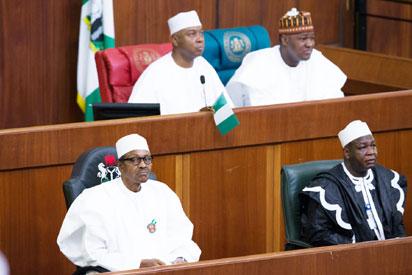
Buhari presents N6.08trn 2016 budget to NASS
Soni Daniel, Northern Region Editor
When President Muhammadu Buhari presented the 2016 Budget before the joint session of the National Assembly on December 22, 2015, he must have leaped for joy that
he had at last begun the journey to delivering his much touted change agenda to
Nigerians.
Though, seen as a national annual ritual that must be perfunctorily performed by a sitting president, the event marked for Buhari and his administration a golden opportunity for him to unfold his major economic blueprint for Nigeria, the first he had ever done since assuming power on May 29, 2015. If not for anything, the fiscal document boasted of an ambitious provision of over N6 trillion with more national projects slated for implementation under capital votes as opposed to previous estimates.

File: Buhari during the 2016 budget presentation to the National Assembly.
The budget derived its focus from the 2016 Agenda of the Federal Government; which is majorly to diversify the economy through import substitution and export promotion to build a robust and resilient economic legacy for the future.
According to the government, the budget is anchored on the President’s commitment to create a more diversified, sustainable, and inclusive economy which unlocks the latent potentials of the people, communities and natural endowments across the nation’s federating units. This is hoped to be anchored on the instrumentality of a medium-term (up to 2019) and long term (up to 2030) development plan as well as an updated Monitoring and Evaluation Framework.
The agenda is hinged on Economic Reforms, Social Development, Infrastructure, Governance and Security, Environment as well as States and Regional Development. The strategy proposed by the administration is prioritization of critical policies and targeted interventions to deliver expected outcomes in the next 12 months using disciplined, consistent, measurable and sustainable progress across the six pillars adopted.
For these reasons, many Nigerians were expectant that Buhari would at least arrest the rot in the economy, which had virtually been torpedoed by continuously declining oil prices, faltering power supply, warped foreign exchange regime and depleted foreign reserves, and offer fresh hope and a new direction with his fiscal and economic policies.
For that reason, many Nigerians were expectant that Buhari would at least arrest the rot in the economy, which had virtually been torpedoed by continuously declining oil prices, faltering power supply, warped foreign exchange regime and depleted foreign reserves, and offer fresh hope and a new direction with his fiscal and economic policies.
But these Nigerians were dead wrong! The expected change they were hoping for, was not to be for obvious reasons.
First, as the bill went into the National Assembly for approval as stipulated by law, several malevolent forces actuated largely by pecuniary and political interests and driven by intrigues related to the 2019 election, actively connived to truncate the workability of the budget.
No sooner had the president presented the appropriation bill than some Senators who were waiting on their wings to unleash their tar brush against him, screamed that the ‘’Budget was missing’’ while others in the same camp, declared that it had been stolen. But when their counterparts in the House of Representatives maintained that their copy was intact, the Senators changed their narrative with a new allegation that there were many versions of the budget.
But somehow, the NASS and the Presidency found their way around and the issue was laid to rest, raising the bar that a common ground had been found. Unfortunately, the Presidency did not still get the clear message at that point that it was dealing with people who had since fallen apart with him and, therefore, were not on the same page with him. Ironically, most of these lawmakers are the same who stood on the same podium with PMB to chorus the ‘’Sai Baba’’ and “Change’’ slogan and actually gave him the votes during the last election to become Nigeria’s epochal leader.
The politicians, like chameleons, have changed their ideology and now appear to be actively working against Buhari and his change agenda for the country.
For them, Buhari has hurt them by not being willing to call off the current political trial of the Senate President, Bukola Saraki, by the Code of Conduct Tribunal, which is pressing ahead with a 13-count charge against the former Kwara governor and the perceived arrowhead of the opposition against Buhari.
Unfortunately for the Presidency, it played into their hands by not tidying the budget it presented to the legislators.
It was obvious to all that more brickbats were to be thrown at the Presidency over the budget in the days ahead but the Presidency, though new on the horizon, would not be taken in as a minor in a game that is well known. With a fore knowledge that the NASS usually ‘’pad’’ whatever is presented to them and take the ‘extra cash’ for their ‘Constituency Projects’, Buhari and his team were not to be taken unawares nonetheless.
Thus, while the NASS played around with the budget, removed key national projects in many cases, introduced strange and irrelevant ones into the budget and also substantially removed the amount earmarked for some and strategic projects, in the name of working on it, the Presidency patiently waited for them to be through with their work. As it were, the manoeuvring by the NASS over the budget, led to a prolonged ‘work’ on the matter and forced the lawmakers to miss all the deadlines set by them, including February ending.
But when the lawmakers eventually ‘finished’ work on the budget and transmitted it to the President for assent, the unthinkable played out.
They played a fast one on the Presidency and Nigerians by withholding the details of what they passed and sending only the summary or highlights, to Buhari, to assent, praising themselves to high heavens that they had done their very best for the nation and its people.
Buhari was not impressed. To him, the budget passed by the NASS had thrown more spanners into the works than advance the course of change, which he had proposed. He vowed not to sign it into law and the furore between the two tiers of government, began in earnest. Apart from distancing himself from what the lawmakers sent to him, Buhari made it clear he would go through the document ministry by ministry to see if what had been sent to him by the NASS substantially agrees or deviates from what was proposed.
He was right.
His instincts had forewarned him that something serious and dangerous to the health of the budget had happened. Beyond his instincts, his loyalists in the NASS, who believe strongly in his Change Agenda, had been reporting to him on a steady basis that the budget had been tainted by avarice and opportunism by those who pretended to ‘work’ on it.
They had made it clear to Buhari that the major projects like the Calabar-Lagos Coastal Railway and other key projects meant to revitalise the economy by opening up the country and creating new jobs, had either not been accommodated or the sums provided for others drastically reduced so as to make it impossible for such projects to be realised within the fiscal year.
Apparently armed with such feed forward, Buhari was already seething with anger and disbelief by the time the budget was transmitted to him by the NASS leadership on April 7, 2016.
But rather than betray his emotions, PMB displayed a calm mien and summoned an emergency meeting of his ministers, who met on April 8 to look critically at the budget details from the NASS. They were shocked by what they saw after sitting with Vice President Yemi Osinbajo for over three hours to review the document. Their verdict was unanimous: “The budget has largely been distorted by the NASS and we cannot work with it,” they all fumed.
While some members of the NASS initially insisted that the Calabar-Lagos railway project was not included in the budget passed by them and transmitted to the president for assent, the Chairman of the Senate Committee on Land Transportation, Senator Gbenga Ashafa, countered his colleagues on the matter and insisted that the project was actually included (at a later date) and accepted by the National Assembly and expressed shock that it was removed. Ashafa was forced to issue a statement to put the record straight.
He said in the statement: “I confirm that the Lagos to Calabar rail line was not in the original document that was presented to the National Assembly by the Executive. However subsequently at the budget defence session before the Senate Committee on Land Transport, the Hon. Minister for Transport, Rotimi Amaechi, did inform the committee of the omission of the Lagos to Calabar rail modernisation project and indeed sent a supplementary copy of the ministry’s budget to the committee which contained the said project.
“The minister noted that the amount needed for the counterpart funding for both the Lagos to Kano and Lagos to Calabar rail modernisation projects was in the sum of N120 Billion, being N60 billion per project.
While the committee did not completely agree with all the changes made in the subsequent document, being fully aware of the critical importance of the rail sector to the development of our dear country, distinguished members of the Senate Committee on Land transport keyed into the laudable (Lagos to Calabar, rail modernisation) project and found ways of appropriating funds for the project without exceeding the envelope provided for the ministry.
“In so doing, the committee observed that the Lagos to Kano rail rehabilitation project had been allocated the sum of N52 billion as against the sum of N60 billion which the Hon. Minister requested as counterpart funding while no allocation whatsoever was made for the Lagos to Calabar rail line.
“The Lagos to Calabar rail modernisation project was therefore included in the Senate Committee on Land Transports recommendation to the Senate Committee on Appropriations”.
A senior official of the Ministry of Transportation, who is familiar with how the project was included in the budget, said that removing the N60 billion counterpart funding for the Calabar-Lagos Coastal rail project and increasing the Lagos-Kano lot, which also had N60 billion, to N92 billion, was to give the impression that Buhari and Amaechi did not do anything for the Southern part of Nigeria but only favoured the north when they were in office. The official said that such plot could make undiscerning Nigerians from the South to vote against Buhari and his party in the next election.
Convinced that the NASS was playing politics with the project so as to humiliate Buhari and Amaechi, the official challenged the House of Representatives and the Senate to produce the report of their respective submissions to the NASS if they insist that the project was not included in the budget.
The officer said: “When the budget was collated by the Budget Office and copies sent back to the respective ministries for perusal, it was noticed that the Coastal Rail Project was erroneously omitted at the compilation stage, although the total amount did not change.
“The Transportation Ministry immediately, through a memo, drew the attention of the Budget and National Planning Ministry to the omission and it was corrected in the amended version which the Minister took the National Assembly and defended,” he said.
He insisted that it was the amended copy that the team from Ministry defended before the National Assembly and not the one that had the error, an indication that there may have been in circulation a budget that did not contain the Calabar/Lagos rail project.
Sunday Vanguard learnt that although members of the Appropriation Committee of the House of Representatives raised some issues about an assumed duplication of the project because both the Lagos – Kano and Calabar – Lagos had the same figure of N60b each in the allocation, Amaechi explained that there were two different projects that would be funded through the assistance of the Chinese government.
According to the ministry, the sum of N80b was also provided in the same amended version for all other rail projects indicated.
The source said the minister even met with the Chairman of the Appropriation Committee in the Senate, Senator Danjuma Goje, on the two strategic rail projects; and also with the Chairman of the Senate Committee on Transportation, Senator Gbenga Ashafa, and the projects were clearly explained after which they were appropriately reflected in the Senate Transportation Committee report to the Appropriation Committee.
“That may be reason why the Senate Committee Chairman on Appropriation has been quiet since the controversy started because he cannot claim ignorance on the issue”, the source said.
The source also drew attention to the fact that the House of Representatives Appropriation Committee Chairman, Abdulmumin Jubrin admitted that the Transport Ministry budget overshot by N54b and queried if they were sincere, why the Ministry’s attention was never drawn to it during the several interactions they had with the National Assembly committees; but decided to distribute the funds to projects which were either not included anywhere in the budget or were provided for elsewhere.
He also queried why the allocation for Kano Airport jumped from N60b to the N92b reflected in the details sent to the President.
“Since Jubrin was referring people to the original budget, let him also show the people where either N60b or N92b was reflected in the original budget for the Lagos – Kano rail project?” he insisted.
Although some of the Senators tried to sound tough by insisting that they would not revisit the budget if the president does not sign it into law, those who are familiar with what was done to the appropriation bill, believe the lawmakers overreached themselves in the course of approving it.
It is argued that although the law stipulates that the lawmakers should approve the budget prepared by the Executive, such law does not confer on them the right to rewrite the budget, add whatever they want and remove whatever they feel and transfer the amount to their Constituency Projects. Those who are in this category argue that the action of the lawmakers amounts to taking over the function of the executive and a breach of the law.
Nobel Laureate, Prof Wole Soyinka, belongs to the group of Nigerians who feels that the NASS has stabbed Nigerians on the backs with what they did to the budget.
Their argument bolsters the fine line that it is the president, and not the NASS that promised Nigerians change through a new policy direction anchored on corruption-free budget implementation strategy.
Nigerians further argue that at the end of the four years, it is Buhari who will be called upon to account for the mandate given him by the people and not the NASS and asked them to give the president the needed support to drive home his agenda for the country.
And for the first time since the brouhaha over the budget began to rage, the Minister of Budget and National Planning, Senator Udoma Udo Udoma, spoke out in defence of the Transport Minister, Rotimi Amaechi, confirming the Calabar – Lagos rail project was captured in the 2016 Budget and for which the President went to China to press for funding.
Udoma, who issued a statement via his Media Adviser, Mr. Akpandem James, made it clear that both Calabar-Lagos and Lagos-Kano rail projects were captured in this year’s budget.
The explanation by Udoma substantially helped to douse the tension in both the NASS and the nation as the parties to the ‘conflict’ opted to censor themselves after his statement as the chief custodian of the nation’s budget document. The minister’s position coupled with revelations that the key members of the NASS Committees on Appropriation cornered projects ranging from N2 billion to N4 billion because of their privileged positions, infuriated majority of the members of the legislature, who promptly called for the resignation of those who benefitted from the budget impasse to the detriment of the country.
One influential lawmaker from Kano, who headed one of the committees, is reported to have converted the votes meant for many national capital projects into Constituency projects for his state and added many other projects which the Presidency did not include in his submission to the NASS. That decision of introducing entirely new projects into the budget and removing what was provided for, or substantially reducing the money set aside for projects and services, are the major ploys deployed by the NASS to distort the budget and by extension make it increasingly impossible to implement it.
Buhari’s loyalists, including former President Olusegun Obasanjo, who visited him last week, have bluntly told him not to succumb to the blackmail of the NASS by signing the doctored budget, which would be difficult to implement so as not to rubbish his presidency as was the case in the past.
They informed Buhari that signing the budget the way it is, would be akin to committing suicide and may pave the way for his administration’s failure and make the opposition to prevail over him in the next election.
Last night, there were apprehensions within the NASS that heads might roll over the budget padding but all the members were asked to ‘ceasefire’ and watch the next salvo to be fired by Buhari upon his return to the country.
While that remains the position, the House of Representatives has agreed to revisit the budget and accommodate whatever is said to be missing.
But the Senate on the other hand, has vowed to veto the president should he refuse to sign within the stipulated 30 days.
For the upper legislative chamber, the lawmakers did their job well and should be commended for its patriotism and altruism.
In a major response to the budget row, the Spokesman for the Senate, Sabi Abdullahi, warned Buhari to stop inciting Nigerians against them.
The caption of the story by major newspaper was with the audacity of a lion. It screamed: “Senate issues final warning to Buhari”.
Abdullahi, who was flanked by other Senators and under the kleighlight of major television and stations and print journalists covering the Senate, said boisterously, “While the executive is mandated to prepare and lay before the National Assembly a proposed budget detailing projects to be executed, it should be made clear that the responsibility and power of appropriation lie with the National Assembly. If the presidency expects us to return the budget proposal to them without any adjustments, then some people must be living in a different era and probably have not come to terms with democracy.
“We make bold to say, however, that the said Lagos-Calabar rail project was not included in the budget proposal presented to the National Assembly by President Muhammadu Buhari, and we challenge anyone who has any evidence to the contrary to present such to Nigerians.
“Since the beginning of the 2016 budget process, it is clear that the National Assembly has suffered all manner of falsehood, deliberate distortion of facts, and outright blackmail, deliberately aimed at poisoning the minds of the people against the institution of the National Assembly.
“This latest antics of this particular minister of transportation, Rotimi Amaechi, is reckless, uncalled for and dangerously divisive. Apart from setting the people of the southern part of the country against their northern compatriots, it potentially sets the people against their lawmakers from the concerned constituencies and sets the lawmakers against themselves.
“We hereby demand from Mr. Amaechi a publicly tendered apology if he is not able to show evidence that the Lagos-Calabar rail project was included in the budget. Otherwise, he should resign forthwith.
“Finally, by the provision of Section 81 (4) (a) and (b) of the constitution, the President is allowed to sign the budget and kick-start the implementation of the other areas that constitute over 90 per cent of the budget where there is agreement between both arms, even as we engage ourselves to resolve the contentious areas, if there were any.
“We, therefore, urge President Buhari to sign the 2016 budget without any further delay”.
It was a twin fireworks directed at Mr. President from his ‘men’ in the hallowed chambers.
A day before the Senate unleashed its anger on Buhari, the House of Reps had also claimed ignorance of the Calabar-Lagos railway project and accused Amaechi of stoking the fire this time around.
Its spokesman, Namdas, accused Amaechi of bringing the project through the backdoor of the NASS but did not explain how.
According to him, the report that the project was removed, and its budget appropriated for the completion of the Lagos-Kano rail project was misleading and intended to set the Southern and Northern parts of the country against each other.
The crossfire of tantrums notwithstanding, Buhari is yet to respond to the matter, having spent the whole week in China to secure vital funding for the controversial projects and draw down over $6 billion worth of investments for Nigeria in one swoop. As he returns to Abuja, there are fears he may wield the sledgehammer against his party men and women, who have been caught napping in the budget fraud.
Others have suggested that in a bid to douse the tension in the land and in the spirit of party harmony, PMB might simply allow sleeping dogs to lie and forge ahead and do the job for which he was elected.
Disclaimer
Comments expressed here do not reflect the opinions of Vanguard newspapers or any employee thereof.