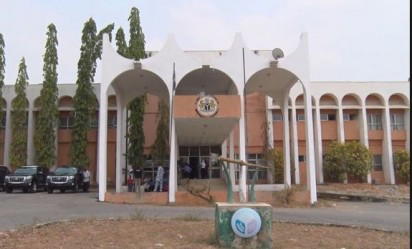
Kogi-Assembly
By Boluwaji Obahopo, Lokoja
The war in Kogi State House of Assembly before it was hijacked by external forces was self-inflicted. Though the executive arms of government, the Peoples Democratic Party, PDP, the deputy governorship candidate of the APC in last November governorship election in the state, James Faleke, and the Presidency have now been dragged into the crisis, the legislators ignited the fire before it spread and now seems uncontrollable.
The state assembly, since 1999 when the country returned to democratic governance, has not enjoyed peace. Aside the Clarence Olafemi speakership which was not impeached; no term has gone without two or three Speakers emerging to lead the House and mostly in a dramatic manner that is at variance with democratic ethos.
GENESIS
In December last year, a group within the House, led by Godwin Osiyi (Ogori/Mangogo, PDP), organised a palace ‘coup’ to oust the Speaker, Momoh Jimoh Lawal, citing lack of internal democracy and weak leadership. Political observers, however, alleged that the move, which came at the twilight of former Gov. Idris Wada administration was to force the Speaker to attract some favour from the outgoing governor. The move did not receive executive backing, it flopped.
Meanwhile, the group continued to parade itself as a factional caucus and, since then, peace has eluded the House.
BELLO’S INVOLVEMENT
Though the Assembly crisis was inherited, Governor Yahaya Bello’s saw it as an opportunity to achieve his political aim.
With the legitimacy crisis hanging over his head, and possible fear that the tribunal may order for re-run election, Bello moved to find a soft landing for himself. To achieve this, the governor ignored the Kogi West where Faleke’s hails from for the deputy governor slot to pick his deputy, Simon Achuba, from Kogi East. With the governor from the Central, deputy from the East, there was no doubt that the Speakership should have moved to the West; in the spirit of equity. That development gave a natural ultimatum to the occupier of the seat; Momoh Jimoh Lawal, who is not only from the Central but also from the same local government and same home town with Bello to step down.
Sunday Vanguard gathered that the Speaker, at a meeting with the governor, agreed to step down so that the West will produce the Speaker. The West is divided into two zones: the Okun axis with five LGAs and the Lokoja/Koto axis with two LGAs. The zone endorsed Prince Kolawole Matthew from the Okun axis but the governor kicked against it. Kola ‘sin’ was said to be because he hails from the same federal constituency with Faleke who is challenging Bello at the tribunal. Bello’s camp therefore ruled out the Okuns from occupying the seat for the fear that if the tribunal orders for re run-election, the Speaker will become the acting governor and may use the ethnic connection to favour his kinsman The governor thereafter anointed Umar Imam (Lokoja 1, APC) as the number three citizen of the state.
Though there are other two members from the Lokoja/Koto axis who are PDP membeers ( Lokoja 11 and Kogi,) the governor did not want that either; his desire was for his party man to be the Speaker and, by extension, acting governor at the ‘appropriate’ time.
PDP CONNECTION
While the Speaker agreed with his kinsman, the governor, to accept the executive zoning arrangement, the decision did not go down well with the PDP which holds the majority in the House (the PDP has 14 members in the House, APC 11).
Meanwhile, the PDP national leadership summoned its 14 members to Abuja, chastised the Speaker for such accord with Bello,begged the Osiyi camp which had commenced impeachment move against the Speaker to relent and asked them to maintain the status quo.
The PDP calculation was also hinged on re run-election and wanted the acting governor to come from its fold should the tribunal rule in such direction. Lawal accepted the PDP offer and renounced his earlier stand with the governor.
That was the beginning of the unending war.
The governor, in trying to make his plan work, called on some of his APC members in the House to impeach’ Lawal. Only five lawmakers were involved in the so-called impeachment in a parliament of 20 members.
The G5 members have since been looking for every means to legitimise their illegitimacy. They first attracted three members who moved to their camp from the Lawal’s group. The caucus also attracted three of those who won their bye-election; raising their flank to 10.
FALEKE’S ANGLE
The G15, before they lost two members to the G5, approached the House of Representatives for solution to the Kogi parliament impasse. The House of Reps raised a committee to investigate the crisis; the committee recommended that the assembly be sealed and the National Assembly to take over its function.
Faleke’s involvement in the crisis is an open secret. Though his (Faleke) campaign organisation, through his Director, Media and Publicity, Duro Meseko, has continued to denied having hand in the crisis; he cannot in political logic wriggled himself out from the saga, being a House of Representatives member.
The Reps committee decision gave credence to it. Within 10 days that the G15 lodged its complaint, the Reps deliberated, raised a committee; the committee came on a ‘fact finding’ mission to Kogi, submitted its report and the report was endorsed by the House.
The Bello’s camp believes that Faleke is the political drummer beating the drum which the House of Representatives is dancing to.
PRESIDENCY ANGLE
When the G15, who are now 13, alleged that President Muhammed Buhari was supporting the governor to continue to perpetrate act of illegality, not many political analysts believed the allegation. But recent events seem to have justified the claim. First the governor visited the Presidency, held a closed door meeting with the SGF, Babachir, and proclaimed to the media that there was no crisis in the state Assembly. The next day, the Assembly complex, earlier sealed by the police, was unsealed before public outcry made the police to lock the Assembly again.
Secondly, the Attorney General, just like his hasty proclamation on the replacement of the late Abubakar Audu as the APC candidate for the last year guber race which favoured Bello, also advised the Inspector General of Police to ignore the National Assembly order to seal the state Assembly complex and it was reopened.
Presently, the G5, led by Umar Imam, is having the upper hand in the crisis despite its illegitimate impeachment. Its members are enjoying patronage from the executive; using the Assembly complex; enjoying security escort. The 13 other legislators have been denied their salary but did not have a common ground to press for their demands.
The reason the National Assembly summoned the IG and the Attorney General to appear before it was the ‘suspension’ of the embattled Speaker, Lawal, and nine of his supporters by the factional Speaker, Umar Imam. This was done to enable them pass the budget. Sensing that they needed 2/3 of 23 which is 16 to pass the budget and, they being just 10 which fall short of the constitutional requirement, Imam group suspended 10 of Lawal’s camp; reducing the assembly figure to 13 ‘legitimate’ members. And their 10 is now a good number to carry out that constitutional responsibility.
Disclaimer
Comments expressed here do not reflect the opinions of Vanguard newspapers or any employee thereof.