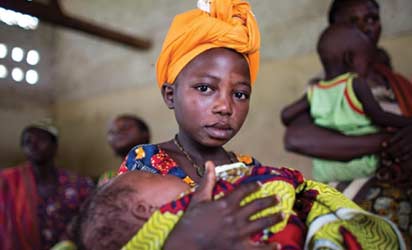
File; Child-marriage
By Amaka Abayomi, Ikenna Asomba & Tare Youdeowei
Education, they say, is an important foundation to improve the status of women and has also been recognised as a fundamental strategy for development as no sustainable development is possible if women remain uneducated, discriminated against and disenfranchised.
Recognising that education is a powerful instrument that enables women to access a variety of opportunities, while rendering them less vulnerable to HIV/AIDS, abuse, and exploitation, the World Bank has stated that there is no investment more effective for achieving development goals than educating girls.

File: Child-marriage
It’s against these backdrops and the declining rate of the girl-child in schools that Nigeria joined the rest of the world to mark the annual International Day of the Girl Child.
Being the fourth edition, this year focuses on adolescent girls and the Sustainable Development Goals (SDGs), which set a range of international targets, including gender equality, to be achieved by 2030.
Marking the International Day of the Girl Child, the United Nations Secretary General, Ban Ki-moon, said the newly adopted SDGs offer an opportunity for global commitment to breaking inter-generational transmission of poverty, violence, exclusion and discrimination – and realizing the vision of a life of dignity for all.
Referring to the newly–adopted 2030 Agenda and its landmark 17 Global Goals, Ki-moon said “our task now is to get to work on meeting the SDG targets and making good on our promises to give girls all the opportunities they deserve as they mature to adulthood by 2030.
“That means enabling them to avoid child marriage and unwanted pregnancy, protect against HIV transmission, stay safe from female genital mutilation, and acquire the education and skills they need to realize their potential. “It also requires ensuring their sexual health and reproductive rights. Girls everywhere should be able to lead lives free from fear and violence. If we achieve this progress for girls, we will see advances across society.
“Adolescent girls have the right to a safe, educated, and healthy life, not only during these critical formative years, but also as they mature into women. If effectively supported during the adolescent years, girls have the potential to change the world – both as the empowered girls of today and as tomorrow’s workers, mothers, entrepreneurs, mentors, household heads, and political leaders.”
Also speaking, UN Women Executive Director, Phumzile Mlambo-Ngcuka, said the cadre of 15-year-old girls living today were born at the advent of the Millennium Development Goals (MDGs) into a world of hope. Not all of those hopes were fulfilled as many have already dropped out of school to look after family members or take informal work to help support the family.
“More than 250 million of our 15-year-olds are already married, too many are facing the likelihood of HIV infection, especially given the high unmet needs for family planning, and every 10 minutes somewhere in the world, an adolescent girl dies by violent means. These, and the generations that follow them, are the young women for whom we are working so hard.”
Shocking statistics
With children under 15 years of age accounting for about 45 per cent of the country’s population, the burden on education and other sectors has become overwhelming. 40 percent of children aged 6-11 do not attend any primary school with the Northern region recording the lowest school attendance rate in the country, particularly for girls. Despite a significant increase in net enrolment rates in recent years, it is estimated that about 4.7 million children of primary school age are still not in school.
Another challenge in Nigeria is the issue of girls’ education. In the North particularly, the gender gap remains very wide and the proportion of girls to boys in school ranges from 1 girl to 2 boys to 1 to 3 in some states.
According to statistics obtained by Vanguard Learning from Afri-Dev.Info’s Policy Brief and Editorial entitled: “Education, Governance, Peace and Security: Percentage of Males/Females with no Education by Geographical Zones,” of the six geopolitical zones, the North East, with 62.8%, has the highest number of females with no education, followed by North-West with 61.1%. 38% of females in North-Central have no education; South-East 18.7%; South-West 17.1% and South-South 13%.
Child marriage
The effect of under-age marriage on the education of the girl-child in Nigeria is particularly prominent in the north. The girl-child, according to statistics, is on the lowest rung of the education ladder. This is besides the health implication of under age pregnancy for the girl-child. In the North, for instance, many under age girls are at risk of Vesico-viginal Fistula (VVF) when they become pregnant. Despite the Senate’s attempt to clear the controversy, the girl-child lags behind in education in Nigeria and one of the factors responsible is child marriage.
To combat this, the National Assembly, in 2003, passed The Child Rights Act, which clearly states in Section 21: ‘No person under the age of 18 years is capable of contracting a valid marriage, and accordingly, any marriage so contracted is null and void and of no effect whatsoever. ‘22.1. No parent, guardian or any other person shall betroth a child to any person. 2. A betrothal in contravention of subsection (1) of this section is null and void.”
Though violation of the Act attracts penalties of N500,000 fine or five-year imprisonment, it is not binding on all states until the law becomes domesticated, which some states House of Assembly are yet to do.
Similarly, the African Charter on the Rights and Welfare of the child stipulates in Article 11 that (1) Every child shall have the right to education. It recommends the preparation of the child for responsible life in a free society, in the spirit of understanding, tolerance, mutual respect, equality of sexes, and friendship among all peoples, ethnic, tribal and religious groups.
When asked on her thoughts on the girl-child marriage bill, a retired civil servant, Mrs. Claudia Chidera, said her husband metes out similar treatments to all her male and girl children, and they are happier for it.
Chidera said: “When it comes to education, there are no exemptions. One of my daughters is a successful engineer while another is a doctor. Though, I frowned at the thoughts of her spending eight years in school but my husband convinced me to let her be. Today, I am a proud mother. Educating a girl-child should not be seen as a waste, after all, it can be used to ask for higher bride- price.”
Disclaimer
Comments expressed here do not reflect the opinions of Vanguard newspapers or any employee thereof.