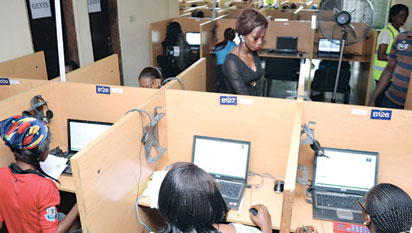
Candidates writing the JAMB UTME.
By Dayo Adesulu
For Nigerian universities and their products to compete favourably with their counterparts globally, it has been suggested by over 50 universities that there must be a strategic adoption of technology as an integral part of the teaching and learning process.
 According to a group of experts and university administrators that spoke at the maiden edition of the Future Ready University Conference held at Covenant University, Ota, Ogun State, which drew participants from over 50 Nigerian universities, the country cannot afford to lag behind in the deployment of technology at its tertiary institutions.
The conference organised by Softcom Limited in partnership with Diamond Bank and Samsung Electronics, provided opportunities for participants to witness practical applications of mobile learning devices which are already operational at Covenant University.
Edusocial, was described as a software deployed in a tablet which makes learning sociable and exciting. It does not take away the need to go to class. However, it makes learning more effective. Before students get to class, they can know everything they ought to know about the lecture and lecturer, such that, if coming to class for the first time, a student can know who is sitting next to him or her, know what courses are to be thought and who the lecturers are.
With this App in the special tablet, lecturers don’t need to come to class before students read their notes. Students can discuss with classmates. It is total education put into one tablet. Over 7,000 tablets have been deployed to students of Covenant University for this purpose. With the tablet, students don’t need to go to the classroom with notebooks but with their tablets. When writing a note via the tablet, it synchronizes such that students can share notes and ideas together.
Upon getting wind of the innovation, Diamond Bank keyed into it with Diamond Account that supports students. The aim being that universities that cannot afford the device, have the bank to provide them some funds. To Covenant University, Diamond Bank came with a $100 million technology intervention fund to support universities.
On the part of Samsung, they agreed to provide devices that are strictly configured for Edusocial. This means that the software will be deployed on Samsung devices globally. The 7000 tabs presently used by Covenant University is strictly customized for the software. Also, for other universities that buy the idea, Samsung has promised to do the same for them.
MTN has reiterated commitment to provide Internet facility as low as N5000 subscription for a whole year for a student. This is while Samsung, Diamond and MTN are on it. Together they form the Edusocial Future Ready Students. The brain behind this innovation is Softcom, an idea from Covenant University Alumnus.
In his opening remark, Managing Partner/CEO, Softcom Limited, Mr. Yomi Adedeji, an alumnus of Covenant University said that the Future Ready University Conference was a strategic initiative aimed at encouraging Nigerian universities, having realised that mobile learning is the future of education globally.
According to him: ‘’The vision of this conference is to educate and inspire leaders from selected universities in the country to improve education service delivery through technology adoption which will improve learning experience and boost the overall academic outcome of students in Nigeria. Mobile learning is the future of education and we have successfully kick-started it here in Nigeria through the Covenant University Future Ready University programme.”
He said the mobile learning programme is a revolutionary portable mobile device bundled with EduSocial apps that allows students access course materials, lecture notes, case studies and university libraries via their mobile devices. Meanwhile, the NUC representative, Deputy Director eLearning, Engr Kayode Odedina at the event affirmed that everything about the globe presently is electronic.
He said that NUC is always open to anything that will assist Nigerian universities adding that one of its key mandates is to ensure the production of globally competitive graduates, so that second class upper graduates in Nigeria are equivalent to any anywhere in the world.
According to him, “In NUC, we now have dual mode degree education, the conventional which is the classroom setting and the department of open and distance education that assists us in leveraging in the new global order. “We have already developed guidelines for distance and open education. While we regulate universities, the delivery of education rests squarely on the universities. So, it is not out of place that 50 universities were invited and NUC is here.”
Odedina who urged all universities to go global maintained that “We expect universities to follow global trends.” He disclosed that there are presently six universities including the Open university, that are already going global by what they are doing with ICT in their various institutions.
Odedina while applauding universities which have adopted ICT to boost communications, urged them to consistently upgrade their ICT adding that electronics is the fastest evolving discipline in the world. Undermining the challenges with the driving of ICT, the Engineer urged every institution to make up its mind on what they want to do without considering the availability of fund and electricity to drive ICT.
Speaking in the same vein, social critic, university administrator and entrepreneur, Prof. Pat Utomi averred that the adoption and deployment of technology is a great opportunity for Nigerian tertiary institutions to leapfrog the numerous challenges confronting higher education in the country.
Utomi, who delivered a key note address titled, Tertiary Education: Key drivers, Challenges and the Role of Technology, listed some of the challenges confronting tertiary education in Nigeria as; poor infrastructure, lack of competent teachers, high cost of quality education and lack of practical relevance of tertiary curriculum.
Meanwhile, using Covenant University as a case study, its Vice Chancellor, Prof. Charles Ayo, noted that technology has transformed the learning process in the institution He said: ‘’Technology is an integral part of life at the Covenant University. It is an important part of our curriculum. We have also made sure that the university deploys it into as many of our activities as possible.
Right from the admission process to payment, lecture delivery in the classroom, teleconferencing to engage our partners all over the world and most importantly equipping our laboratories with state of the art technology that will place us at the same pedestal with any world-class university anywhere in the world, we are proud to say that we do not compromise when it comes to deploying ICT.”
In his address, the Managing Director of Intel Corporation West Africa, Mr. Olubumi Ekundare, stressed the importance of making Nigerian tertiary institutions ICT complaint. He decried the situation where 1 in 10 students own a PC and 3 in 10 students have occasional access to a PC.
He said: “Today, a paltry five percent of our universities have computer infrastructure for scientific research. Only 20 percent of our tertiary institutions have digitised their academic records while 30 percent have digitised their admin and records.” This is not sustainable. The sooner ICT begins to be treated as priority then we will see a huge improvement in our tertiary institutions.”
Disclaimer
Comments expressed here do not reflect the opinions of Vanguard newspapers or any employee thereof.