“Even God cannot change the past”, Agathon, 447-401 BC.
By DELE SHOBOWALE
RECOLLECTING THE PAST – 1984 T0 1985.
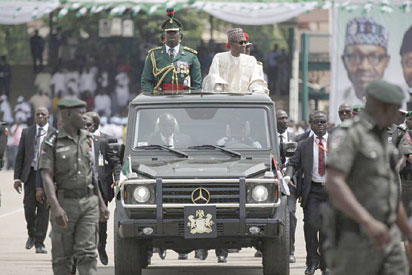
The Chinese were only half right when they said that “nobody steps into the same river twice.” Nigeria which seems bent on disproving every universally accepted social theory has already experienced quite a few people stepping into the river twice – although a changed one. Obasanjo was a military Head of State and returned as a civilian president. Muhammadu Buhari was once a military leader, who returned on Friday as a civilian president. We should not forget the immediate past Federal Minister for Finance, Dr Ngozi Okonjo-Iweala who came in 2003 to 2005 as Minister, left, and returned again from 2011 to 2015.
So, President Buhari is the third high profile individual in recent times to step into Nigeria’s turbulent river twice. In the next four years, there might come occasions when he will feel like the late Italian dictator, Benito Mussolini, 1883-1945, who proclaimed that “Governing Italians is not impossible; it is merely useless.”
We pray it will never come to that.
But, if anybody can help Buhari avert disaster, apart from Almighty Allah, then that person is Muhammadu Buhari.
STAY AWAY FROM THE RECYCLE DUST BIN
“The rate of change in our time is so swift that an individual of ordinary length of life will be called on to face novel situations which have no parallel in the past. The fixed person, for the fixed duties, who in the past, was such a God-send, will in the future, be a public danger.”
Alfred North Whitehead, 1861-1947.
 Now, we speak truth to power. The APC campaign was based on CHANGE. Yet only one significant change is necessary – people. That means the people you appoint to help you with your cardinal programmes. Both Obasanjo and Okonjo-Iweala illustrate the point of this essay. Depending on the perceived performance during the first tour of office, Nigerians, and, indeed, the global community create expectations which might be very difficult to satisfy. One plausible reason might lie in the fact that the country has changed since their first outing and they were not aware of it. They invariably rely on the people they were familiar with to help them solve new and/or different problems. Okonjo-Iweala as the Coordinating Minister for the Economy, CME, packed the Economic Management Team with the same people (Dangote, Otedola, GMD of leading banks etc) or clones of those she worked with under Obasanjo.
Obasanjo’s first term as civilian president was a classic case of “Recycle Bin” approach to management of public affairs. Without listing all the participants let me name a few. Mallam Adamu Ciroma, T.Y. Danjuma, Bola Ige were among those “tested” hands who were invited on board. But, the nation went nowhere. It was not until the second term when fresh ideas came in that the nation had a sense of purpose. Granted, it is ever tempting to want to go with those personally known; but they might not be the best for the job. Bola Ige was an absolute failure as Minister of Power and paved the way for the calamities which followed in that sector.
CHANGE FOR WHAT? FROM WHAT? TO WHAT?
“Most schemes of political improvement are very laughable things.”
Dr Samuel Johnson, 1709-1784 (October 26, 1769).
The All Progressive Congress, APC, which you now lead, campaigned on the mantra of change. Quite noticeable, however, is the lack of specificity as to the content of the change programme. It is quite possible that not all the members of the APC, and certainly not the voters, have agreed on what they want changed and what direction the change process should follow. That is obvious from the numerous suggestions made by those who have indicated their preferences for the improvements they want to see made in governance. Some want corruption tackled first; others favour power; yet a segment want the focus to be placed on security and job creation. Left to the Nigerian Governors Forum, NGF, bailing out the states should be the top priority.
Each of these, as well as others not mentioned, deserves attention. But, any attempt to address all of them simultaneously will lead to paralysis of governance; it would amount to attempting to do too many things at once. So, the toughest decision for you will be one of selection of the three or four top priorities of your administration. That decision will answer the questions asked above.
Irrespective of your choices of intervention, bear in mind that even a change from bad to good or good to better still faces resistance from certain segments of society – those benefiting from the existing arrangement. As Bernard Malamud had reminded us in THE FIXER, “In a sick country, every step to health is an insult to those who live on the sickness.” Nigeria, it is generally agreed is a sick country. But, there is no unanimity of views about the nature of the diseases; and no consensus on how to go about curing them.
GHOSTS FROM THE PAST
“The man [Buhari] that is coming on board has a lot of experience in terms of governance.” Former President Obasanjo, PUNCH, May 25, 2015, p 8.
The two of you have something in common. You were both military heads of state who were later elected as civilian presidents. Add to that is the fact that you were both selected by political parties formed largely by others. Like Obasanjo in 1999, you now have to take control of the APC and lead the party as well as the country. It will not be easy. Under such circumstances it is easy to resort to measures taken in the past – political and economic. Permit me to leave matters social untouched for now. Instead, let me cast your mind back to the economic policies of your government in 1984-5.
Fate must really want to test your mettle because in 1984 you inherited an economy that was on its knees on account of plummeting crude oil prices and the profligacy of the Shagari administration. Once again, in 2015, you are stepping up to receive from President Jonathan an economy back on its knees for mostly the same reasons. Nobody can fault you for thinking that your Fellow Nigerians never learn from history – even their own history.
Be that as it may, your economic policy in 1984-5 rested on three main pillars – severe austerity, counter-trade and allocation of foreign currency (through the regime of Form M). Given space constraints, permit me to focus on foreign exchange allocation and the administration of Form M. Among others, Chief Ernest Shonekan, GCFR, a former Head of Government himself, Mr. Ohiweri, Chief Olusegun Osunkeye and Chief Arthur Eze, representing, UAC of Nigeria, Nigerian Brewery Limited, Nestle and CFAO, among others will be my witnesses.
The administration of Form M, shorthand for foreign exchange allocation in 1984/85, unknown to you was riddled with corruption. Although you were not known to have benefited materially from the frauds perpetrated, they undermined your positive economic policies – which are too numerous to discuss now. Form M administration and the problems associated with it resulted in “Wealth without work” (Ghandi, 1869-1948) on a grand scale and denied industry of the life-blood needed to survive the downturn.

Handover : Jonathan presenting handing over notes to Buhari.
Fortunately, the allocations to various organizations were published in the Daily Times and are fully recorded in the archives, they would reveal that UAC, which at the time was the largest conglomerate in the country, Nigerian Brewery, the largest brewery, Nestle the largest food manufacturer and CFAO all received less than half the foreign exchange allocation given to small businesses – some without office addresses – who turned around and to legitimate businesses at great profits to them. I was in North Brewery, Kano, at the time and I know how we made up part of the short-fall in our foreign exchange requirements. All these were major employers of labor at the time.
One Minister went from being the owner of a Peugeot 504 to jet owner in the short period – “Wealth without work”.
To the obvious question: why were these nefarious activities not reported by the media? The answer is: Decree 4 which made it a crime to embarrass a government official even if the report was true. No journalist or newspaper could report the scam when telling the truth had been criminalized.
What is the point of all these? Simple! Times have changed and the media is stronger and not so easily intimidated. For Buhari to save himself from saboteurs within his government, and maintain his reputation for integrity, he must pay attention to media reports about malfeasance by those he appoints to office. Unless he can ensure that the officers of 2015-2019 are better disciplined than those of 1984/5, his best intentions will only pave the highway to another hell for Nigerians.
Instead of the undisguised hostility he had for the media in the 1980s, he must now embrace them because they will constitute his army of whistle blowers helping to keep corruption in check within his government. He would be making a monumental mistake to think that all his officials share his view about honesty. To use the language of the 1980s, there is no alternative to Buhari getting closer to the media – they are (at least most) not his enemies. They want the best for their country; just as he does.
LEADERSHIP STYLE FOR A TROUBLED DEMOCRACY
Nor should [he] listen to those who say, ‘The voice of the people is the voice of God’, for the turbulence of the mob is always close to insanity, Alcuin, 735-804 (slightly modified).
It is probably presumptuous to try telling a 72-year old leader how to set about his duties. One is conscious of the saying that, “You can’t teach an old dog new tricks.” That may be so. But, it is also true that for effective leaders learning is a life long experience. At any rate, the experience Obasanjo referred to was in a different setting. Military dictatorships and democracies are miles apart. For Buhari this is a new experience. He runs the risk of bending over backwards too much as to become Nigeria’s Dwight Eisenhower, 1890-1969, the American General and Commander of the Allied Forces during World War II, who later became a lackluster President. America could survive a poor president in the 1950s to early 1960s because strong institutions were already firmly established. Nigeria in 2015 cannot now afford a weak President. We just went through eight years of indecisive leadership; and the horrors we now experience cannot continue for long before we join the ranks of failed states.
Although he was elected into office by the people, Buhari still needs to retain some amount of the toughness which generals must have to win wars. The professional politicians in APC will want him to pander to the wishes “of the people” – whoever they are. He should resist.
Instead, like Mandela, he should take the attitude that, “There are times when a leader must move ahead of the flock, go off in a new direction, confident that he is leading his people the right way.”(VANGUARD BOOK OF QUOTATIONS, p 124). Elections are popularity contests; post-election leadership is not.
Nigerians have not elected Buhari for him to pamper us like spoilt kids; we have chosen him to lead the way to social justice and material prosperity. That should be his goal.
Disclaimer
Comments expressed here do not reflect the opinions of Vanguard newspapers or any employee thereof.