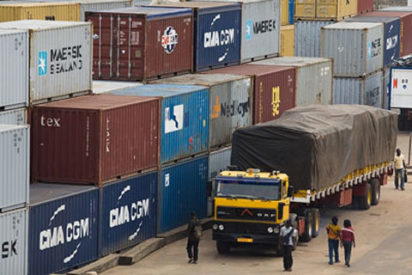
A fully loaded truck in one of the inland dry ports in the sub-region, will be delayed, harassed for bribes by the numerous security agents along the region’s transport corridor before it gets to its destination.
By Godwin Oritse
As Nigeria makes move to reclaim over 10 million metric tonnes of lost transit cargoes, the factors that initially led to the loss of this category of the country’s trade to neighbouring countries are still very much present in the Nigerian ports.

The 10 million metric tonnes of transit cargoes are from Niger alone and have been distributed amongst four neighbouring countries namely: Ghana, Togo, Republic of Benin, and Ivory Coast.
The issue of port has also been given as the major factor militating against the return of these cargoes to Nigerian ports.
In an exclusive interview with Vanguard, the country representative of the Niger Council of Public Transport Users, NCPTU, Alhaji Idi Homissou told Vanguard that high duty rate and other associated port costs actually drove Nigerien importers to port of neighbouring countries.
Homissou said that while 4.3 million metric tonnes of the 10 million metric tonnes of transit cargo has been taken to Togo, Nigerien importers have also moved 2.5 mliion metric tonnes of their transit cargo to Togo.
For Ghana and Ivory Coast,1.8 million metric tonnes and 400,000 metric tonnes were taken over respectively, while Nigeria is left with a paltry 200,000 metric tonnes of transit cargoes from Niger.
“The issue of port cost is the major challenge importers from Niger are facing in Nigeria, even though we see some level of efficiency,” he said
“The high duty rate is still an issue that must be looked into,” he added.
He explained that Nigeria and Niger used to be a single country until the Europeans came and separated them and carved Niger out of Nigeria.
The Nigerien representative in Nigeria said that Nigerian ports are nearer to Jibiya (a border town between both countries) than Togo or Ghana.
He further said that Ghana to Niger is about 3,400 kilometers as against 1,300 kilometers from Lagos to Jibiya in Niger.
He disclosed that transit cargo from Niger was lost to other countries long before the ports were concessioned adding that the seeming efficient services currently being experienced at the port is what is attracting importers from Niger.
Homissou also said that the issue of safe passage of their goods has been a source of concern until the leadership of the Nigeria Customs Service assured them of safe passage of transit cargoes.
“Naturally, Nigeria is the nearest country to Niger and it makes sense for us to move our cargoes through Nigeria but if the Customs duty is as high as it is now, then we may have to look elsewhere for us to transit our cargoes.
Even what we pay to Nigerian Customs officials to escort our goods to the border is very exorbitant when compared to what other countries collect from us.
“While other countries collect payment per convoy, in Nigeria, we pay per container,” he said.
He also disclosed that there have been situations where the Nigerian Shippers’ Council has to come to the rescue of a vessel that almost got stranded with Nigerien transit cargoes on board.
He commended the effort of the management of the Nigerian Shippers’ Council for trying to woo Nigerien importers back to Nigeria.
Homissou also told Vanguard that the Comptroller-General of the Nigeria Customs Service has visited importers in Niger and assured them of quick passage of their cargoes through the Nigerian port system.
Disclaimer
Comments expressed here do not reflect the opinions of Vanguard newspapers or any employee thereof.