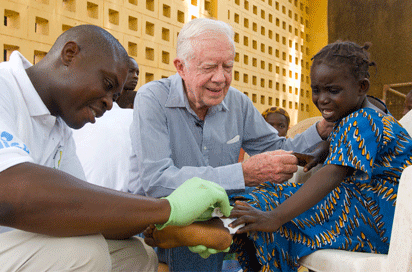
• Former U.S. President Jimmy Carter comfort ing 6-year-old Ruhama Issah at Savelugu (Ghana) Hospital as a Carter Centre technical assistant dresses Issah’s extremely painful Guinea worm wound. In May 2010, Ghana reported its last case of Guinea worm disease and announced it had stopped disease transmission a year later.
By Sola Ogundipe
The move toward a Guinea worm free world became more realisable last week as Ghana was officially certified by the World Health Organisation, WHO, as having eliminated the disease.
Guinea worm (Dracunculus medinensis), is a water-borne parasitic disease poised to be the second human disease in history to be eradicated.

• Former U.S. President Jimmy Carter comfort ng 6-year-old Ruhama Issah at Savelugu (Ghana) Hospital as a Carter Centre technical assistant dresses Issah’s extremely painful Guinea worm wound. In May 2010, Ghana reported its last case of Guinea worm disease and announced it had stopped disease transmission a year later.
At end of 2014, a total of 197 countries and territories have been certified by the WHO to be free of Guinea worm disease. Nigeria was officially declared Guinea worm free by the World Health Organisation in July 2013.
Congratulatory message
In a congratulatory message to Ghana, Former US President Jimmy Carter said: “Ghana’s triumph over Guinea worm disease serves as a reminder to the world and the remaining endemic countries that the greatest challenges can be overcome with hard work, political commitment, and the support of the international community,” s
Carter who is founder of The Carter Centre, which has led the international campaign to eradicate the disease, recalled seeing his first case of Guinea worm disease in Denchira, a village near Accra in March 1988.
The WHO’s International Commission for the Certification of Dracunculiasis Eradication, in consultation with Ghana’s Ministry of Health, sent a certification team to Ghana in July 2014 to assess whether transmission of the disease continued or whether it was interrupted for three or more years after the last indigenous case was reported.
On January 14, 2015, WHO Director-General Dr. Margaret Chan provided Ghana with the official notification that WHO has certified Ghana as Guinea worm-free.
For a disease to be eradicated (worldwide), every country must be certified as free of the disease, even if transmission has never taken place there. To date, 198 countries and territories have been certified. The WHO is responsible for certifying countries as Guinea worm-free, and is the only organization that can officially certify the eradication of a disease.
The Carter Centre began leading the international Guinea worm eradication campaign in 1986. The following year, Ghana became one of the Carter Center Guinea Worm Eradication Programme’s first country partners.
Nearly 180,000 cases of Guinea worm disease were reported during the county’s first national case search in 1989. This ranked Ghana second in the world in cases at the time.
Strong partnerships throughout the campaign helped the nation overcome many challenges and setbacks, including a massive Guinea worm outbreak in Savelugu town in 2007.
International commitments
As a result of redoubled program efforts and reaffirmed national and international commitments, cases were reduced the following year by 85 percent—the greatest single-year reduction of any moderately endemic country in the history of the campaign.
In May 2010, Ghana reported and contained its last indigenous case, indicating that the disease cycle had been broken after a 22-year (1988-2010) nationwide battle.
Today, Guinea worm disease remains endemic in pockets of South Sudan, Mali, Chad, and Ethiopia. On Jan. 12, 2015, The Carter Centre announced there were 126 provisional Guinea worm cases reported in 2014.
When the campaign began, there were an estimated 3.5 million cases in 21 countries in Africa and Asia.
Disclaimer
Comments expressed here do not reflect the opinions of Vanguard newspapers or any employee thereof.