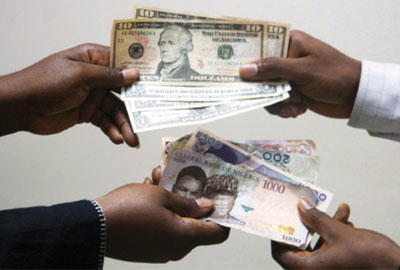
Indeed, Naira devaluation is probably the most potent weapon against the prosperity of Nigerians. Nigeria’s migration from a potential industrial power house with bustling social affluence, to a subdued and stumbling economy clearly began with the adoption of IMF’s Structural Adjustment Programme during Babangida’s regime: the chorus from International Agencies, at that time, was also that falling oil prices with an unserviced debt burden and the consequent restriction of trade credit to Nigeria, were the products of an allegedly overvalued Naira exchange rate.
By Dele Sobowale
“Were it left to me to decide whether we should have a government without newspapers, or, newspapers without government, I should not hesitate a moment to prefer the latter.” Thomas Jefferson, 1743-1826.
(VANGUARD BOOK OF QUOTATIONS p 200).
Devaluation of the currency, brought about mostly by the lack of foresight of the Minister of Finance, and Coordinating Minister for the Economy, CME, will savage all business sectors in Nigeria. As the price of crude oil slides further away, downwards, from the $78 per barrel, on which the original budget, now discarded, and the second one based on $73, now in the dust bin, were based, the outlook becomes bleaker for everybody in Nigeria. The CME can no longer be relied on to provide a reasonable guide to what has become a murky future for Nigerian businesses – mega, large, medium, small or micro. Everybody is suddenly at risk.
This series will address, truthfully, what the prospects for many sectors of the Nigerian economy can expect. This unlike the official propaganda, designed to capture votes in 2015, will explain why those operating in the sector should expect what is hereby projected. Because charity should ordinarily begin at home, permit me to start with the print media – my own primary sector. And, perhaps, it is better to also begin with the conclusion – which is depressing. The current devaluation and the domino effect it will spurn will result in the disappearance of many newspaper and magazine titles from the news stands. In fact, if it had been part of the Transformation Agenda of the Jonathan administration, to reduce the number of print media titles, it could not have succeeded more marvelously. Already, several newspapers and magazines are hanging on an economic thread that is so fragile it can be likened to the equivalent of a cobweb. The devaluation of currency will inevitably lead to the breaking point. The reasons are easy to explain.
The eight per cent official devaluation of the currency, coupled with the one per cent increase in CBN’s rates, will, at the end of the cycle, result in more than twenty per cent increase in prices. Bearing in mind, that every first devaluation unavoidably results in inflation spiral, it is unlikely that the eight per cent will remain the official position. Indeed, two days after the CBN’s announcement global crude prices dived below the $73 per barrel proposed by the Ministry of Finance. Furthermore, the meeting of the Organisation of Petroleum Exporting Countries, OPEC, ended without an agreement to cut supplies. As a matter of fact, any agreement to cut back supplies would not have been beneficial to Nigeria – given the reduced volume the country already supplies. Failure to agree to limit supplies merely compounds our problems. It means that the oil glut, responsible for depressing prices will continue – and perhaps get worse.
Print media houses, collectively and individually, face at least fort per cent increase in the cost of production – whose components include raw materials, interest rates, duties paid, increased expenditure on power (all DISCOs will start applying a new tariff from December 1, 2014) and VAT. As if that is not enough, they will soon have to confront their staff demanding salary increases, while at the same time they will find it difficult to increase cover charge.
Finally, hard copy circulation, which was about 420,000, for the leading titles in 2008, will decline further as more consumers, savaged by the downturn, stop buying papers.
Print media stakeholders will long live to remember this period as one of their darkest hours.
Disclaimer
Comments expressed here do not reflect the opinions of Vanguard newspapers or any employee thereof.