By Japhet Alakam
After two years of research and documentation, Photo artist, James Iroha has joined millions of Nigerians to condemn the epileptic power supply in the country which has caused a lot of problem to the people.
 According to him, the situation which has beleaguered the nation since the late 1980s, when the initial signs were marked by Federal Government’s neglect and poor maintenance of the hydro power stations in Kainji, Shiroro and Jebba resulting in a spiraling decline in electrical power supply across the country.
These present a risk to the health of Nigerians, the potential investors, hampering socio-economic development, yet all efforts put in place to remedy it has not yielded the desired result. But to him, it can be remedied if the country wants.
In the light of the above, Iroha who has been described as the “Leading light of a new generation of Nigerian photographers” who has used the medium to intervene in many issues takes a visual look at the epileptic power situation in the country with a captivating solo exhibition tagged Power and Powers, an exhibition of recent photographs.
Powers according to him, is a metaphor for several actors that play an often ignored but no less significant role in the complex drama; vandals, dealers and contractors, the electricity workforce and quite sadly, ourselves.
The exhibition which is coming after his last solo exhibition in Nigeria in 2004, is scheduled to open at one of the leading art gallery in Nigeria, Omenka Gallery, Ikoyi from November 8th to 22nd, 2014.
In it, the artist presents one of the most significant bodies of art concerned with social commentary in the country. Featuring 16 works, that vividly address complex problems and issues in recent Nigerian history culture and society.
The works, all in black and white signifying darkness are largely a critique of a corrupt leadership that proffers cosmetic solutions to the persistent issue of electric power supply and serve as a springboard for confronting issues that continue to face Nigerians today.
In this show, the artist who has exhibited extensively in Nigeria and around the world calls for a self-examination and invites the audience to an introspective of 54 years of epileptic power supply in Nigeria.
Epileptic power supply
According to the artist, “These are images that explore the dark and unprogressive romance between political power and electrical power distribution in Nigeria. By far the most populous nation in the continent with vast human and material resources and enormous potential, electricity is still a big issue.
Marred by erratic power supply, the nation is caught in the web of deceit where political office seekers clearly use the promise of ‘light ‘as the most effective bait.
It is interesting to know that tons of white elephant projects which include a cashless economic system and automated rail transport, are in the works gulping mammoth budgets and will all depend on an efficient electrical supply system.”
Looking at the body of works, one would be struck by the tactile and unusual sculptural qualities of the forms in the artist’s work, molded by stark contrasts of light and dark, as well as a broad range of grays. Some of the images depict one form of rot or the other by the people, they speak volumes about the issue.
They include; Looking Down Still Shackled, Looking Up Still Shackled; Standing on the Fence; After the Raid; Electro Manipulation; KBK- Krazy Bill Klan;Canon Ball–Anti Progress Machine etc.
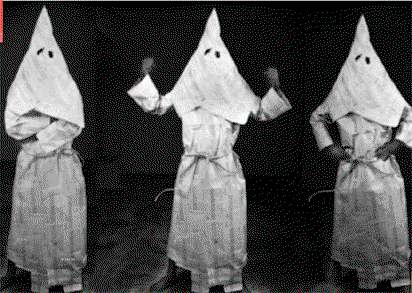
For example in KBK- Krazy Bill Klan, the artist photographs three figures adorned in the distinctive costume of the Klan, fashioned entirely from PHCN bills.
The figures raise fictitious bills to threaten consumers with disconnection, as well as extort bribes to adjust energy meters. Canon Ball-Anti Progress Machine and Shackled 1&2; here the chains bind the subjects as a metaphor for restraint on the growth of the Nigerian economy, driven largely by a manufacturing sector dependent on power.
Engine manufacturers
In Rolls Royce 1 and 2, the images brings to the attention to the poor maintenance of installed generators and other power generating equipment by referencing the prestigious engine manufacturers.
After the Raid, turns the attention to illegal connections by many consumers of electricity who have no formal business relations with PHCN while Realities of Self Help depicts a man chained to a power generator.
He resorts to generating his own electricity to meet his consumption needs. Finally, in Ready for Post-Mortem, Iroha gives a verdict on the death of the power sector. Through the work, he calls for self examination, inviting his audience to an introspective reflection of 54 years of epileptic power supply in Nigeria.
According to the artists, “the buying of generators are not the solutions to the problem, Nigerians should rise and ask questions, it is a trend that is man made, darkly articulated.
Ebola was coughed out of Nigeria, I give kudos to the government for that, but why can’t them do so in the power sector? They can do it if they want , it is a manifestation, they know what to do but the powers that be know what they are doing.”
The exhibition is supported by Nikon, the market leader in camera and imaging technologies and all images were shot exclusively with Nikon. According to Irene Wong,the country manager of Nikon Nigeria, the topic he is taking on is a very strong topic, so we support his voice for the Nigerian art to bring it to a bigger platform.
Disclaimer
Comments expressed here do not reflect the opinions of Vanguard newspapers or any employee thereof.